







Ankit Bhattacharya
International School of Management Excellence
ankitb.isme2124@gmail.com
Pratik Jaiswal
International School of Management Excellence
pratikj.isme2124@gmail.com
Pretheesh Maiti
International School of Management Excellence
pretheeshm.isme2124@gmail.com
Rounak Prajapati
International School of Management Excellence
rounakp.isme2124@gmail.com
Abstract:
As the financial industry continues to evolve rapidly, Generative AI is poised to revolutionize the way we manage money. This powerful technology holds the potential for smoother transactions and financial experiences tailored to each individual’s needs. This research delves into the profound impact of GenAI on financial services while addressing critical concerns. Employing a meticulous methodology that combines a comprehensive review of literature, academic publications, industry research, and expert opinions, our study unveils the complexities of GenAI. The major findings underscore its potential for enhanced efficiency, improved customer experiences, and strengthened risk management. However, shadows of concern loom, including algorithmic biases and potential liquidity risks. We advocate for clear regulatory frameworks and human oversight to ensure accuracy, trust, and ethical standards. The interconnectedness of the financial system introduces the specter of systemic risk, emphasizing the need for cautious integration. While GenAI holds the promise of a brighter financial future, our research emphasizes the importance of patience and diligence to navigate its evolution responsibly. In paving the way for GenAI integration, we contribute to creating a symbiotic relationship between technology and finance for the benefit of all stakeholders.
Keywords: Generative AI, Fintech, Financial Innovation, Responsible Integration, Algorithmic Bias.
Introduction
The financial landscape is undergoing a seismic shift, propelled by a potent new force: Generative AI (GenAI). This burgeoning technology, capable of mimicking human creativity and generating novel data, is rapidly transforming the way we think about, manage, and access financial services.From robo-advisors offering personalized investment strategies to chatbots dispensing instant loans, GenAI is weaving itself into the fabric of the fintech industry, promising a future of seamless transactions, democratized access to financial tools, and hyper-personalized financial experiences.
The allure of GenAI’s potential is undeniable. Imagine an AI-powered platform that analyzes your financial data and tailors a bespoke investment portfolio that anticipates your evolving needs and risk tolerance. Or a credit scoring system that leverages alternative data to grant loans to underserved communities traditionally excluded from mainstream financial systems. GenAI holds the key to unlocking a more inclusive, efficient, and personalized financial ecosystem, one where financial services are no longer one-size-fits-all, but rather bespoke solutions woven from the tapestry of individual needs and aspirations.
However, amidst the glittering promises, shadows lurk. Algorithmic bias, a persistent specter in AI systems, threatens to perpetuate discrimination in loan approvals, insurance rates, and investment recommendations. The opaqueness of GenAI models raises concerns about explainability and accountability, particularly when critical financial decisions are at stake. Moreover, the interconnectedness of the financial system introduces the specter of systemic risk, where the failure of one GenAI-powered algorithm could trigger a domino effect of cascading financial meltdowns.
Therefore, we stand at a critical juncture. The GenAI genie, like all powerful forces, demands a cautious approach. This paper embarks on a journey to unravel the complexities of GenAI in fintech, exploring its transformative potential while unearthing its hidden dangers. Through meticulous analysis and thoughtful consideration, we seek to forge a path towards responsible GenAI integration in the financial world, one that harnesses its power for good while ensuring a future where technology serves humanity, not the other way around.
Review Of Literature
This literature review, drawing upon a varied corpus of academic publications, industry research, and expert opinions, seeks to analyze the multifaceted implications of generative AI for the future of the financial sector, highlighting both its potential benefits and potential drawbacks.
GenAI technologies have the potential to significantly impact the fintech sector, driving efficiency, improving customer experience, and strengthening risk management and compliance (Shabsigh & Boukherouaa, 2023). However, caution is necessary due to the intrinsic risks associated with GenAI. These risks could have material implications for the reputation and soundness of the financial sector, potentially undermining public trust. For example, GenAI applications could contribute to liquidity risk if their algorithms inadvertently promote herd behavior among market participants, leading to large-scale market dislocations. While enterprise-level GenAI applications may help mitigate some risks, smaller financial institutions may find this option cost-inefficient (Shabsigh & Boukherouaa, 2023).
A paper by Suman Kalia published in the International Journal on Cybernetics & Informatics (IJCI) explores the potential of generative AI (GenAI) in the financial industry, emphasizing both the opportunities and potential risks (Kalia, 2023). The paper differentiates between generative and discriminative AI algorithms, providing a foundation for understanding machine learning, deep learning, and neural networks in the financial context (Kalia, 2023). It then delves into two prominent GenAI model families, Generative Adversarial Networks (GANs) and Variational Autoencoders, highlighting their applications in risk management, credit assessment, and loan approvals (Kalia, 2023). Importantly, the paper stresses the need for ethical considerations and robust regulatory frameworks to ensure the responsible development and use of GenAI in finance, safeguarding user privacy and aligning with societal values (Kalia, 2023).
Kulkarni and Barde’s paper examines the current applications of generative AI (GenAI) in Fintech, highlighting potential risks alongside its uses (Kulkarni & Barde, 2024). The authors acknowledge the inherent biases, privacy concerns, transparency limitations, and cybersecurity vulnerabilities that can arise with GenAI in finance (Kulkarni & Barde, 2024). They point out how biases, such as gender bias, can permeate the entire development process, making mitigation strategies challenging (Kulkarni & Barde, 2024). Additionally, the paper identifies constraints like difficulties with contextual understanding, lack of common-sense reasoning, and dependence on training data, which can impact GenAI’s performance in financial services (Kulkarni & Barde, 2024). To gain a deeper understanding of GenAI’s potential and constraints, the paper calls for further investigation into its application by major financial institutions such as Bloomberg, Goldman Sachs, Wells Fargo, and Capital One. (Kulkarni & Barde, 2024).
A recent report by the OECD (Organisation for Economic Co-operation and Development, 2023) raises concerns about data breaches extending beyond personal information to include sensitive financial data within the financial sector. The report highlights the ability of Artificial Intelligence and Machine Learning (AIML) to infer identities based on user behavior. This emphasizes the need for clear and accessible “opt-out” mechanisms for user data collection and use in the financial industry. However, it is acknowledged that opting out may limit GenAI responses and possibly diminish the technology’s utility, though the extent of this limitation is unclear (Organisation for Economic Co-operation and Development, 2023).
Ronen Assia of Team8 discusses the impact of generative AI on fintech, noting challenges in adoption due to limited regulation and the need for clear frameworks (Assia, 2024). Assia predicts increased regulation in the next few years, with a focus on specific industries within fintech. The goals for 2024 include replacing human advisers and streamlining tasks like tax and legal work using generative AI. Despite advancements, human oversight is deemed crucial for accuracy and trust, especially in highly regulated financial services (Assia, 2024).
ChatGPT, particularly GPT-4, is discussed in a Forbes article, highlighting its transformative impact on the financial services sector (Johnson, 2023). Traditional roles like personal finance management and financial advisors are envisioned to become obsolete, with features such as empathetic advice and real-time information delivery. The integration of ChatGPT with open banking is proposed for hyper-personalization in consumer interactions. The article questions whether the banking industry will adopt these advancements swiftly or risk being left behind in the AI revolution (Johnson, 2023).
Generative AI’s potential to transform the finance industry is acknowledged in a report by Deloitte (Deloitte, 2023). To achieve successful deployment and adoption of AI in finance, strong collaboration between top executives (C-suite) is crucial. Implementing generative AI requires a significant upfront investment of both time and resources. However, there are limitations and risks associated with generative AI, including the amplification of biases in training data and potential conflicts with diversity and inclusion commitments. Caution should be exercised to mitigate risks such as liquidity risk and market dislocations (Deloitte, 2023).
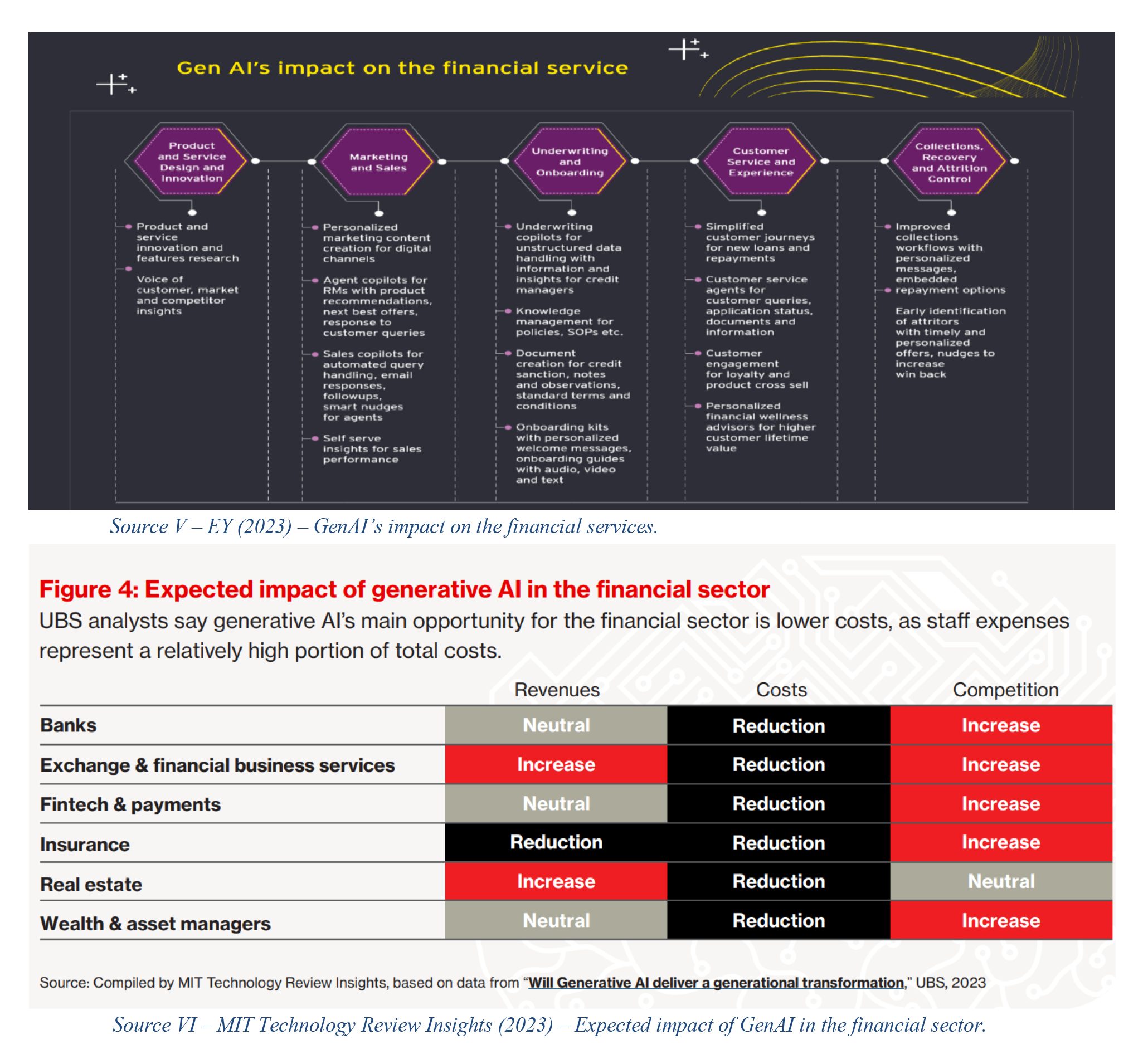
A periodical by MIT Technology Review Insights discusses the promise and challenges of generative AI in the finance sector (MIT Technology Review Insights, 2023). It highlights the potential of generative AI in tasks such as information analysis and summarization, as well as its ability to generate new content in response to natural language questions. The document also addresses the challenges of reliability, bias, and accountability in using generative AI, emphasizing the need for retraining models in the financial services industry. While generative AI is considered a valuable tool, it is yet to be fully disruptive (MIT Technology Review Insights, 2023).
Research Gap
While the potential of AI in finance has been extensively explored, its “generative” cousin, GenAI, remains largely uncharted territory. Existing research on AI in fintech focuses primarily on traditional techniques like machine learning and natural language processing for tasks like fraud detection, credit scoring, and algorithmic trading. However, GenAI’s unique ability to create novel data and tailor financial services to individual needs presents a significant leap forward, warranting dedicated investigation. This research gap stems from several factors:
- Nascent technology: GenAI is still in its early stages of development, making it challenging to assess its full impact on the complex financial landscape.
- Data limitations: Evaluating GenAI’s effectiveness requires access to real-world financial data, which can be highly sensitive and difficult to obtain.
- Methodological challenges: Traditional research methods may not be well-suited to analyzing the nuanced and dynamic nature of GenAI systems.
Therefore, a critical research gap exists in understanding the specific impact of GenAI on various aspects of fintech, including:
- Personalization and democratization: How can GenAI personalize financial services and improve access for underserved communities?
- Algorithmic bias and fairness: Can GenAI exacerbate existing biases in financial systems, and how can we ensure fairness and ethical use of this technology?
- Systemic risk and resilience: What are the potential risks of GenAI-driven interconnectedness in the financial system, and how can we build resilience against potential failures?
By addressing this research gap, we can pave the way for a future where GenAI empowers a more inclusive, personalized, and resilient financial system, benefiting both individuals and the broader economy.
Research Methodology
Secondary data analysis: This research was carried out by analysing existing data sources, such as financial reports, industry publications, and academic research, to identify trends and patterns in the adoption and use of GenAI in Fintech, how it has impacted the Fintech industry and to uncover opportunities for further research. A search was conducted on the internet for relevant data through keywords and all data sources have been cited as references accordingly. This methodology offers several advantages, including:
- Time and resource efficiency: It allows us to access and analyze a vast amount of existing
data without the time and expense of primary data collection. Existing data on GenAI in
fintech is rapidly evolving, and secondary analysis allows us to stay abreast of the latest
developments. - Diversity of perspectives: Utilizing varied sources like academic journals, industry
reports, and financial documents provides a comprehensive understanding of different
facets of GenAI in Fintech. - Objectivity and credibility: By relying on established and credible sources, this
methodology minimizes researcher bias and enhances the paper’s validity.
Discussion – Results & Findings
The Promises of GenAI in Fintech – Generative AI is poised to revolutionize the fintech landscape, unlocking a wealth of possibilities for delivering, accessing, and experiencing financial services in entirely new ways. Its transformative potential lies in several key areas:
- Cost Cutting and Proportion of Workforce Exposed to Automation: A recent U.S. Bureau
of Labor report highlights that a substantial portion of bank and insurance company jobs could
be automated by generative AI. The primary driver behind generative AI adoption in financial
services appears to be cost reduction through automation of repetitive, low-value tasks. This
involves utilizing generative AI tools to streamline time-consuming processes that previously
relied on human analysis of unstructured data. - Potential for Growth: Generative AI holds substantial opportunities for financial services
companies, with the sector being one of the three with the highest potential for growth arising
from the technology in the near term, according to (Boston Consulting Group, 2023). - Specific Use Cases: Generative AI is being applied in various areas within fintech, including
customer service support, fraud prevention, risk management, code generation, and information
analysis and summarization. These applications have shown promising results in increasing
productivity, improving consumer happiness, and enhancing risk detection. The current focus
of generative AI in finance is on improving existing workflows. This is achieved through its
ability to generate reports and analyze data from specific sets, rather than large, complex
datasets. Present and imminent applications throughout the financial value chain encompass:
- Financial Operations: Automating initial text drafts for tasks with high volume or minimal analysis, including contract creation and credit review summaries.
- Accounting and Financial Reporting: Generating preliminary insights to streamline financial statement iterations during month-end close, and assisting with audit trail documentation for reclassification entries.
- Finance Planning and Performance Management: Conducting ad-hoc variance analysis on the company’s structured or unstructured datasets (e.g., comparing actuals to plans) and generating reports for business partners to elucidate their unit’s financial
performance. - Investor Relations: Offering support for various aspects of quarterly earnings calls.
FinTech Fusion: Real-World Examples of Successful Generative AI Integration –
In the dynamic landscape of financial technology, Generative AI is reshaping the industry, and examining successful implementations can provide valuable insights. Several noteworthy examples underscore the impact of GenAI in FinTech.
- Morgan Stanley has strategically partnered with OpenAI,
accessing AI products like Next Best Action and Genome to deliver personalized
financial insights. This collaboration exemplifies a commitment to AI-driven
personalization in client interactions. - Bloomberg is at the forefront of this transformation,
employing Bloomberg GPT, a language generation model, to revolutionize
financial analysis and reporting. This tool excels in generating high-quality
financial content, personalizing news, engaging in conversations, and
conducting risk analysis and forecasting with remarkable speed. - Nedbank, utilizing Microsoft Copilot generative AI, has
introduced the Electronic Virtual Assistant (EVA), a chatbot that addresses
80 percent of customer inquiries at a fraction of the cost. By integrating
machine learning and advanced data analytics, Nedbank harnesses intelligent
decision-making to enhance productivity, streamline processes, mitigate risks,
and promote innovation.
Source: (Rishabh Software, 2023)
These real-world examples exemplify how GenAI is not only a theoretical concept but a tangible force driving efficiency, personalization, and cost-effectiveness in the FinTech sector.
Tomorrow’s Generative AI Capabilities Will Be Transformative –
As the capability of generative AI to analyze extensive datasets improves and finance professionals gain proficiency in its usage, we anticipate a gradual rise in the prevalence of AI-driven “copilots” or “assistants” working alongside practitioners. Moreover, we foresee the seamless integration of traditional AI and generative AI in collaborative applications. For instance, a conventional AI forecasting tool may generate forecasted financials, while generative AI could elucidate variances and, notably, provide recommendations for diverse forecast scenarios and associated business decisions. Consequently, the forthcoming generation of finance copilots is poised to empower the finance function in three key ways:
- Transformation of Core Processes:
A growing array of generative AI assistants will continually revolutionize core
finance processes, including tasks like contract drafting, invoice processing,
and general ledger reviews. Initially, focused assistants may enhance the
efficiency of specific processes by approximately 10% to 20%. However, with
evolving tools and capabilities, they are expected to play a more substantial
role in overall finance operations. As generative AI expands across use cases,
it will seamlessly integrate with currently manual or tedious processes. - Reinvention of Business Partnering:
Generative AI is anticipated to offer support to finance function business
partners by providing insights into financial forecasts, facilitating scenario
planning throughout the budget cycle, and delivering faster and more
comprehensive business intelligence. Processes that currently impede insight
generation due to their tedious nature can be revamped to enable swift and clear
insights. The synergistic use of generative AI alongside traditional AI will
further amplify capabilities. - Management and Mitigation of Risk:
Finance teams are already leveraging AI in audit and control environments to
identify anomalies indicative of fraud or noncompliance. The latest advancements
in generative AI hold promise for pinpointing and interpreting irregularities in
financial transactions, helping organizations strengthen governance, reduce
operational risks, and improve decision-making.
The Perils of GenAI in Fintech
Despite the potential benefits, there are challenges and limitations in the widespread adoption of generative AI in fintech. These include the need for customization to address specific use cases, the requirement for continuous model retraining due to evolving financial products and processes, and the regulatory hurdles associated with data privacy and bias.
- Data Accuracy: Current versions of generative AI tools may struggle with precise calculations and data analysis.
- Data Security: Training models on public data raises concerns about sensitive financial data leaks.
- Governance Gap: GenAI currently lacks contextual understanding and real-time information processing.
- Illusion of Truth: Generative AI can generate convincing but inaccurate responses, often called hallucinations.
Managerial Implications
The use of Generative AI presents a compelling yet complex landscape for fintech managers. While the potential for increased efficiency and innovation is substantial, navigating associated risks is crucial.
Strategic Adoption and Investment
- Prioritize GenAI Exploration and Integration: Explore and invest in GenAI solutions to remain competitive.
- Focus on High-Impact Areas: Prioritize customer service, fraud prevention, and information analysis.
- Invest in Talent and Infrastructure: Develop internal AI capabilities and technical resources.
Risk Management and Ethical Considerations
- Mitigate Algorithmic Bias: Implement rigorous testing and validation processes.
- Enhance Data Security: Strengthen cybersecurity measures to protect sensitive information.
- Address Transparency and Explainability: Foster trust through transparent AI systems.
- Monitor for Systemic Risk: Assess interconnected risks across the financial ecosystem.
Human-AI Collaboration
- Maintain Human Oversight: Ensure human control in critical decision-making processes.
- Develop a Copilot Approach: Use GenAI to augment rather than replace human capabilities.
- Upskill and Reskill Workforce: Prepare employees for AI-driven changes.
Regulatory Compliance and Collaboration
- Stay Informed on Evolving Regulations: Monitor changing regulatory requirements.
- Collaborate on Industry Standards: Participate in initiatives that promote responsible AI adoption.
Key Metrics (Secondary Data)
| Statistical Data | Description |
|---|---|
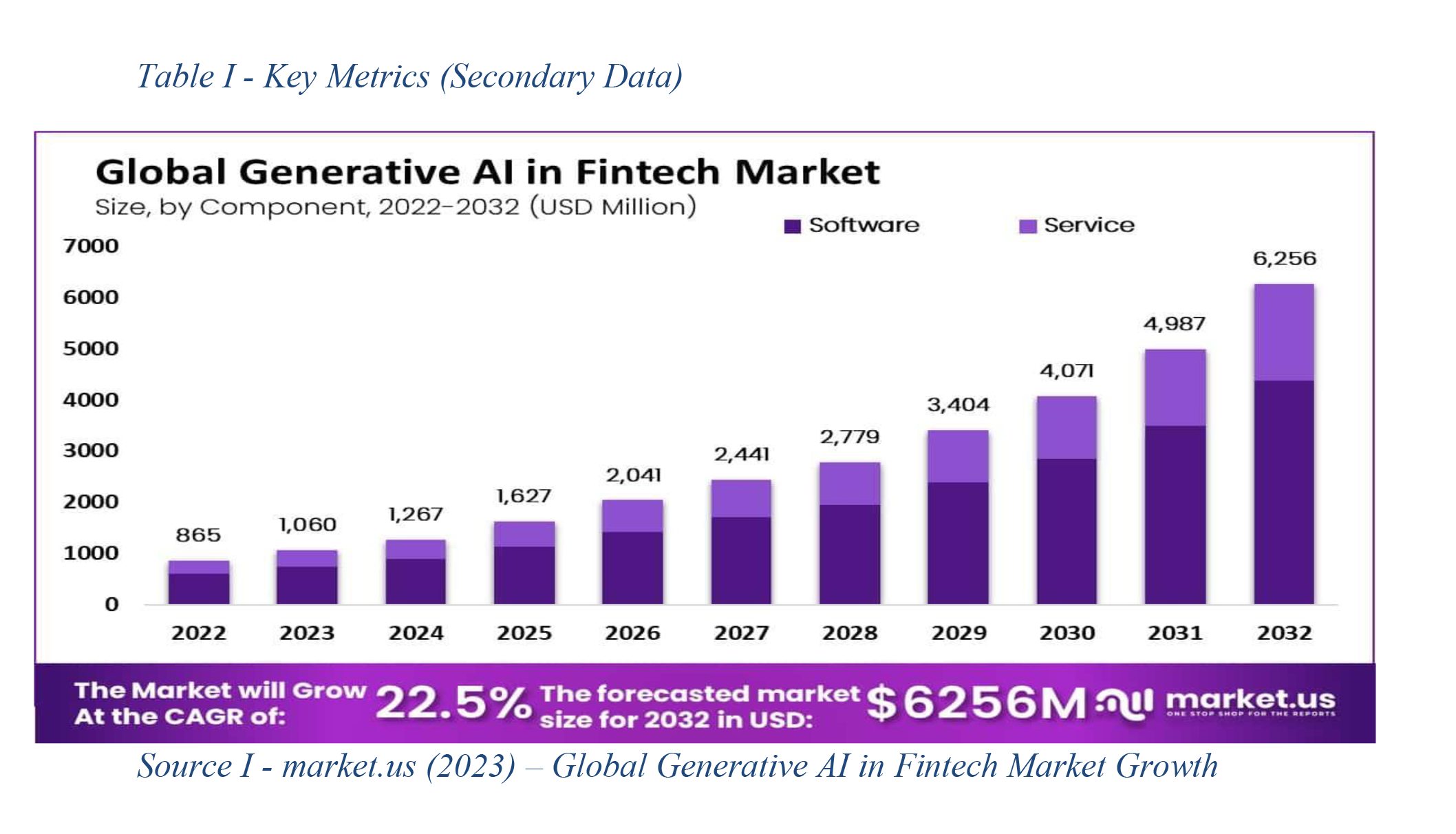
| Market Statistics | By 2032, the Generative AI in Fintech Market is anticipated to reach USD 6,256 Million with a compounded annual growth rate projected at 22.5% from 2022-2033. (Source: Market.us, 2023) |
| Demand | Generative AI applications in fintech have seen rising interest due to an increasing need for personalized financial advice, increasing fraud incidents, and an ever more complex market landscape. |
| Analysis | The Software Segment had the highest revenue share with 70% in 2022. (Source: Market.us, 2023) |
| Deployment Analysis | Cloud deployment models are anticipated to experience rapid expansion between 2023-2032. (Source: Market.us, 2023) |
| Drivers | AI’s rapid adoption within the financial industry and an increase in personalized financial advice services are major influences. |
| Restraints | High development and implementation costs associated with generative AI solutions and lack of trained AI professionals are major obstacles to their adoption. |
| Opportunities | Creation of innovative generative AI solutions. |
| Challenges | Addressing concerns over the ethical implications of using AI in finance and reducing development and implementation costs associated with generative AI solutions are among the many obstacles to be surmounted. |
| Largest and Fastest Growing Region | North America is projected to be the largest and fastest-growing market for Generative AI Fintech. (Source: Market.us, 2023) |
| Top Vendors | Key vendors in the Generative AI Fintech market include Open AI, Microsoft Corporation, Google LLC, Genie AI Ltd., IBM Corp, MOSTLY AI Inc., Adobe Inc, Synthesis AI, Paige.AI, and Rephrase.ai. (Market.us, 2023) |
| Indian Retailers | 71% of Indian retailers plan to adopt Gen AI in the next 12 months. |
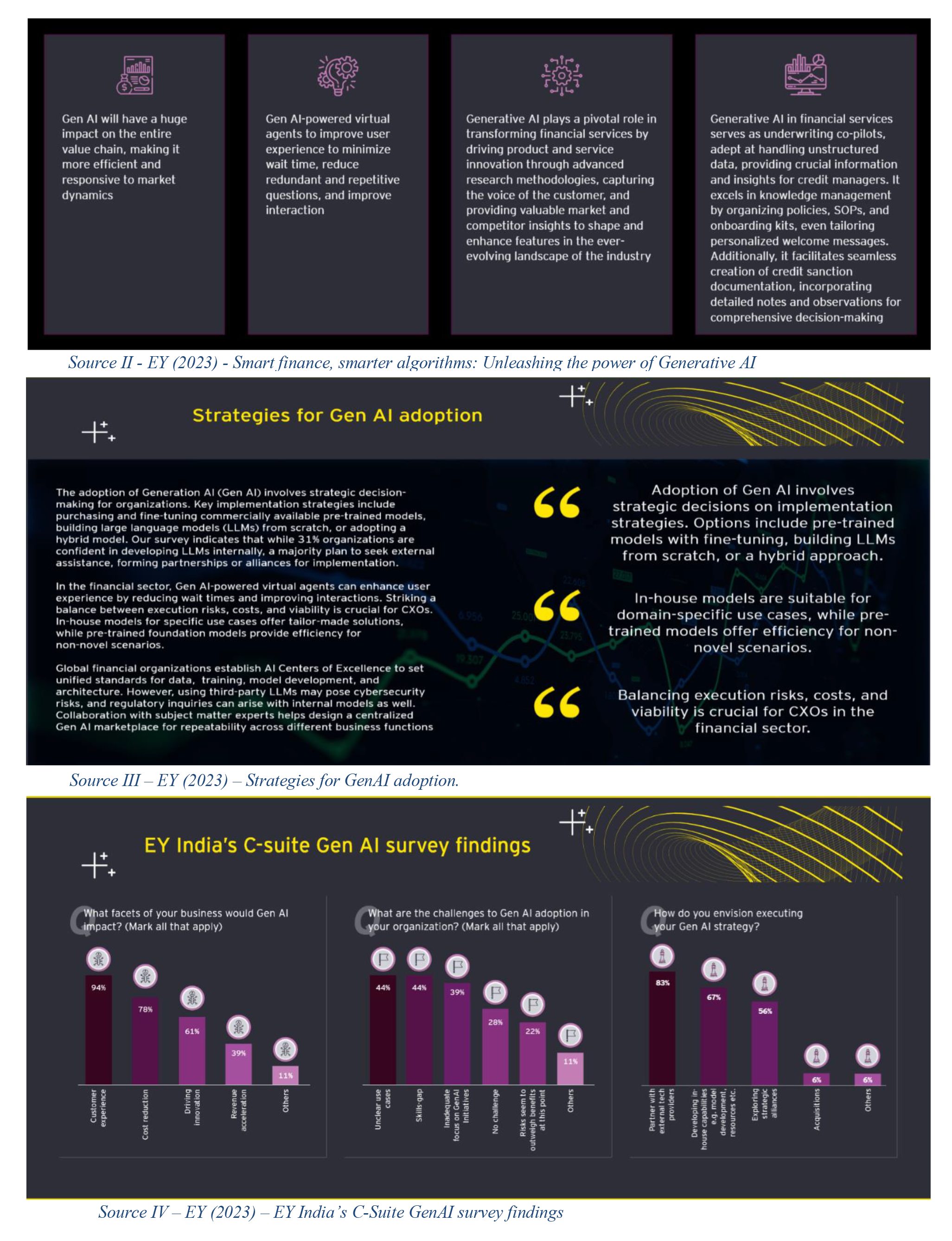
| CEO Commitment to Investment | 100% of CEOs surveyed by EY said they were committed to generative AI investment. |
| Financial Services Adoption | 78% of financial services respondents have either implemented Gen AI or plan to pilot it within a year. |
| Impact on Financial Services | 61% of survey respondents believe Gen AI will have a huge impact on the entire financial services value chain. (EY, 2023) |
| Key Takeaways |
|---|
| GenAI holds promise for the financial sector but requires cautious implementation. |
| Potential benefits include improved efficiency, enhanced customer experience, and strengthened risk management. |
| Intrinsic risks in GenAI, such as reputation damage, need careful consideration. |
| Enterprise-level GenAI applications can mitigate risks but may not be cost-effective for smaller institutions. |
| GenAI applications could contribute to liquidity risk and concentration risk in the financial sector. |
| Regulatory policy will evolve to guide the use of GenAI in financial institutions. |
| Close human supervision is essential for managing risks associated with GenAI use. |
| Prudential oversight authorities should strengthen monitoring and collaboration efforts. |
| The combination of language models and knowledge graphs can enhance performance in GenAI applications. |
| Explainability and interpretability challenges exist in GenAI systems. |
| Prompt engineering is crucial for configuring input structure and guiding model output in GenAI. |
| GenAI poses cybersecurity challenges, including phishing and deepfakes. |
| The deployment of GenAI in finance requires understanding and mitigation of associated risks. |
| Biases introduced by GenAI may persist and worsen over time. |
| GenAI governance issues parallel those of AI/ML and should be addressed accordingly. |
| Opting out of data collection may limit GenAI responses. |
| GenAI can generate solvency and liquidity risks if not properly trained. |
| Herding behavior and rumors from GenAI can impact market liquidity. |
| Financial institutions must explain GenAI-driven decisions and actions to stakeholders. |
Conclusion
Generative AI (GenAI), a potent force within the technological landscape, has captivated the financial sector with its transformative potential. Like a mythical genie emerging from its lamp, it offers a plethora of boons for reshaping the fintech landscape. Yet, as with any potent magic, the promise of GenAI comes intertwined with inherent perils. This paper has delved into the intricate tapestry of GenAI’s influence in fintech, illuminating both its dazzling potential and the lurking shadows of risk.
On one hand, GenAI’s transformative power is undeniable. It possesses the potential to significantly enhance operational efficiency, streamline processes, and personalize customer experiences. Its analytical prowess can bolster risk management frameworks, identifying and mitigating financial threats with unparalleled precision.
However, we must tread cautiously, for within the depths of GenAI’s power lurk potential pitfalls. Algorithmic biases, liquidity and concentration risks, cyberattacks, deepfakes, and phishing scams all pose significant threats to financial stability.
Therefore, the critical question arises: Is GenAI friend or foe? The answer lies not in simplistic binaries, but in a nuanced understanding of its potential and limitations.
- Human oversight: Tethering GenAI’s power to ethical
principles and responsible use through vigilant human supervision. - Regulatory frameworks: Weaving robust regulatory
frameworks to guide GenAI’s development and deployment within clear
ethical boundaries. - Governance and oversight: Establishing strong governance
structures and vigilant oversight mechanisms to ensure transparency and
accountability.
Ultimately, the key to unlocking the positive potential of GenAI lies in transparency. Illuminating the intricacies of its algorithms and decision-making processes is crucial for fostering public trust and mitigating risk.
In conclusion, the GenAI genie is not a preordained friend or foe; its character lies in the spell we choose to cast. By embracing it with wisdom, caution, and a commitment to ethical use, we can harness its power to transform the fintech landscape for the better.
References
- Assia, R. (2024, January 17). Challenges the fintech industry faces with generative AI.
- Boston Consulting Group. (2023, August 22). BCG.com Generative AI.
- Deloitte. (2023). The implications of generative AI in Finance.
- EY. (2023). Smart finance, smarter algorithms: Unleashing the power of Generative AI.
- Johnson, M. (2023, March 20). Forbes.
- Kalia, S. (2023). Potential Impact of Generative Artificial Intelligence (AI) on the Financial Industry.
- Kulkarni, P., & Barde, K. (2024). Applications of Generative AI in Fintech.
- Market.us. (2023). Generative AI in Fintech Market.
- MIT Technology Review Insights. (2023). Finding value in generative AI for financial services.
- Organisation for Economic Co-operation and Development. (2023). Generative Artificial Intelligence in Finance.
- Rishabh Software. (2023). Generative AI in Fintech: Impact, Use Cases, Success Stories & More.
- Shabsigh, G., & Boukherouaa, E. B. (2023). Generative Artificial Intelligence in Finance: Risk Considerations.