

Anand Thakur
Professor, Head & Dean, School of Management
Central University of Punjab
Email:
anand.thakur@cup.edu.in
Kamini Singla
Research Scholar
Central University of Punjab
Email:
kaminisingla213@gmail.com
Kavita Singla
Research Scholar
Central University of Punjab
Email:
kvsingla11@gmail.com
Lavudya Bablu
Student
Central University of Punjab, Bathinda
Email:
l.bablu3241@gmail.com
Abstract:
The pursuit of Sustainable Development Goals (SDGs) by 2030 emphasizes achieving inclusive and equitable quality education globally. This conceptual study explores the impact of Sustainable Development Goal 4 (Quality Education) adoption in higher education institutions (HEIs), focusing on enhancing student perceptions of educational quality and institutional loyalty. Utilizing the Stimulus-Organism-Response (S-O-R) framework, findings suggest that SDG-4 initiatives promoting inclusive education and lifelong learning can positively influence students’ educational experiences and foster enduring institutional loyalty. The study highlights the transformative potential of aligning educational practices with global sustainability goals. The findings shed light on the significant role of educational leaders and policymakers in strategically implementing SDG-4 principles to enhance institutional reputation and attract socially responsible stakeholders. By fostering a culture of innovation and sustainability, Higher Education Institutions can not only improve educational outcomes but also build a student base committed to sustainable development. This approach amplifies the institutions’
appeal, contributing to the broader goal of sustainable global education. The study ultimately highlights the importance of strategic alignment with SDG-4 for long-term success and impact in the education sector, emphasizing the need for continued efforts and investments in promoting inclusive, equitable, and high-quality education in alignment with global sustainability objectives.
Keywords: Sustainable Development Goals, Inclusive Education, Lifelong Learning, Students’ Perception, Institutional Loyalty JEL Code Classification: M; I
1. Introduction
The United Nations Sustainable Development Goals (UN SDGs) present a universal framework aimed at addressing global challenges and achieving a better future by 2030. Central to this agenda is the education sector, which plays a critical role in promoting sustainable development and human well-being across all societies (Mori Junior, 2019; Cheng, 2021). Envisioned during a 2015 summit of world leaders, the SDGs provide a comprehensive set of goals, targets, and indicators to guide the policies and agendas of UN member states for the next fifteen years (Molden, 2018). The success of this ambitious agenda hinges on the ability to maximize synergies and address inherent trade-offs (Kroll, 2019), building on the progress made under the Millennium Development Goals (MDGs) (Pizzi, 2020).
Despite broad support from corporations, social reformers, governments, and environmental advocates, the concept of sustainable development remains subject to varying interpretations (Paoli, 2019). The Brundtland Report (1987) famously defined sustainable development as development that meets current needs without compromising the ability of future generations to meet their own needs (De Neve, 2020). Within this context, the role of education, particularly higher education institutions (HEIs), is pivotal.
A paradigm shift in educational discourse is evident within the SDGs, particularly in SDG 4, which emphasizes inclusive and equitable quality education for all (Bruns, 2019). Recognized as a fundamental human right and a cornerstone for social harmony and sustainable development by UNESCO (Nazar, 2018), education is crucial for fostering economic development, environmental sustainability, and social inclusion globally (Boeren, 2019).
Education empowers individuals and societies, and its quality significantly impacts a nation’s global competitiveness (Webb, 2017; Thamrin, 2020).
India’s strategic development plans and priorities provide an opportune moment to align with the SDGs, leveraging national initiatives for community development and resource management (Dhanapal, 2023). The SDGs, which address diverse areas such as poverty, health, education, and sustainability, are particularly relevant in the Indian context (Srivastava, 2018).
As a key player in the global achievement of the SDGs by 2030, India holds a significant role in implementing the 2030 Agenda (Tandon, 2019). Recognizing the transformative power of education, particularly through the influence of teachers, is critical for shaping a sustainable future (Goyal, 2023). India’s National Education Policy (NEP) 2020 aims to overhaul the educational system to align it with economic development and improve quality of life (Radha, 2023). Higher education institutions (HEIs), functioning as autonomous entities, have a profound impact on sociocultural frameworks, economies, and governance structures (Parvez, 2019).
HEIs are increasingly adopting sustainability as a core principle, contributing to the development of a dynamic society, responsible leadership, and a contemporary economy (Ahmad, 2017). Historically, universities have been drivers of innovation and societal well- being, making them integral to achieving the SDGs (Kioupi, 2020). The critical role of education in sustainability has been emphasized by scholars, particularly in ensuring that students acquire knowledge and skills supporting sustainable development (Chaleta, 2021).
Since SDG-4 is essential for addressing the current global challenges, it is imperative to understand the relationships between SDG-4 adoption and student behavior. Understanding these associations may guide improvements in higher education, enhancing student satisfaction and retention.
2. Review of Literature
2.1 SDG-4 Adoption
The alignment of higher education with SDGs has gained significant attention, with Buerkle et al. (2023) underscoring the necessity for innovative teaching methods that promote sustainable
development. The study proposes integrating various aspects of SDGs into higher education, including poverty alleviation, health and well-being, quality education, and environmental sustainability. This approach is essential for achieving SDG-4, which aims to ensure inclusive and equitable quality education and promote lifelong learning opportunities for all.
2.1.1 Inclusive Education
Inclusive education, the practice of educating students with diverse needs in mainstream classrooms, has gained significant traction over the past decades. This approach is rooted in the principle of equal opportunities for all students, regardless of their abilities or disabilities (Mackelprang et al., 2021). Recent literature (Moriña, 2019; Graham, 2020; Lindner et al., 2023; Mendoza & Heymann, 2024) highlights various aspects of inclusive education, including its benefits, challenges, implementation strategies, and impact on students’ perceptions of their institution. Studies consistently demonstrate the positive outcomes of inclusive education for all students. This social integration enhances the self-esteem and social skills of students with disabilities while encouraging empathy and respect among their peers (Avramidis & Norwich, 2002; McLeskey et al., 2014). Furthermore, inclusive classrooms often employ differentiated instruction, which can benefit all students by catering to diverse learning styles (Florian & Spratt, 2013; Tomlinson, 2014). A study by Ruijs and Peetsma (2009) also suggests that inclusive education can improve academic outcomes for students with disabilities.
Inclusive education not only benefits academic and social outcomes but also significantly impacts students’ perceptions of their institutions (Iacono et al., 2023). Recent studies underscore the importance of systemic support for inclusive education. Loreman (2014) emphasizes the role of school leadership in fostering an inclusive culture. Schools prioritizing inclusive values and providing ongoing support for teachers tend to have more successful inclusion outcomes (Liasidou, 2012). Furthermore, Hehir et al. (2016) highlight the long-term benefits of inclusive education, including improved academic achievement and post-school outcomes for students with disabilities.
2.1.2 Lifelong Learning
Lifelong learning encompasses learning that occurs at all stages of life, from early childhood through retirement and takes place in various settings, including formal education institutions, workplaces, and informal environments (Laal & Salamati, 2012). Recent literature highlights the importance (Vera‐Toscano et al., 2017), challenges (Moore, 2020), strategies (Endres et al.,
2021), and impact of lifelong learning (Watkins et al., 2011), especially in the context of the 21st century.
Lifelong learning is crucial for individual and societal development (Regmi, 2020). According to Aspin and Chapman (2012), lifelong learning helps individuals adapt to changes in the labor market, enhances personal development, and promotes social inclusion. Lifelong learning is vital for maintaining competitiveness in the global economy and fostering innovation. It also plays a significant role in personal fulfillment and active citizenship (Watson, 2009). Recent studies underscore the importance of lifelong learning in enhancing employability and career progression. For example, Biesta (2020) found that lifelong learning opportunities significantly contribute to professional growth and adaptability in various sectors. Similarly, Jarvis (2004) highlights that lifelong learning is essential for personal and professional resilience in the face of economic and technological changes.
Despite its importance, several challenges hinder the implementation of lifelong learning. One significant barrier is the lack of access to learning opportunities for disadvantaged groups, including low-income individuals and those living in rural areas (Green, 2011; Rogers, 2014). Additionally, there are often financial constraints, with the cost of education and training being prohibitive for many (Watson, 2009). Another challenge is the recognition and validation of non-formal and informal learning, which can limit individuals’ ability to use their skills and knowledge effectively (Colardyn & Bjornavold, 2004). Recent studies provide insights into effective strategies for promoting lifelong learning.
Lifelong learning also significantly impacts students’ perceptions of their institutions (Neves & Henriques, 2020). Institutions that promote lifelong learning are often viewed more favorably by students, as they are seen as supportive, innovative, and responsive to their needs. Furthermore, promoting lifelong learning can improve the institution’s reputation and attractiveness to prospective students. Institutions that are committed to lifelong learning are often seen as leaders in educational innovation and excellence (Brennan, 2020). This can lead to higher enrollment rates and greater overall success for the institution.
2.2 Students’ Perception of the Institution
Students’ perceptions of their educational institutions are critical indicators of institutional effectiveness and quality. Borishade et al. (2021) explore the relationship between service quality, student satisfaction, and loyalty in higher education, highlighting that delivering
consistent and acceptable service quality significantly influences student satisfaction and loyalty. Factors such as instructor effectiveness, affordability, community involvement, digital trust, and digital experience quality play pivotal roles in shaping students’ perceptions.
Barta et al. (2023) investigate how the implementation of environmental, social, and economic SDGs can influence consumer perceptions of firm reputation, trust, and user organization identification, with potential implications for loyalty. The findings suggest that aligning institutional practices with broader sustainability goals can enhance students’ perceptions of their institutions. This alignment demonstrates a commitment to broader societal goals, which can positively impact how students view their educational experience.
De Visser et al. (2018) emphasize the importance of developing trust in intelligent and smart education systems. Technological interventions must be complemented by training for all stakeholders to ensure the effective adoption and acceptance of smart learning environments. As digital interactions become more integral to education, the quality of the digital experience and the trust students place in these systems are critical components of their overall perception of the institution.
2.3 Institutional Loyalty
Institutional loyalty emerges as a key outcome of positive student perceptions and experiences. Borishade et al. (2021) highlight that student satisfaction mediates the relationship between service quality and loyalty, suggesting that enhancing student satisfaction can significantly boost institutional loyalty. This relationship highlights the importance of delivering high- quality educational experiences to retain students and encourage their continued engagement with the institution.
Krishna et al. (2023) discuss the role of cybersecurity and trust in digital information systems, emphasizing that secure and trustworthy digital environments are essential for maintaining institutional loyalty. As educational institutions increasingly rely on digital platforms, ensuring the security and privacy of these systems becomes paramount in fostering student trust and loyalty.
Mallika Appuhamilage & Torii (2019) demonstrate that perceived value and student satisfaction directly impact loyalty, with satisfaction playing a major intermediary role. This finding suggests that higher education institutions should focus on enhancing perceived value
through various initiatives, such as improving educational quality, fostering inclusivity, and integrating sustainability practices. By doing so, institutions can build and maintain student loyalty, which is crucial for their long-term success and sustainability.
The adoption of SDG-4 in higher education, students’ perceptions of their institutions, and institutional loyalty are deeply interconnected themes. The integration of inclusive and equitable quality education, alongside efforts to enhance student satisfaction and trust, can drive institutional loyalty and contribute to the broader goals of sustainable development. By focusing on these areas, higher education institutions can play a pivotal role in achieving sustainable educational outcomes and fostering a culture of lifelong learning.
Teachers’ perspectives play a crucial role in shaping students’ futures aligned with SDGs (Zafar & Afzaal, 2019). Imran et al. (2022) emphasize the pivotal role of educational standards in fostering agile learning environments that enhance students’ decision-making and intuitive thinking. Despite insights from Armstrong et al. (2021) on SDG-4’s impact on inclusive education and lifelong learning, there remains a significant gap in understanding how SDG-4 adoption influences student perceptions within the diverse educational landscape.
The educational environment varies widely in access, quality, and socio-economic factors, necessitating a deeper exploration of how SDG-4 principles are perceived and internalized by students. While inclusive education and lifelong learning are discussed broadly, their integration into daily educational experiences and perceptions of institutional effectiveness remains underexplored. Additionally, the increasing relevance of digital experience quality and trust post-pandemic highlights a critical research gap on how these factors intersect with traditional measures of educational quality and inclusivity.
To address these gaps, this study adopts the Stimulus-Organism-Response (SOR) framework to conceptualize a theoretical model on how SDG-4 adoption influences student perceptions of instructor effectiveness, community involvement, digital experience quality, digital trust, and educational affordability. Through this conceptualization, the study aims to illuminate pathways through which SDG-4 adoption can enhance educational outcomes and influence students’ loyalty to institutions, offering valuable insights for educational policymakers and leaders striving to align practices with sustainable development goals.
3. Conceptual Framework
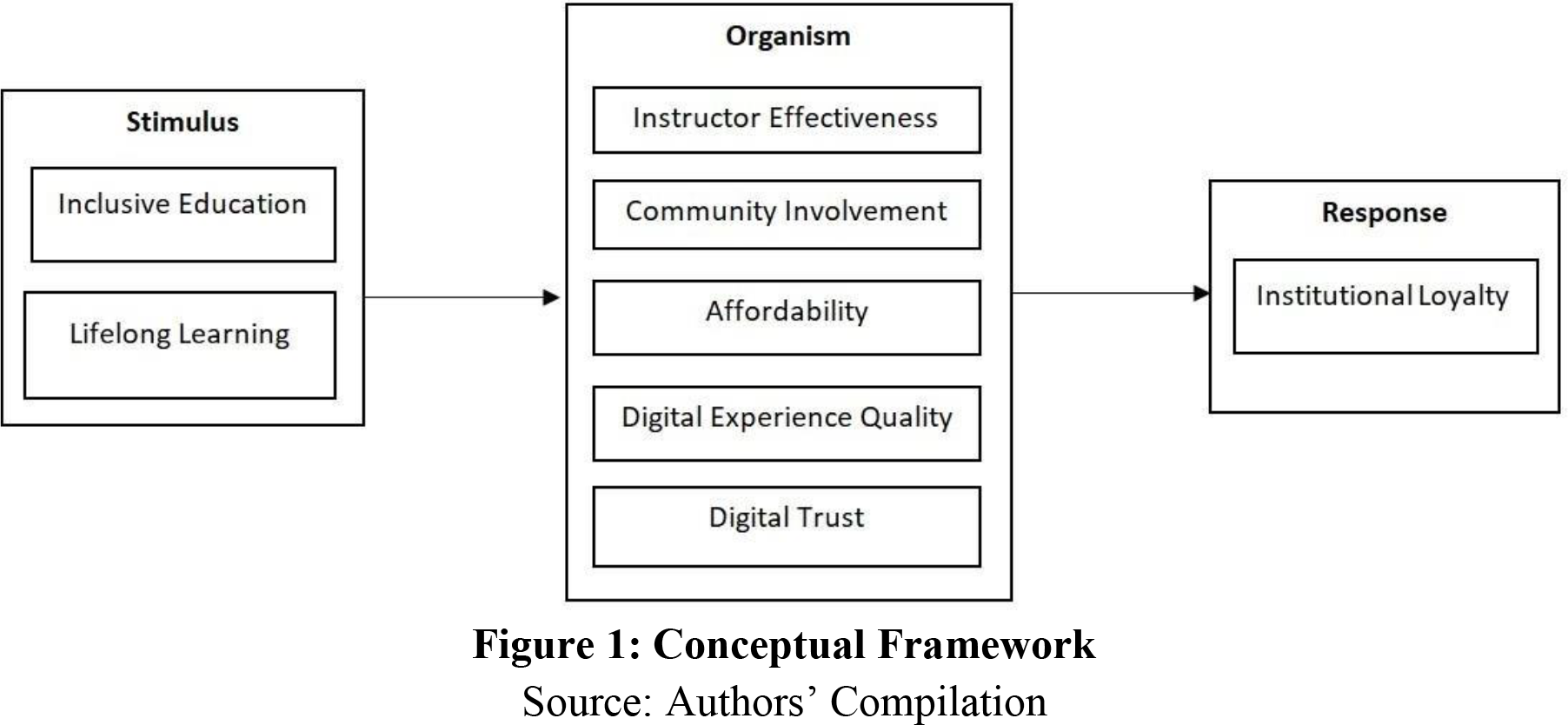
The conceptual framework (Fig. 1) employed in this study draws from the Stimulus-Organism- Response (S-O-R) paradigm, where SDG-4 compliance serves as the stimulus, students’ perceptions of the institution as the organism, and institutional loyalty among students as the response (Zafar, 2019; Imran et al., 2022). SDG-4 compliance is operationalized through measures of inclusive education and lifelong learning, reflecting global goals for equitable and quality education (Armstrong et al., 2021).
Students’ perceptions of the institution are assessed across several dimensions: instructor effectiveness, community involvement, digital experience quality, digital trust, and the affordability of the institution. These dimensions are crucial in understanding how educational environments are perceived and valued by students within the complex educational landscape, characterized by diverse access, quality, and socioeconomic factors (David, 2018; Srivastava, 2018).
By integrating these elements within the S-O-R framework, this study aims to explore the pathways through which SDG-4 adoption influences students’ perceptions and, subsequently, their loyalty to educational institutions.
4. Discussion & Findings
4.1 SDG-4 Adoption and Students’ Perception
The SDGs, particularly SDG-4, underscore the global commitment to inclusive and equitable quality education for all, aiming to transform educational landscapes worldwide. This study explores how HEIs align with SDG-4 principles and impact students’ perceptions of educational quality and loyalty (Imran et al., 2022). Drawing on the Stimulus-Organism- Response (S-O-R) framework, SDG-4 compliance serves as the stimulus, shaping students’ perceptions of the institution as the organism and influencing institutional loyalty as the response (Zafar, 2019; Imran et al., 2022).
The findings highlight that SDG-4 adoption may have a positive impact on students’ perceptions across multiple dimensions. Inclusive education initiatives and lifelong learning opportunities are pivotal in enhancing students’ experiences, fostering a sense of belonging, and promoting educational equity (Armstrong et al., 2021). Students value instructor effectiveness, community involvement, and the quality of digital experiences as critical factors that contribute to their overall perception of institutional effectiveness and educational quality.
Moreover, the study reveals how SDG-4 principles are interpreted and implemented within the diverse educational landscape. Variations in access, quality, and socioeconomic factors influence students’ perceptions differently, suggesting that localized approaches are essential for effectively embedding SDG-4 into educational practices (David, 2018; Srivastava, 2018). This underscores the importance of contextual understanding in advancing sustainable educational outcomes and fostering a supportive learning environment for all students.
4.2 Fostering Institutional Loyalty through Enhanced Student Perception
Institutional loyalty emerges as a critical outcome of positive student perceptions shaped by SDG-4 adoption. Students who perceive their institutions as inclusive, supportive, and technologically adept are more likely to develop strong affiliations and loyalty (Borishade et al., 2021; De Visser et al., 2018). The study emphasizes that enhancing student satisfaction through high-quality educational experiences and reliable digital platforms significantly contributes to institutional loyalty (Krishna et al., 2023; Mallika Appuhamilage & Torii, 2019).
Furthermore, the integration of sustainability principles into institutional policies and practices enhances students’ trust and confidence in their educational journey (Barta et al., 2023). Institutions that prioritize sustainability not only fulfill educational mandates but also demonstrate a commitment to broader societal goals, fostering a positive institutional image and reinforcing loyalty among students.
The findings underscore the transformative potential of SDG-4 adoption in higher education, highlighting its role in shaping students’ perceptions and fostering institutional loyalty. By aligning educational practices with SDG-4 targets, HEIs and beyond can enhance educational outcomes, promote student engagement, and contribute to sustainable development goals on a global scale.
5. Implications
5.1 Theoretical Implications
This study pioneers’ pathways by exploring the adoption of SDG-4 within HEIs using the Stimulus-Organism-Response (S-O-R) framework. Exploring how inclusive education and lifelong learning initiatives shape student perceptions and institutional loyalty advances the theoretical understanding of integrating sustainable development goals in diverse educational settings. The findings challenge existing paradigms by highlighting the dynamic interactions between educational quality, digital experiences, and sustainability practices, offering a novel perspective on adapting global mandates to local educational landscapes. This theoretical framework sets a precedent for future research exploring adaptive strategies that balance local contexts with global sustainability requirements.
5.2 Managerial Implications
Based on the findings, educational leaders and policymakers may strategically align institutional strategies with SDG-4 to foster transformative educational environments. By prioritizing inclusive education, enhancing digital infrastructure, and cultivating community partnerships, institutions can distinguish themselves as leaders in sustainable educational development. This approach not only enhances institutional reputation and student satisfaction but also attracts stakeholders committed to social responsibility and sustainability. Furthermore, the study advocates for innovative policy interventions that promote collaborative learning among HEIs, facilitating the exchange of best practices and catalyzing
systemic reforms. By fostering a culture of innovation and collective action, educational leaders can position their institutions at the forefront of global efforts to achieve SDG-4, ensuring a sustainable future for generations to come.
Conclusion
This study underscores the pivotal role of HEIs in advancing SDG-4 through inclusive education and lifelong learning. By employing the Stimulus-Organism-Response (S-O-R) framework, the study illuminates how SDG-4 adoption influences students’ perceptions of educational quality and, ultimately, institutional loyalty. The findings reveal that initiatives promoting inclusive education, lifelong learning, effective digital experiences, and community engagement have an impact on students’ educational experiences and foster enduring loyalty to their institutions.
Further, integrating SDG-4 principles into educational practices not only supports global sustainability goals but also strengthens institutional reputations and attracts stakeholders committed to social responsibility. Educational leaders and policymakers may embrace these findings to strategically align institutional strategies with SDG-4, thereby contributing to transformative educational environments that prepare students for a sustainable future.
Future studies can explore the role of digital experience quality and trust in the post-pandemic era to reveal critical insights for enhancing student satisfaction and loyalty in increasingly digital educational environments. Longitudinal studies can offer insights into the long-term effects of SDG-4 adoption on student perceptions and loyalty. Comparative research across different regions may be conducted to identify contextual factors influencing SDG-4 effectiveness. Additionally, the S-O-R-based conceptual framework can be empirically tested to validate the proposed relationships.
References
Ahmad, J. (2017). Sustainable development and social responsibility—Volume 1: Proceedings of the 2nd American University in the Emirates International Research Conference, AUEIRC’18—Dubai, UAE 2018. Springer.
Armstrong, A. C., Johansson-Fua, S. U., & Armstrong, D. (2021). Reconceptualising inclusive education in the Pacific. International Journal of Inclusive Education, 27(11), 1177- 1190.
Aspin, D. N., & Chapman, J. D. (2012). Lifelong learning: Concepts and conceptions. In Second International Handbook of Lifelong Learning (pp. 3-19). Springer.
Avramidis, E., & Norwich, B. (2002). Teachers’ attitudes towards integration/inclusion: A review of the literature. European Journal of Special Needs Education, 17(2), 129-147.
Barta, S., Belanche, D., Flavián, M., & Terré, M. C. (2023). How implementing the UN sustainable development goals affects customers’ perceptions and loyalty. Journal of Environmental Management, 331, 117325.
Biesta, G. (2020). What is the educational task? Arousing the desire for wanting to exist in the world in a grown-up way. Pedagogía y Saberes, 53, 69-78.
Black-Hawkins, K., & Florian, L. (2012). Classroom teachers’ craft knowledge of their inclusive practice. Teachers and Teaching, 18(5), 567-584.
Boeren, E. (2019). Understanding Sustainable Development Goal (SDG) 4: What about adult education? International Review of Education, 65, 277-298.
Borishade, T. T., Ogunnaike, O. O., Salau, O., Motilewa, B. D., & Dirisu, J. I. (2021). Assessing the relationship among service quality, student satisfaction and loyalty: the NIGERIAN higher education experience. Heliyon, 7(7).
Brennan, J. (2020). Higher education and the achievement of life goals: The impact of lifelong learning. Higher Education Quarterly, 74(3), 287-304.
Bruns, B. (2019). SDG 4—Quality Education: Reaching the marginalised and hard-to-reach. Springer.
Buerkle, A., O’Dell, A., Matharu, H., Buerkle, L., & Ferreira, P. (2023). Recommendations to align higher education teaching with the UN sustainability goals–A scoping survey. International Journal of Educational Research Open, 5, 100280.
Chaleta, E. (2021). Education for sustainable development and its role in achieving the SDGs: Lessons from the field. Sustainability, 13(1), 593.
Cheng, P. W. (2021). The pursuit of well-being: The role of education. Educational Philosophy and Theory, 53(4), 371-384.
Colardyn, D., & Bjornavold, J. (2004). Validation of formal, non-formal and informal learning: policy and practices in EU member states. European Journal of Education, 39(1), 69-89.
David, M. (2018). Achieving the Sustainable Development Goals (SDGs) through the private sector: A look at India’s approach. Development in Practice, 28(4), 544-552.
De Neve, J.-E. (2020). The Brundtland Report: Our Common Future revisited. Environmental Science & Policy, 114, 1-8.
De Visser, E. J., Pak, R., & Shaw, T. H. (2018). From ‘automation’to ‘autonomy’: the importance of trust repair in human–machine interaction. Ergonomics, 61(10), 1409-1427.
Dhanapal, D. (2023). Aligning India’s development priorities with the Sustainable Development Goals. Journal of Sustainable Development, 16(2), 1-19.
Endres, T., Leber, J., Böttger, C., Rovers, S., & Renkl, A. (2021). Improving lifelong learning by fostering students’ learning strategies at university. Psychology Learning & Teaching, 20(1), 144-160.
Florian, L., & Spratt, J. (2013). Enacting inclusion: A framework for interrogating inclusive practice. European Journal of Special Needs Education, 28(2), 119-135.
Forlin, C. (2017). Teacher education reform for enhancing teachers’ preparedness for inclusion. International Journal of Inclusive Education, 14(7), 649-663.
Goyal, N. (2023). Teacher’s role in shaping a sustainable future: Insights from India’s educational reform. Journal of Education for Sustainable Development, 17(1), 43-59.
Graham, L. J. (2020). Inclusive education in the 21st century. In Inclusive education for the 21st century (pp. 3-26). Routledge.
Green, A. (2011). Lifelong Learning, Equality and Social Cohesion 1. European Journal of Education, 46(2), 228-243.
Hehir, T., Grindal, T., Freeman, B., Lamoreau, R., Borquaye, Y., & Burke, S. (2016). A summary of the evidence on inclusive education. Institute on Disability and Policy Studies.
Iacono, T., Landry, O., Garcia-Melgar, A., Spong, J., Hyett, N., Bagley, K., & McKinstry, C. (2023). A systematized review of co-teaching efficacy in enhancing inclusive education for students with disability. International Journal of Inclusive Education, 27(13), 1454-1468.
Imran, H., Hafeez, A., & Iqbal, S. (2022). Education for Sustainable Development: EMO Project Connecting the SDGs’. Journal of Development and Social Sciences, 3(1), 111-125.
Jarvis, P. (2004). Adult education and lifelong learning: Theory and practice. Routledge.
Kioupi, V. (2020). The role of education in achieving the Sustainable Development Goals: Theoretical and empirical insights. Environmental Education Research, 26(9-10), 1393-1406.
Krishna, B., Krishnan, S., & Sebastian, M. P. (2023). Understanding the process of building institutional trust among digital payment users through national cybersecurity commitment trustworthiness cues: a critical realist perspective. Information Technology & People.
Kroll, C. (2019). Sustainable Development Goals: Are we moving in the right direction? Sustainability Science, 14(1), 172-178.
Laal, M., & Salamati, P. (2012). Lifelong learning; why do we need it?. Procedia-Social and Behavioral Sciences, 31, 399-403.
Liasidou, A. (2012). Inclusive education, politics and policymaking. Continuum International Publishing Group.
Lindner, K. T., Schwab, S., Emara, M., & Avramidis, E. (2023). Do teachers favor the inclusion of all students? A systematic review of primary schoolteachers’ attitudes towards inclusive education. European Journal of Special Needs Education, 38(6), 766-787.
Loreman, T. (2014). Measuring inclusive education outcomes in Alberta, Canada. International Journal of Inclusive Education, 21(6), 608-620.
Mackelprang, R. W., Salsgiver, R. O., & Parrey, R. C. (2021). Disability: A diversity model approach in human service practice. Oxford University Press.
Mallika Appuhamilage, K. S., & Torii, H. (2019). The impact of loyalty on the student satisfaction in higher education: A structural equation modeling analysis. Higher Education Evaluation and Development, 13(2), 82-96.
McLeskey, J., Waldron, N. L., Spooner, F., & Algozzine, B. (2014). Handbook of effective inclusive schools: Research and practice. Routledge.
Mendoza, M., & Heymann, J. (2024). Implementation of inclusive education: A systematic review of studies of inclusive education interventions in low-and lower-middle-income countries. International Journal of Disability, Development and Education, 71(3), 299-316.
Milana, M., & Holford, J. (2014). Adult education policy and the European Union: Theoretical and methodological perspectives. Springer.
Molden, D. (2018). Sustainable Development Goals: Pathways to 2030. Environmental Sustainability, 33, 283-285.
Moore, R. L. (2020). Developing lifelong learning with heutagogy: contexts, critiques, and challenges. Distance Education, 41(3), 381-401.
Mori Junior, R. (2019). Education and the UN Sustainable Development Goals: The contribution of Brazilian higher education institutions. Higher Education Policy, 32(2), 291- 307.
Moriña, A. (2019). Inclusive education in higher education: challenges and opportunities. Postsecondary educational opportunities for students with special education needs, 3-17.
Nazar, S. (2018). Education as a human right and its role in achieving the SDGs. Journal of Human Rights Practice, 10(2), 331-341.
Neves, C., & Henriques, S. (2020). Exploring the impacts of distance higher education on adult learners’ lives and reclaiming lifelong learning as a human development process. Open Praxis, 12(4), 439-456.
Paoli, L. (2019). Corporate perspectives on sustainable development: Challenges and strategies. Journal of Business Ethics, 160(1), 1-14.
Parvez, A. (2019). Higher education institutions as agents of social change: An Indian perspective. Journal of Indian Education, 45(1), 75-89.
Pizzi, S. (2020). From the Millennium Development Goals to the Sustainable Development Goals: A comparative analysis of goal-setting approaches. Sustainability, 12(17), 7134.
Radha, S. (2023). The National Education Policy 2020 and its implications for higher education in India. Journal of Education Policy, 39(3), 1-18.
Regmi, K. D. (2020). Social foundations of lifelong learning: A Habermasian perspective. International Journal of Lifelong Education, 39(2), 219-233
Rogers, A. (2014). The base of the iceberg: Informal learning and its impact. Springer.
Ruijs, N. M., & Peetsma, T. T. D. (2009). Effects of inclusion on students with and without special educational needs reviewed. Educational Research Review, 4(2), 67-79.
Srivastava, P. (2018). The role of national initiatives in achieving the SDGs in India. Development in Practice, 28(4), 500-515.
Tandon, R. (2019). India’s role in achieving the Sustainable Development Goals: A roadmap for 2030. Journal of South Asian Development, 14(2), 219-240.
Thamrin, Y. (2020). The impact of education on a nation’s global competitiveness: An analysis of international education policies. Journal of Global Competitiveness, 8(1), 35-48.
Tomlinson, C. A. (2014). The differentiated classroom: Responding to the needs of all learners. ASCD.
Vera‐Toscano, E., Rodrigues, M., & Costa, P. (2017). Beyond educational attainment: The importance of skills and lifelong learning for social outcomes. Evidence for Europe from PIAAC. European Journal of Education, 52(2), 217-231.
Watkins, K. E., Marsick, V., & Kim, Y. S. (2011). The impact of lifelong learning on organizations. In Second international handbook of lifelong learning (pp. 859-873). Dordrecht: Springer Netherlands.
Watson, D. (2009). Learning through life: Inquiry into the future for lifelong learning.
Webb, R. (2017). The importance of education in achieving gender equality and empowering women: Insights from SDG 4. Gender & Development, 25(3), 489-501.
Zafar, H. S., & Afzaal, H. M. (2019). Pedagogy for Sustainable Educational Development of Students with Special Needs: Teacher’s Perspective.