







Dr. Thanapackiam*
*Assistant Professor, Department of Commerce & Management
St. Francis College, Karnataka
Abstract:
Purpose: Agriculture is an evergreen and growing field that requires global efforts to improve sustainability and manage competitiveness in fast-growing, dynamic, resource-based environments. Agriculture is the base and common thread that interconnects and interlinks all 17 sustainable development goals. This paper explores the sustainable development of agriculture using a statistical model, Explorative Data Analytics, which is concerned with competitiveness. Understanding the relationships among market dynamics, natural climate conditions and variations, and increasing issues of resource limitations is crucial inobtaininglong-termenvironmentalsustainabilityandseamlessagriculturalproductivity.Thisproblemis considered themostimportantandemergingproblemsinceagriculture isthe mainsourceofhumanlife.It aims to provide a statistical model to forecast the public’s support for agriculture to increase sustainable productivityandtheenvironment.
Methodology: The proposed statistical model in this paper uses the EDA technique, which includes various internal mechanisms, such as statistical and visualization methods, for analyzing and summarizing the dataset. EDA’s main features are exploration, visualization, summarization, pattern recognition, and problem identification. The main objectives of using EDA are to recognize patterns, extract the entity relationship, identifyanomalies,andmakedecisions.
Findings: The corresponding food and climate dataset is analyzed using the EDA model in Python,and some major points are found. The findings revealed that agriculture production completely depends on a few major factors, such as climate, using, managing, and balancing resources, and advanced technological updates exhibit a high level of competitiveness with improved sustainability. Though agriculture is one of the competitive industries, it is essential to focus on sustainability because it impacts highly all the global sustainable goals. The proposed EDA model analyses multidimensional agricultural data, including agriculture output, economic factors, sustainability indicators, and temporal backgrounds. It also highlights the productivity of agriculture, which relies on utilizing modern resources to overcome competitive market values. The robustness of using modern, advanced technology-based resource utilization supports agriculture formers, farmers, and stakeholders in fostering sustainable and competitivesystems.
Keywords: Competitiveness Agriculture, Sustainable Agriculture, Agriculture Data Analytics, Competitiveness and Sustainability on Agriculture.
Agriculture has always been the backbone of human civilization, forming the basis for producing food fibre and essential raw materials necessary for survival and economic growth. It has nourished billions of people and influenced societies, economies, and cultures worldwide.Overtime,theagriculturalsectorhas seen major changes evolving with technological progress, shifting societal needs and environmental challenges. From the basic methods of subsistence farming to the advanced stage of industrial agriculture, agriculture’s history highlights humanity’s ability to innovate, adjust and sustain itself. In recent years, sustainability has become a key focus of agricultural discussions. This change stems from the growing recognition of the environmental harm, resource exhaustion, and social inequalities linked to traditional farming methods. Sustainable agriculture is no longer considered optional or temporary but an essential approach. Its goal is to ensure that farming practices are environmentally friendly, economically practical, and socially fair, protecting future generations’ ability to meet theirneedswhileaddressingcurrentdemands. At the same time, the concept of competitiveness has gained prominence in agriculture. Competitiveness refers to the ability of farming systems, regions, or nations to produce and market agricultural goods efficiently and profitably in an increasingly interconnected and globalized market. On the surface, sustainability and competitiveness may appear to be opposing forces. Pursuing higher profits and market share often leads to intensive farming practices that strain natural resources, degrade ecosystems, and exacerbate socioeconomic inequalities. However, a deeper exploration reveals that sustainability and competitiveness can coexist, creating a synergistic relationship. When approached thoughtfully, sustainable practices can enhance long-term competitiveness by ensuring resource availability, improving soil health, reducing input costs, and responding to the growing consumer demand for environmentally friendly and ethically produced products. The integration of sustainabilityintoagriculturalcompetitivenessis especially important due to the unprecedented global challenges. The world’s population is expected to reach nearly 10 billion by 2050, increasingthedemandforfood,fibre,andfuel.At the same time, climate change presents serious risks to agricultural productivity with rising temperatures, changing rainfall patterns, and more extreme weather events such as droughts and floods. Economic inequalities make the situation even more complex because small- scale farmers, who produce most of the world’s food, often lack access to the resources, technologies, and support required to adjust to these challenges. The combined challenge of improving agricultural competitiveness while ensuring sustainability is one of the key issues of ourtime. Emerging trends and technological advancements are beginning to reshape the agricultural landscape, offering innovative solutions to these intertwined challenges. Precision agriculture, for instance, utilizes technologies such as GPS sensors and drones to optimize resource use, reduce waste, and increase efficiency. Artificialintelligence(AI) and machine learning are being harnessed to analyze vast datasets,enabling farmers to make informed decisions about crop management, pestcontrol,andirrigation.Geneticallymodified crops are being developed to resist pests, tolerate extreme weather conditions, and improve nutritional content, contributing to
productivity and sustainability. Renewable energy sources, including solar-powered machinery and biogas, are being adopted to reduce the carbon footprint of agricultural operations. These advancements improve competitiveness by enhancing efficiency and cutting costs but also promote sustainability by reducing environmental impacts, supporting biodiversity, and increasing climate resilience. For example, precision agriculture helps reduce the excessive use of fertilizers and pesticides, which can harm soil and water systems. Renewable energy decreases the reliance on fossilfuels,reducinggreenhousegasemissions. These innovations show how combining sustainability and competitiveness can powerfully drive agricultural development. However, achieving this balance comes with its challenges. Small-scale farmers, essential to global agriculture, often encounter significant obstacles in adopting sustainable and competitive practices. These include limited access to modern technologies, financial resources, infrastructure, and market opportunities. Furthermore, policy frameworks andinternationaltraderegulations often favour large-scale industrial agriculture, overshadowing traditional and Indigenous farming systems. These traditional systems, based on local knowledge and ecological practices, often embrace sustainable methods that have been perfected over generations. Disregarding these systems not only threatens biodiversity but also disrupts the cultural and socialfabricof ruralcommunities. To overcome these challenges, inclusive andsupportive agriculturalpoliciesareurgently needed. Governments, international organizations, and private sector stakeholders must work together to create enabling environments that empower smallholders, promote fair trade, and encourage investment in sustainable technologies. Financial incentives, capacity-building programs, and infrastructure development can help bridge the gap between small-scale and large-scale agricultural producers, ensuring that the benefits of competitiveness and sustainability are accessible to all. The relationship between sustainability and competitiveness significantly affects agricultural development at various levels.Competitiveagriculturalsystemssupport economic growth, rural employment, and food security by consistently supplying affordable, high-quality products. At the same time, sustainability ensures that these benefits are long-lasting byprotecting naturalresources and strengthening resilience to environmental shocks. The connection between these two goals emphasizes the need to incorporate sustainability into agricultural competitiveness strategies. By doing so, agriculture can address critical issues like food insecurity, rural poverty, and climate change while contributing to global economicstabilityandecologicalpreservation. New sustainable and competitive agriculture methods are sparking innovation and changing traditional practices. Approaches like agroecology, permaculture, and organic farming are becoming more popular, providing ways to maintain productivity while protecting biodiversity and improving soil health. These practices mitigate climate change effects by capturing carbon, reducing greenhouse gas emissions, and conserving water. At the same time, advanced technologies like blockchain are improving transparency and traceability in agricultural supply chains, building trust and ensuring fair trade practices. Smart irrigation systems enhance water use efficiency, and renewable energy solutions make farming operations more eco-friendly. The effects of
these developments go beyond individual farms, impacting entire food systems, rural economies, and global trade. Sustainable and competitive farming practices can decrease food loss and waste, improve nutrition, and strengthen supply chains, making them less vulnerable to market disruptions. They also open up new economic opportunities for rural communities, such as eco-tourism, organic certifications, and value-added processing. Consumer demand for sustainably and ethically produced food is changing market trends, motivating agricultural producers to adopt environmentally friendly practices as a competitive edge.
This paper contributes an effective data analytical method for agriculture fields by integrating competitiveness and sustainability analysis to identify patterns and trends in large datasets and provide actionable insights for policymakers. It offers a scalable framework for regional analysis, promotes innovative, resource-efficient, and climate-resilient practices, and advances data analytics in agriculture to support global challenges. It highlights the trade-offs and synergies between economic growth and environmental care, aiming to enhance productivity while ensuring long-term sustainability.
This section provides a detailed literature survey on different methods of analyzing agricultural data regarding production and profit or sustainability. For example, Syed Amir Ashraf et al. (2021) have presented an investigation on the recent development of nanomaterials in agriculture industries. Nanotechnologies provide various essential features for multiple sectors. These featurescanbroadly help withfood solutionsfor farms, functional foods, and nutraceuticals, improving nutritional status, bioavailability, and the quality of food colour, texture, taste, and packaging. Nanotechnology is also used in agriculturalproducts,includingnanopesticides, nanofertilizers,andnanogrowthpromoters. Arun V. Baskar et al. (2022) have presented an investigation on spent absorbent techniques which could provide recovery, regeneration and safe disposal of the spent absorbent from the water resources. Various recovery and regeneration techniques are availabletorecoverthespentabsorbent,suchas filtration, decomposition, separation, thermal desorption, supercritical fluid desorption, chemical desorption and absorbent regeneration through the microbial materials. Finally, this investigation shows the current challenges in recovering the spent absorbent and the future direction to overcome the challenges in upcoming years for sustainability. SyedBilawalBukhari(2024)haspresentedacrop recommendation system for improving sustainability in the agricultural sector using machine learning techniques. The proposed system helps to suggest a suitable crop for a particular area by analysing the environmental factors of the region, which include humidity, soil pH value, temperature, and rainfall. It uses a random forest classifier to examine environmental factors and suggest suitable cultivating crops. Finally, this crop recommendation system is used as a powerful technology in the agriculture fields, which also improves the sustainabilityofagriculture. According to research from the UN and many others, by 2050, the world population will be around 9 billion, leading to an increasing number ofpeople facing hungerandfamine.So,
it creates a need for increasing agricultural production. It is the only solution to the hunger problem. So, Fatmanur Varlik et al. (2023) have presented a suitable plan for plant production based on agricultural lands located in cities. It will increase production and the growth of the plant.Finally,thismethodwillhelp increasefood production and improve food quality. Ammar Chouchane et al. (2024) have presented a deep learning (DL) based prediction for tomato plant disease by analysing the plant’s leaf image, which helps avoid spreading and improve production. It uses the hybrid model that combines theExponentialDiscriminantAnalysis (EDA) method with the transfer learning (TL) method.Italsodevelopeddeepneuralnetworks suchasDarknet53,EfficientNetB0andResNet50 to analyse the leaf image. Two tomato leaf datasets, the Plant Village and Taiwan datasets, are used to evaluate the efficiency of this hybrid model. Finally, the simulation result shows that this proposed hybrid model achieves 98.29% meanaccuracy inpredictingtomatoleaf disease using leaf images. It helps to improve tomato production and also leads to sustainable agriculture. Christine Musanase et al. (2023) have presented an ML and Internet of Things (IoT)algorithmforimprovingcropproductionby optimising cultivating practices. It uses the ML model to recommend crops based on environmental factors such as soil type, rainfall, nitrogen, potassium, and phosphorus levels. A rule-based model helps to recommend suitable fertilisers by analysing the particular crops. These models were trained and tested on Rwandan crops to evaluate the model’s efficiency.Theestimatedresultshowsthatthese proposed models have attained 97% accuracy in fertiliserrecommendation systems,whichhelps to increase agriculture production. Chouaib El Hachimi et al. (2022) have presented an innovative weather data management (SWDM) systemtoprovide weather updates by analysing the meteorological station data, which helps to maintain the crop growths,yields andalso make an irrigation schedule based on the weather condition. It uses both ML and DL models to analyse the raw data. This process consists of four steps: acquisition of data, storing the data, processing the data and sending the data to the application layer. This SWDM system helps to improve the sustainability of agriculture production inMorocco. The agriculture sector contributes significantly to sustainable development goals (SDGs) by ensuring food security, achieving zero hunger, improving nutrient foods and ensuring sustainable agriculture. So, Nurul Izza Afkharinah et al. (2023) have presented an ML model for predicting the growth phases of the crops more efficiently than the manual methods. It uses the ML boosting classifier method to classify the rice growth phases by evaluating various results such as precision, F1 score, recall, accuracy, cross-validation, Kappa score, and execution time. By analysing these results, the proposed model has efficiently improved the production of crops by examining the growth phases. It has also suggested some stepsandfertilizerstoenhancethegrowthofthe crops. Saltanat Sharipova et al. (2024) have presented the Exploratory Data Analysis (EDA) method to identify the effects of phosphorous on wheat yield. It uses various datasets to analyse the effects, such as precipitation, soil surface temperature, annual phosphorus applicationdatafrom2000to2022andhumidity range from April to September. The main motive of this model is to perform EDA on the given dataset to predict the impact of the phosphorous on the wheat yield. The result shows that the precipitation and soil surface temperature can identify the weak negative
correlations. Humidity helps identify weak positive correlations, which helps improve the sustainability of agriculture. Hafiyya R M et al. (2024) presented a crop rotation management (CRM) method to enhance and modernise agriculturepractices.Itcombinesacutting-edge approach with AI techniques. By analysing historical crop performance data and real-time weather forecasts, AI techniques can help suggest increasing crop rotations, leading to improved production by rotating the right crops at the right time. The result shows that this crop rotation method maximises crop yields, enhances farming techniques by modernising them,andachievessustainable farming.
It is understood that earlier research focused on whether sustainability or competitivenessfailedtoaddresstheissuesand challenges when combined. Strategies focusing on food production and profit cannot address sustainability issues. Similarly, resources, technical devices, and technological advances used for improving sustainability cannot address the issues of improving production and profit. Whereas, in the modern agriculture field, it is essential to focus on both competitiveness and sustainability to fulfil global needs and achieve SDG-2030 successfully because agriculture is the major field that behind supportsmostoftheSDGs,suchasSDG-2,6,8,9, 11, 12, 14, 15, and SDG-17. Thus, this paper has aimed to explore a statistical method to analyze agricultural data to forecast the importance of simultaneously focusing on competitiveness and sustainability. The earlier methods used in agriculture management fields did not use statistical analysis and used only region-based data. Few applications use machine learning techniques for cloud-based agricultural data analysis and are inflexible in adaptation. Hence, this paper is motivated to use the EDA model to create a data analytical model to analyse both competitiveness and sustainability in agriculture.
Improving competitivenessImproving competitiveness when promising sustainable development are two challenges the agriculture sector faces. High production,easyaccesstothe market,andmore economic profit are the factors that classify competitiveness. Several strategies have been developed for increasing greenhouse gas emissions, reducing biodiversity loss, and resource depletion, which are the factors that determine the sustainability level in agriculture. However, creating strategies for improving sustainability compromises short-term production and profit, creating a conflict between environmental and economic objectives. Several earlier research methods have examined sustainability and competitiveness in the agriculture field. Still, they are poorly integrated and lack data-driven approaches for comprehensively indicating the relationship. The earlier methods depended on traditional statistical methods for quantitative analysis. They focused on narrowly solving problems, and thus, they found difficulties in complex data processing, multi-dimensional data relationships, and actionable perceptions. Thisresearchgaprestrictsthestakeholders,and policymakers cannot simultaneously promote competitive and sustainable methods. Hence, this paper has been motivated to use the EDA method for addressing the above-said problem, and it canhandle complex, differentdatasetsfor recognizing data patterns. It can correlate the data entities and trends. However, balancing competitiveness and sustainability in agriculture isstillunderexploration.
The EDA method is widely utilized in data mining and analysis to recognize input data patterns and visualize the extracted essential features. It simplifies the data analysis process and produces more accurate and quick results. This method is more useful for anomaly detection, pattern identification, hypothesis evaluation, etc. Initially, the EDA method is applied to understand the relationship between the data points in the input dataset. some major aspects of EDA techniques are Evaluating distributed data, outlier detection, graphical representation, testing assumptions, handling missing values, correlation analysis, and graphical representation. The EDA technique can handle distributed data types and find their range, metrics, and dispersion. The correlation and variation between the data points are predicted and represent errors in thedata entry. Through this, the missing values in the data are identified and removed or replaced with valid data. Various statistical calculations are performed to classify different classes of input data. The result is graphically presented as a bar, pie, box plot, and histogram [1]. Based on the input data, various types of EDA methods are analyzed. Generally, three EDA methods are utilized: univariate, bivariate, and multivariate analysis. The univariate analysis method is appliedtounderstandthefeaturesorpatternsin single variables. The bivariate and multivariate analysis techniques are applied to find the relationship between the two data points and more than two data points. In addition, spatial analysis, textual analysis, and time-series analysis methods are applied to analyze variations in geographically distributed data, clouddatafrequency distribution data,andreal- time data. Using the following equations, the variance, the correlation between data points, outlier detection, and dimensionality reduction are performedasthe predicted output.
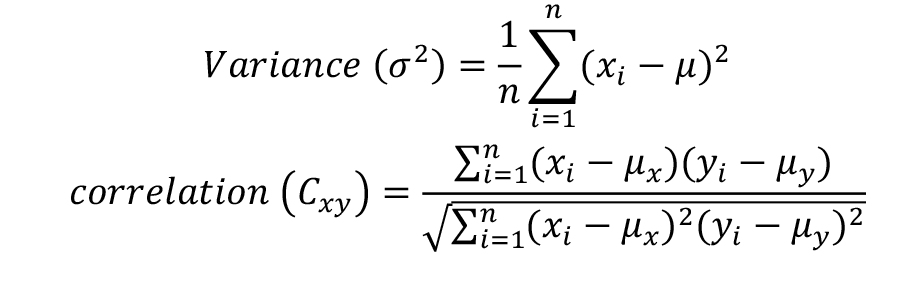
In EDA, the most common method used for outlier detection is Interquartile Range (IQR), and PCA is used for dimensionality reduction, whichisexpressedas; 𝐼𝑄𝑅 = 𝑄 − 𝑄 PCA,
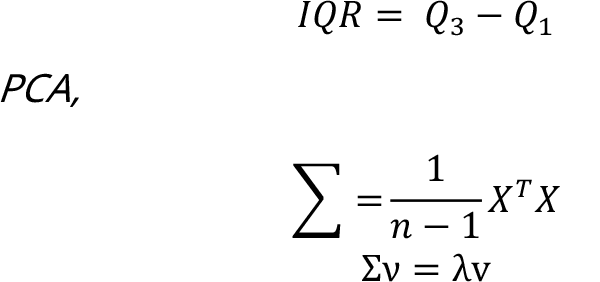
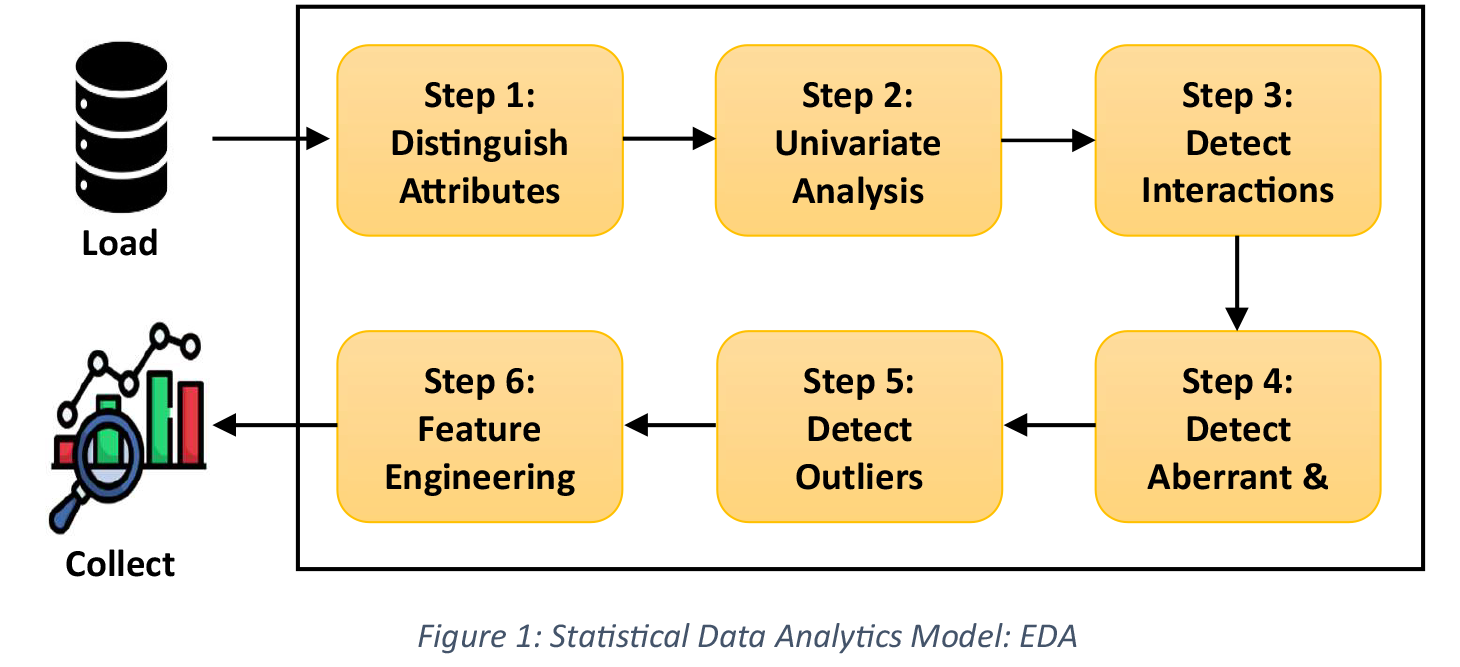
In the above equations, x and y represent the input data, n represents the total number of data, represents the mean value, denotes 𝜇 𝑋 the transpose of X, indicates that the first 25% 𝑄 of thedata indicates theremaining75%ofthe 𝑄 data, represents the covariance matrix, Σ ν denotes eigenvector, and represents λ eigenvalues. EDAmodel-based applications In recent years, EDA-based models have been used in many real-time industries, such as hospitals, education, sports, agriculture, marketing, space travel, retail, and fraud detection. The main function of EDA in these applications is to understand the input data, makedecisions,andproduceafinaldecision.For example, the EDA method in a hospital analyzes real-time patient data such as admission, discharge, health condition, health records, healthcare demand, and healthcare service data. similarly, in agriculture, the EDA method is applied to improve the competitiveness and sustainability of crop production. The steps involved in EDA-based data analysis include (i)
Analyzing user demand, query, or question. (ii) Load the facts in the model. (iii) analyzing the missing value, (iv) detecting data characteristics (variance, outliers, anomalies, etc). (v) Data transformation (data normalization, data encoding, mathematical evaluation, ratio calculation, and combining unique variables), (Vi) data visualization (graphs and tables), (Vii) outlier detection and handling, and (vii) generating the final prediction output. The overall workflow of the EDA model on data analysis isshowninFig. 1.
Step 1: Dis nguish A ributes Load Data Step 6: Feature Engineering Collect Insight Figure 1: Sta s cal Data Analy cs Model: EDA
EDA-basedagricultural dataanalysis The EDA technique is widely applied for data analysis and visualization. Similarly, this paper uses the EDA model in agricultural data to analyze and visualize crop production ratios. This is achieved by analyzing yield production, the relationship between input and output crops, sustainability, and emission level. The main goal of this paper is to analyze the competitiveness of crop production based on factors such as crop yield per hectare, cost per unit, market share, and export ratio. The crop production sustainability is evaluated based on water usage, CO2 emission, soil fertility, and crop diversification index (CDI) value. The input crop field data on different states, districts, seasons, crop types, total area harvested, and total crop production ratio-wise results are analyzed and visualizedusingthese factors. The common equation applied to find and visualize theresultof thesefactorsisexpressedas,

Here, TCP represents the total cost of production, representsthesumof ∑ 𝑃𝑟𝑜𝑑𝑢𝑐𝑡𝑖𝑜𝑛 production and represents production of 𝑖 (state,district,croptype,orfield).
Quantitative Analytics Aglobaldatasetisusedtoanalyzeandobtainkey points regarding agricultural competitiveness and sustainability. The data is collected from various sources, such as the Food and Agriculture Organization, the World Bank, market reports, and UNEP. Food production, crop yield, market access index, productivity in termsofworkers,andcompetitivenessscoreare estimated to understand the production, yield, and profit. The efficiency of water use, fertilizer use, GHGemission,andsustainabilityscoresare estimated to understand sustainability in agriculture. This section provides a quantitative analysis to understand the interconnection between competitiveness and sustainability in agriculture. It provides a way of identifying the opportunities to solve the issues and challenges incompetitivenessandsustainability.
Analytics Outputs and Discussion
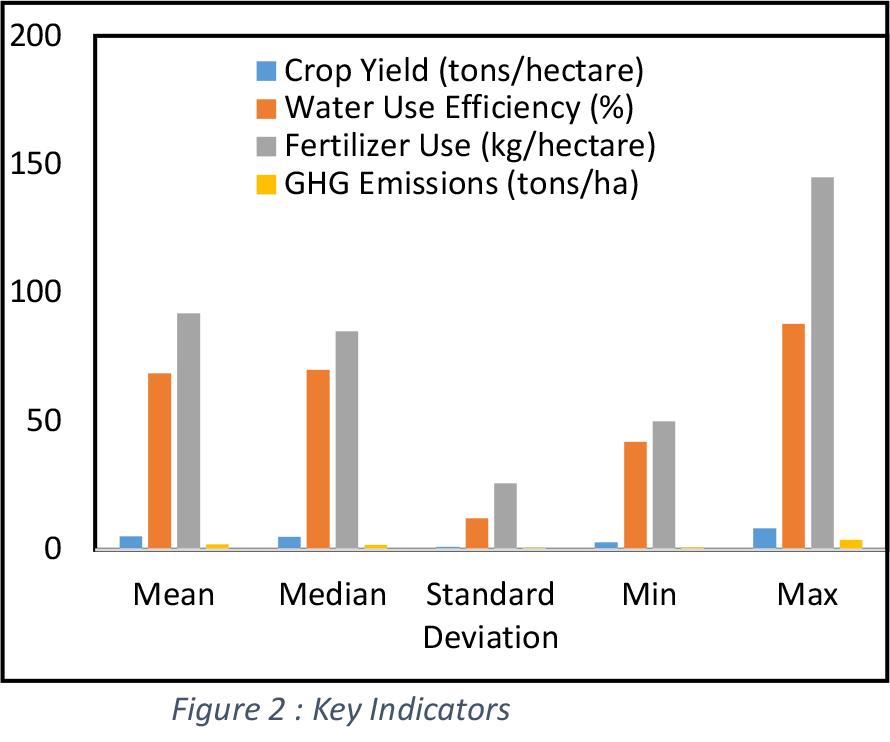
Crop Yield (tons/hectare) Water Use Efficiency (%) Fertilizer Use (kg/hectare) GHG Emissions (tons/ha)
Mean Median Standard Min Max Deviation Figure 2 : Key Indicators
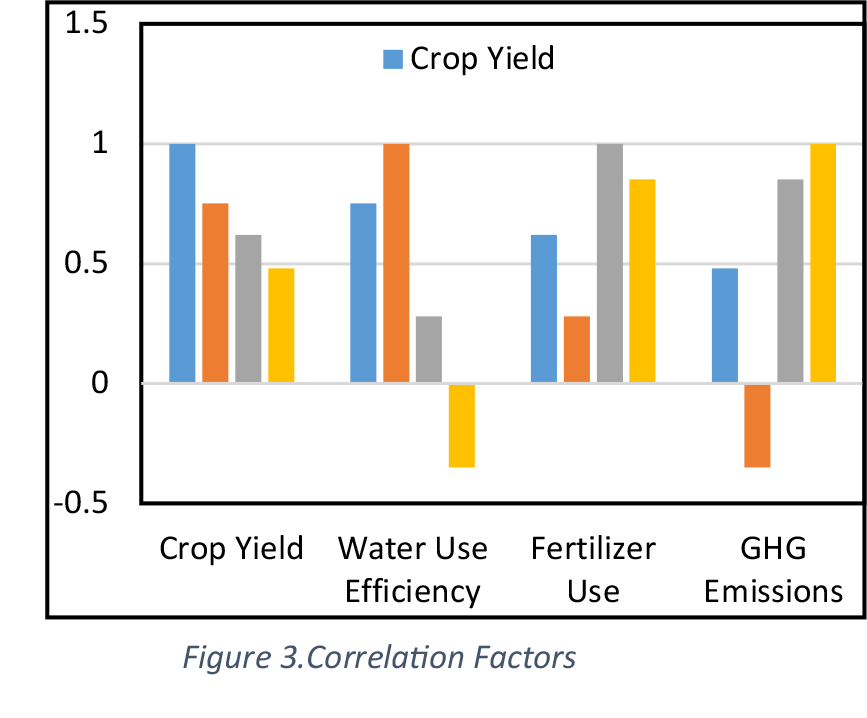
Figure 1 depicts the various performance evaluations in terms of the mean, median, standard deviation, Minimum, and maximum score of the crop yield per hectare, fertilizer used perhectare, waterusage level (%), and GHG emission per hectare. Offering an understanding of both efficiency and environmentalinfluence.Thecropyieldisshown inthebluebar,displayingconsistentlylowsscore across all metrics. pointing to potential challengesinproductivity.Theorangeillustrates Water use efficiency, which shows moderate values with notable peaks in the maximum category—indicating differences in water management strategies. Fertilizer usage is represented in green, which reveals the highest score, particularly in the maximum range— highlighting its significant influence in agriculturalmethodsbutraisingconcernsabout excessive usage. In contrast, greenhouse gas emissions are displayed in light blue, which remains a minimal score across all statistical measures. The standard deviation indicates substantial variation in fertilizer use and water efficiency, which emphasizes the need for more sustainableandconsistentapproaches. Figure 2 presents the correlation factor score of cropyield.wateruseefficiency.fertilizeruse.and greenhouse gas emissions. scaled between -1 and 1 for comparison. Crop yield and water use evaluation show strong positive normalized results, which indicates high performance and optimal resource utilization. Fertilizer use displays moderate positive results, which reflectsitsroleinproductivitybutsuggestsroom for balanced application. Despite their positive value, greenhouse gas emissions highlight environmental challenges as higher emissions represent sustainability trade-offs. The result obtained below 0 in specific metrics highlights inefficiencies or issues in balancing productivity and environmental concerns and requiring enhancementsinagriculturalmethods.
-0.5 Crop Yield Water Use Fertilizer GHG Efficiency Use Emissions Figure 3.Correla on Factors Figure 3 shows strategies, such as fertilizer subsidies, water conservation initiatives, and investments in research and development for sustainable agriculture. The analysis evaluates changes in crop yield and sustainability index in percentage. The prediction result is achieved either a positive or negative value. Farming subsidies result in a moderate rise in crop yield
but negatively affect the sustainability index, which indicatespossibleenvironmental
Change in Crop Yield (%)
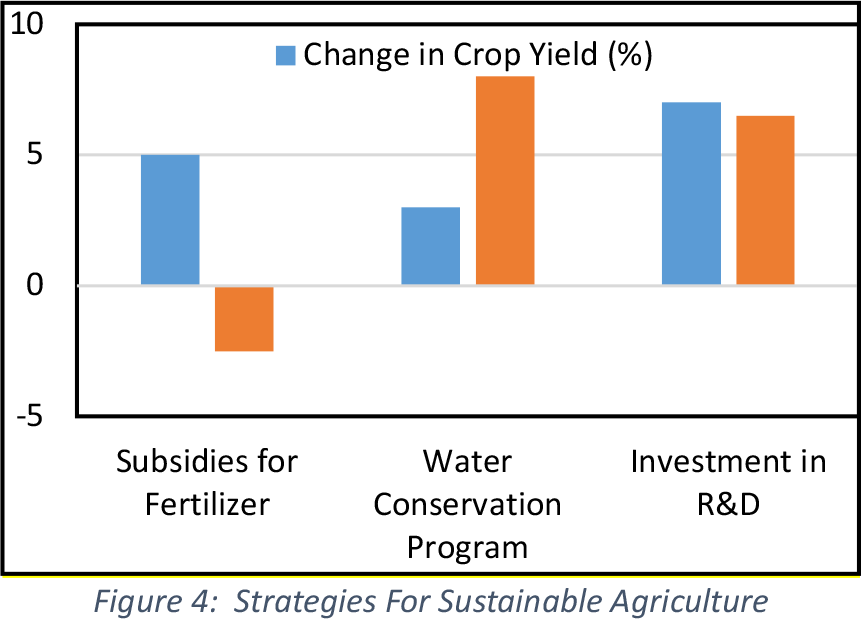
-5 Subsidies for Water Investment in Fertilizer Conservation R&D Program Figure 4: Strategies For Sustainable Agriculture challenges. Water conservation initiatives lead to a smaller increase in crop yield while significantly boosting the sustainability index andreflecting their role in supporting long-term resourceefficiency.Investmentsinresearchand development provide balanced improvements in crop yield and sustainability. showing their potential to align productivity and environmentalobjectives effectively.
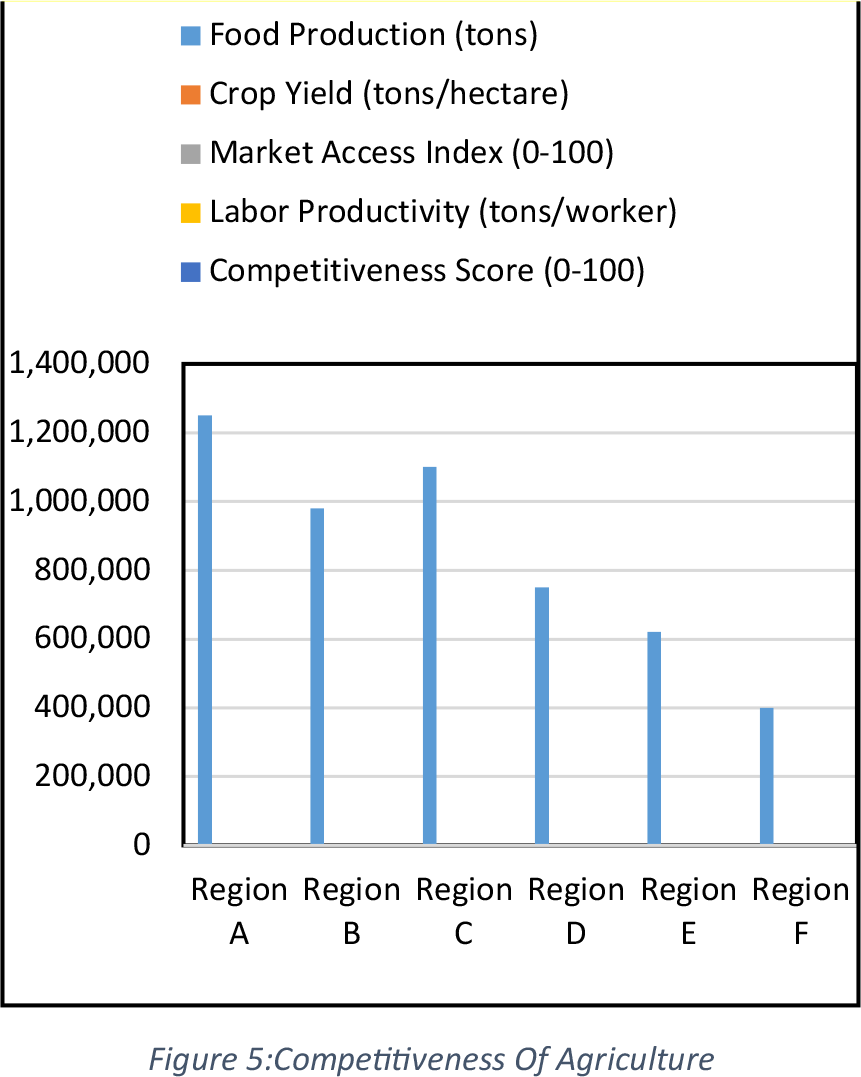
Food Production (tons) Crop Yield (tons/hectare) Market Access Index (0-100) Labor Productivity (tons/worker) Competitiveness Score (0-100) 1,400,000 1,200,000 1,000,000 800,000 600,000 400,000 200,000
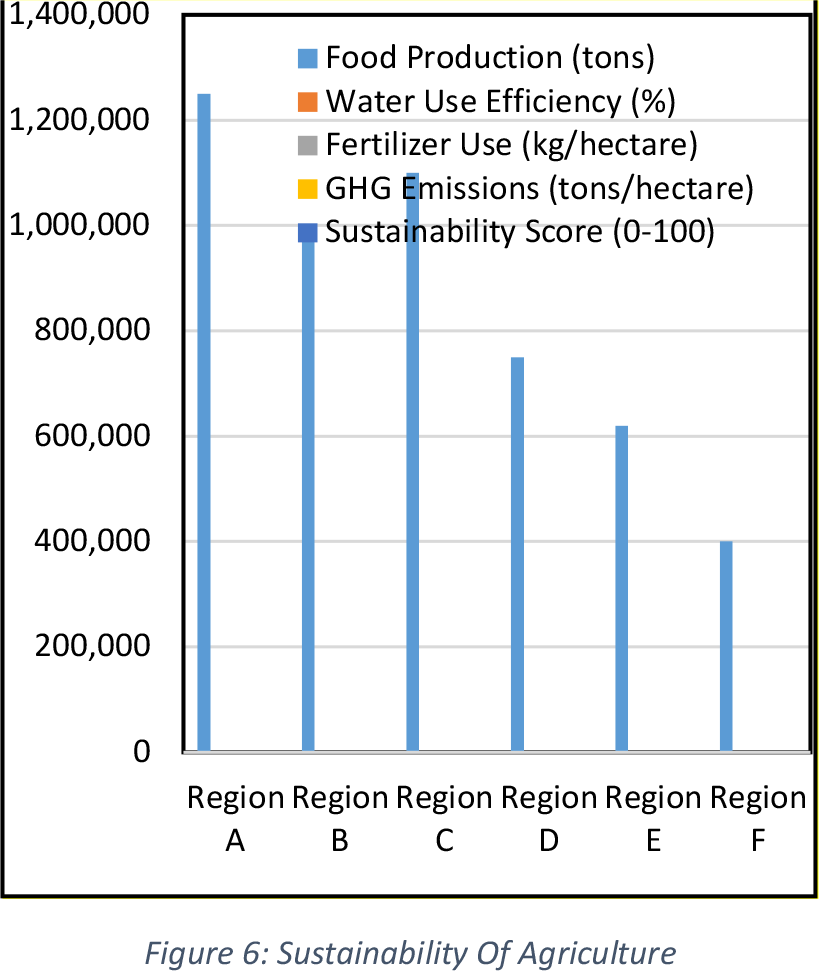
Figure 5:Compe veness Of Agriculture 1,400,000 Food Production (tons) Water Use Efficiency (%) 1,200,000 Fertilizer Use (kg/hectare) GHG Emissions (tons/hectare) 1,000,000 Sustainability Score (0-100) 800,000 600,000 400,000 200,000
Figure 6: Sustainability Of Agriculture Figure 5compares the comparisonresults of the top six regions in Tamil Nadu (Region A- Thanjavur, Region B- Erode, Region C- Salem, Region D- Madurai, Region E- Coimbatore, and Region F- Tiruchirappalli based on food production, crop yield, market access index, labour productivity, and competitiveness score. Region A shows the highest food production, which indicates advanced agricultural practices and superior efficiency. Region C and Region B follow closely, contributing notably to crop yield and labour productivity.Regions D, E,andF have lower production levels, with Region F being the least productive. The market access index and competitiveness score reveal disparities in infrastructure and economic advantages across regions. This technical analysis highlights the need for focused strategies to improve productivity and market connectivity. Figure 5 displays a comparative analysis of six regions based on assessing food production, water use efficiency, fertilizer use, greenhouse gas emissions, and sustainability scores. Region A
achieves the highest food production, but this comes with notable greenhouse gas emissions and moderate sustainability. Region C shows significant production with better water use efficiency and reduced greenhouse gas emissions, which reflects balanced resource utilization. Region B achieves high production butwithincreasedfertilizerconsumption,which raises sustainability concerns. Regions D, E, and F exhibit lower production levels, particularly Region F, having the lowest output and sustainability score. This analysis highlights trade-offs between productivity and environmental impact, which underlines the importanceof sustainable practices.
This research explores the interaction between competitiveness and sustainability in farming through Explorative Data Analytics (EDA) to understand the intricate connection between agricultural productivity, economic progress, and environmental protection. It discovers that increased productivity and improved market opportunities often cause resource depletion and pollution. These challenges can be reduced through efficient management of assets, advanced tools, and targeted strategies. The researchrevealslocaldifferencesandhighlights the need for methods to fit specific conditions. It presents a framework for analyzing farming information, identifies key factors affecting efficiency and durability, and proposes actionable remedies. The findings emphasize EDA as a valuable method for tackling global farming issues and supporting sustainable choices. Future research may apply predictive analytics and larger datasets, including social and climate aspects, to enhance strategies and boost agriculture’s adaptability and sustainabilityina transformingenvironment. Ashraf, S. A., Siddiqui, A. J., Abd Elmoneim, O. E., Khan,M.I.,Patel,M.,Alreshidi, M.,…&Adnan, M. (2021). Innovations in nanoscience for the sustainable development of food and agriculture with implications on health and Science of the Total environment. Environment, 768,144990. Baskar, A. V., Bolan, N., Hoang, S. A., Sooriyakumar, P.,Kumar,M.,Singh,L.,…&Siddique, K.H.(2022). Recovery, regeneration and sustainable management of spent adsorbents from wastewater treatment streams: A review. Science of the Total Environment, 822, 153555. Bukhari, S. B. (2024).Crop recommendation system using machine learning. a data-drivenapproach to sustainable agriculture. Journal of Techno Trainers, 1(2),26-35. Varlik, F., Özçelik, Z., Börü, E., & Öztürk, Z. K. (2023, May). A Decision Support System Design Proposal for Agricultural Planning. International Symposium on Intelligent In Manufacturing and Service Systems (pp. 612- 621).Singapore:SpringerNatureSingapore. Chouchane, A., Ouamanea, A., Himeur, Y., & Amira, A. (2024, October). Deep learning-based leaf image analysis for tomato plant disease detection and classification. In 2024 IEEE International Conference on Image Processing (ICIP) (pp.2923-2929).IEEE. Musanase, C., Vodacek, A., Hanyurwimfura, D., Uwitonze, A., & Kabandana, I. (2023). Data- driven analysis and machine learning-based crop and fertilizer recommendation system for revolutionizing farming Agriculture, 13(11),2141. practices.
Hachimi, C. E., Belaqziz, S., Khabba, S., Sebbar, B., Dhiba,D.,&Chehbouni,A.(2022).Smartweather data management based on artificial intelligence and big data analytics for precision agriculture. Agriculture, 13(1),95. Afkharinah, N. I., Gunawan, E., Masnur, N. F., Agustan, A., Yulianto, S., & Mutijarsa, K. (2023, October). Optimization of Boosting Classifier Method for Paddy Growth Phase Classification using Oversampling and Hyperparameter 2023 International Conference on Tuning. In Electrical Engineering and Informatics (ICEEI) (pp.1-6).IEEE. Sharipova, S., Akanova, A., & Ospanova, N. (2024, February). Data exploration of neural network for predicting the effect of phosphorus on the AIP Conference yield of spring wheat. In Proceedings (Vol.3063,No.1).AIPPublishing. Hafiyya, R. M., Nabhan, P. A., Melethil, S., Mohammed, N., & AP, M. M. (2024, April). AI- EnhancedPrecisionCropRotationManagement for Sustainable Agriculture. In 2024 International Conference on E-mobility, Power ControlandSmartSystems(ICEMPS) (pp.01-06). IEEE.