






Dr. Muhammedali Chalikandy
Former Deputy Head
Department of English, Al Buraimi University College, Oman
mchalikandy@gmail.com
Abstract:
The purpose of this qualitative paper is to explore the difficulties and challenges that the tertiary level arts, science, commerce and business teachers face while using adaptive teaching in their classrooms. Adaptive teaching aims at personalizing teaching and learning process to individual students’ needs, level and abilities. Although in multicultural classrooms like in India the students have different learning styles, attitudes, preferences, likes and dislikes, interests and learning difficulties, they come to the class with a common aim such as achieving success in their learning. As a result, it is imperative to use adaptive teaching techniques to help learners to attain this common goal. However, there are a number of hurdles for the teachers to implement adaptive teaching in their classrooms. In order to examine the challenges and difficulties that the teachers face in the classrooms, ten college lecturers from one of the colleges from Kerala were interviewed using an open ended questionnaire and the data was analysed and interpreted thematically. The result shows that the teachers have a number of hurdles in implementing adaptive teaching and learning techniques in their classrooms.
Keywords: difficulties challenges adaptive teaching techniques classroom
Introduction
Students come to the class with different agendas and their needs, skills, knowledge level are different. Moreover, their interest, attitudes and even motivation level are not identical. Therefore, teachers need to accommodate learners’ different and varied needs, interests; motivation level and knowledge level in the process of teaching and learning so that the learners will be able to achieve success in their learning. Adaptive teaching supports each individual student regardless their abilities and level by personalizing teaching and learning. It enables learners to achieve academic excellence. Adaptive teaching helps teachers to support students with special educational needs and disabilities. Nevertheless, teachers face a number of challenges and practical difficulties in implementing adaptive teaching in their classrooms. This paper explores what challenges and difficulties that tertiary level teachers who teach arts, science, commerce and business courses face while using adaptive teaching techniques and strategies in their classrooms.
Adaptive Teaching
Adaptive teaching is the process of teaching according to each student’s characteristics,needs, level and interest. It is a teaching approach which aims at accomplishing a common teaching objective by accommodating learners’ individual differences, their prior knowledge,learning styles and preferences. Adaptive teaching is “applying different teaching strategies to different groups of students so that the natural diversity prevalent in the classroom does not prevent each student from achieving success” (Borich, 2011). It is “teachers’ adjustments to students’ individual developmental states… and … to students’ individual differences and learning needs” (Hardy et al., 2019). In adaptive teaching learners’ individual needs and level are identified, their skills, strength and weakness are assessed and personalized supports are provided accordingly. It enables the teachers to adapt their teaching to support all students in classrooms (Department for Education, 2021). Teachers do adaptation in all the three stages of teaching i.e., pre-teaching, while teaching and post teaching. According to Allen et al. (2013) a teacher uses adaptive teaching while planning a lesson, in the classroom, and after teaching, and even while using commercially produced or self-developed teaching and learning materials.
Adaptive teaching is very important in classrooms since it helps the teachers to address individual students’ needs. It is suitable for disadvantaged students as it provides learning experience to all students according to their specific needs, skills and level. Adaptive teaching transforms classroom from teacher centered to learner centered. Learner centered classroom permits the learners to make their own learning decisions (Goodman et al., 2018). Since adaptive teaching ensures learner readiness to learn, it brings about learner centered classroom which promotes learner autonomy, and encourages self-regulated learning. Adaptive learning engages students and involves them in the process of learning and provides personalized learning experience since learner performance and their previous knowledge determines and directs mode of content delivery (Dziuban et al., 2016). The learners are no longer passive listeners who receive information from teachers as they are actively constructing knowledge in adaptive teaching classrooms.
Teachers can use adaptive teaching techniques like scaffolding, feedback, technology, formative assessment and self-regulated learning. Scaffolding is the support and guidance given to individual students according to their needs so that they will be able to carry out a task independently or display their competence (Wood et al., 1976). In adaptive teaching, feedback plays a very important role as it reduces the gap between current knowledge and understanding and expected knowledge and understanding (Hattie & Timperley, 2007). Modern technology and technological devices support teachers in the process of adaptive teaching. They enable teachers to provide personalized teaching to their students whose needs and learning styles are varied. Assessment reveals students skills, strength and weakness and indicates learners’ current level which will help teachers to choose the ways of delivering knowledge, information and skills. According to Sadler (1989) formative assessment is the way of using information given to the students about their work so that they can improve their knowledge and competence. The aim of formative assessment is to help the learners move forward and equip them with necessary skills and tools which enable learners to be responsible for their learning so that they own their own learning, success and failure. In self-regulated learning, learners determine, direct, and control their own learning as Pintrich and Zusho (2007) point out that the learner set or have own learning goals, they regulate their learning, monitor their learning progress and control their learning process.
Background of the Study
Research on adaptive teaching has been done extensively in and around the world (e. g. Wang, 2020; Brühwiler & Vogt, 2020; Parsons, 2012); nonetheless, very little has been done attertiary level of education in Indian context. The very few studies that investigated adaptive teaching in India were on effects of regular feedback on adaptive teaching (e.g. Balamurugan & Uppalapati, 2019). To the researcher’s knowledge, no study has focused on difficulties that teachers face while using adaptive teaching techniques to undergraduate and graduate students yet. Since most of the studies have been done in foreign countries, there is very little data about adaptive teaching and learning in higher education in Indian. As a consequence, there is a need to explore what challenges and difficulties that college lectures face in implementing adaptive teaching their in classrooms. In short, this study is an attempt to fill the gap found in the literature.
Purpose and Research Question of the Study
The purpose of this study was to explore the challenges and difficulties that tertiary level teachers from arts, science, and commerce and business departments face while using adaptive teaching and learning in their classrooms. Consequently, the study used two questions, which require the participants to express their views and experience verbally in their own words.
- Do you use adaptive teaching in your class? Why?
- What are the challenges and difficulties do you face in using adaptive teaching and learning techniques in your classrooms?
Context and Participants
This study was done in one of the arts and science colleges in Kerala, India. The participants were ten lecturers, who were teaching arts, science, commerce and business courses to undergraduate students in the Department of Arts, Science and Commerce and Business. The participants were both experienced and novice teachers. Six lectures had more than 8 years of teaching experience and four lectures had just begun their career as they were in their first year of teaching.
Methods
Since the study focused on teachers’ beliefs on adaptive teaching and the difficulties and challenges that they had in using it for their students, the study was interested in generating their views verbally. This study used a qualitative approach since “the researcher collects open-ended, emerging data with the primary intent of developing themes from the data” (Creswell, 2003, p. 18) and “Qualitative research is empirical research where the data are not in the form of numbers” (Punch, 2009, p. 3). An open-ended questionnaire was used to collect the data for this study since open-ended questions are asked to collect information “to be analyzed for its content” (Brown, 2009, p. 202) and people are asked to give their opinion, feelings, and evaluation (Wellington, 2000).
This study used the qualitative data analysis framework given by Miles and Huberman (1994), and thematic interpretation was used to analyze the open-ended questionnaire. Since the data was primarily “textual data”, it employed “interpretative analysis” (Croker, 2009, p. 5) to deal with the qualitative data of the open-ended interview questionnaire that the study generated. As a result, different levels of analysis were done by “moving deeper and deeper into understanding the data and making an interpretation of the larger meaning of the data” (Creswell, 2003, p. 190). First of all, the participants’ written responses were typed and the data was read to get a general overall idea of the data. Meanwhile, the data was edited by removing unnecessary and irrelevant information and summarized without losing any relevant ideas or information. Next, the data was read intensively and carefully more than once to do coding, i.e., “naming” (Punch, 2009, p. 176) the pieces of data to identify their common features such as “crowded class” and “covering syllabus”. After that, codes were converted into themes like “large class”, “infrastructure”, and “administration”. Finally, the themes were explained conceptually. To put it another way, the study used techniques such as identifying patterns and themes by reading and re-reading the data, categorizing and analyzing it, and interpreting it meaningfully (Braun & Clarke, 2006; King, 2004; Rice & Ezzy, 1999).
Results and Findings
Qualitative analysis of the open ended questionnaire demonstrated that the majority of the participant teachers use adaptive teaching in their classes and they face variety of challenges and difficulties in using adaptive teaching and learning techniques in their classrooms.
According to the data, 60% of the participants (six participants) use adaptive teaching for their students while 40% (four participants) do not use adaptive teaching, which is illustrated in the pie chart.
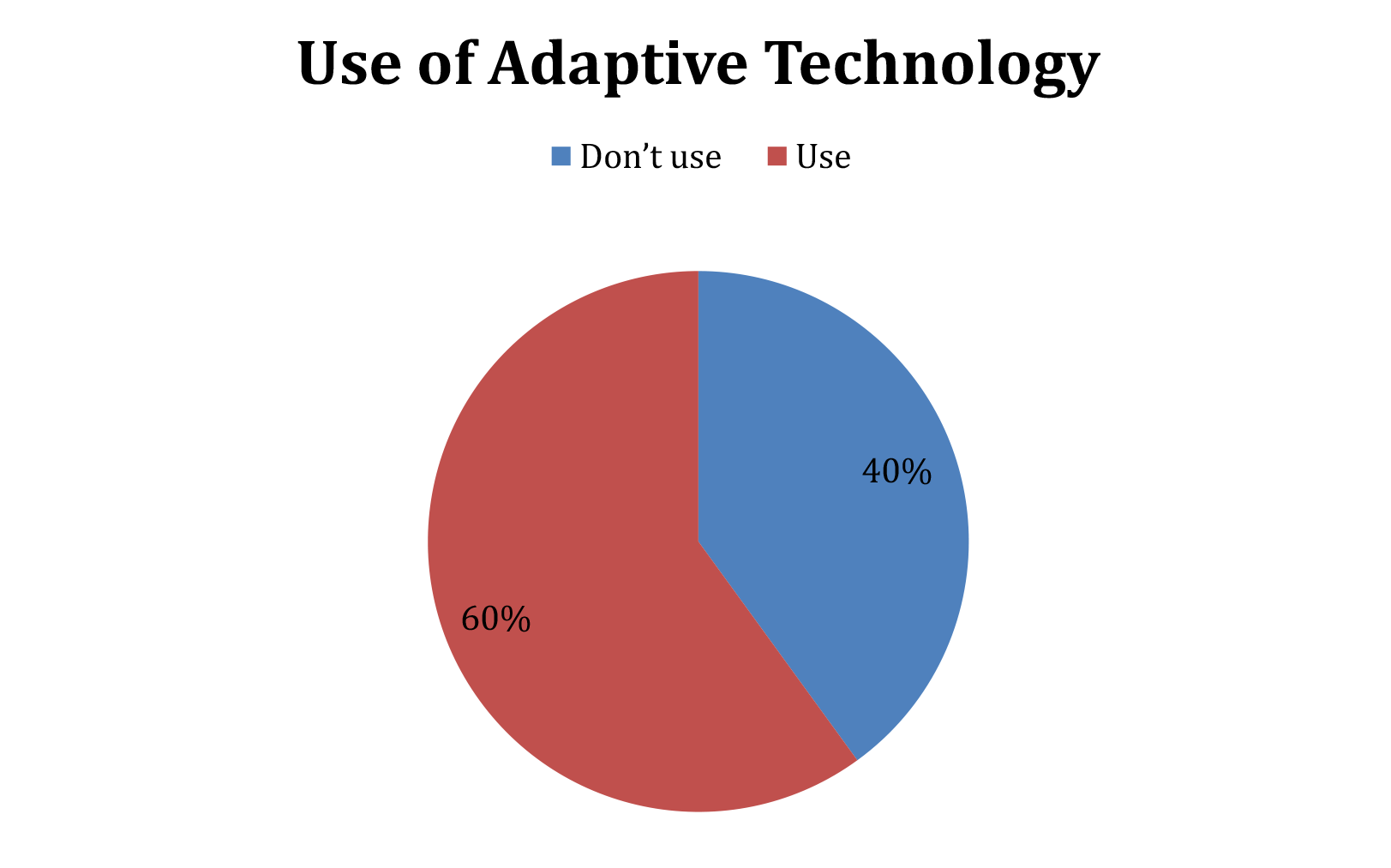
Six participant teachers use adaptive teaching although they face number of difficulties because they have found adaptive teaching is very useful for them and effective in their classrooms. Moreover, it aids them to help weak students or low achievers by involving and including disadvantaged students. According to the participants, adaptive teaching helps them to focus more on “students needs” (participants one, three, seven and nine) and “understand their level” (participants five, seven, eight and nine). They believe that it “involves, includes and engages” (participants one, three, five, seven, eight and nine) the students in the process of learning. Furthermore, the classroom becomes learning oriented. However, four participant teachers (participant teacher two, four, six and ten) have said that they do not use adaptive teaching since they do not have any idea about it.
The analysis of the second question reveals that the participant teachers face a number of difficulties and challenges in implementing adaptive teaching in their classrooms. They are related to classroom teaching, infrastructure, teaching and learning contexts and the nature of administration. The following are the difficulties and challenges that the participants face in using adaptive teaching in their classrooms.
1. Lack of Knowledge and Skills
One of the challenges that the teachers face in implementing adaptive teaching is lack of knowledge about the concept adaptive teaching and learning. Some of the participant teachers do not have a clear idea about it. For example participant teacher two, four, six and ten said that the concept was new to them. Participant four wrote “I had to surf the internet to know the concept.” and participant ten said “it is the first time I have heard the term.”
Another problem that they face is lack of appropriate skills in implementing adaptive teaching techniques like “need analysis, analyzing assessment data, giving feedback, doing formative assessment and scaffolding” (Participants two, six and ten). Participant nine wrote, “Students needs are rarely identified as we are not good at data analyzing.” In short, the participants do not have necessary knowledge and required skills for adaptive teaching.
2. Confusion
Most of the teachers are confused between adaptive teaching and differentiated teaching. They think that both teaching techniques are the same and can use them interchangeably. To demonstrate participants one, three, five, seven and eight said that they “give different tasks for different groups and do one-to-one teaching.” Since there is confusion about the concept, the participants are not able to use adaptive teaching techniques and strategies in their classroom effectively.
3. Large Class
The participant teachers have found that it is not possible to use adaptive teaching in their classroom since the size of the classroom is very large and most of the classes have more than 60 students. For instance, participant teacher six wrote that “I want to try new methods and techniques in my teaching, but the size of the class is a big hurdle. How can I pay attention to individual students’ needs in a class of sixty or seventy?”
4. Syllabus Constraints
All the participants have pointed out that syllabus is one of the biggest hurdles that they have had in implementing adaptive teaching. They have to cover overloaded syllabus within a short period of time as the higher education follows semester system. They have also said that their main concern is to “cover syllabus” and they are pressed with “short of time” since they have to teach more topics within “a short time of three months.” To illustrate, according to participant nine:
Our main concern now is to complete the syllabus within the stipulated time and our focus is on finishing the syllabus before the exam starts. We do not have enough time to finish the crowded syllabus. Therefore, we just run to finish it before the commencement of the exam.
Participant seven wrote “Content in the syllabus is overloaded, so it is not possible for me to think any other idea in my class.” Participant eight expressed “since providing personalized teaching to each student is time consuming, I cannot always do adaptive teaching.”
5. Infra Structure
Inflexible and inadequate infrastructure prevents teachers from implementing adaptive teaching and learning in their classroom. Most of the classrooms have got minimum basic facilities like long benches and desks, projectors and blackboard. Moreover, most of the projectors are not working properly due to poor maintenance. Insufficient computers, laptops and other technological tools in the classrooms are another difficulty that the teachers have had. For example, participant teacher three asked, “How can you expect any innovation in a class where you cannot find any modern technology?” Participant one viewed, “we cannot think of adaptive teaching since we do not have even a good working projector in our classrooms.”
6. Technology
Limited technological resources in higher educational institutions hinder the implementation of technology-based adaptive teaching strategies. According to participant five, “there are no technological support, tools and facilities for using adaptive teaching systems and adaptive learning systems.” Participant six argued, “incorporating adaptive learning technologies can further personalize the learning experience and make the teaching more adaptive. Unfortunately, there are no such technologies available in our classrooms.” Participant ten thought, “technology facilitates adaptive teaching and tools like learning management systems provide personalized learning experience to our learners, which are not affordable and unavailable to our students.” Furthermore, teachers’ lack of knowledge and skills in using technology is another reason why they cannot use adaptive teaching for their students. To demonstrate, some of the participants felt that they were not technologically skilled in using adaptive teaching technology for their learners as participant six wrote, “I am not a techno-friendly and I always get help from others. So I cannot deal with advanced technology like adaptive teaching technology.” Participant nine expressed, “My technological knowledge is very basic like internet browsing, using Word and PowerPoint presentation, but adaptive teaching technology requires more than this.” Lack of technological skills often prevents the teachers from using adaptive teaching.
7. Classroom Management
Participant teachers have felt that disciplinary problems are another reason that hinders implementing adaptive teaching for their students. According to them, whenever they try to focus on individual learners, the class becomes noisy and disturbs the adjoining classes. Therefore, they teach the class as a whole so that there will not be any disturbance. For example, participant two wrote:
Once I was trying to use adaptive teaching techniques like scaffolding with a student who struggled to express his own idea, some students started talking to each other, some others started giggling and a few imitated me which caused chaos in the class. I had to take control of the class, so I just abruptly stopped and continued teaching the class as a whole.
Classroom management issues become a difficult task for teachers to deal with in a large class.
8. Teacher Centered Classroom
According to the participants, adaptive teaching occurs only in a learner-centered classroom and they point out that their classrooms are teacher-fronted or teacher-centered where all the decisions are made by teachers and the learners are less active. To illustrate, “I think adaptive teaching can take place in a classroom where students take some responsibility in their learning, but our students always look for teachers’ help and they want their teachers to make decisions for them” (participant one).
9. Assessment
The type of assessment determines adaptive teaching as it requires formative assessment. However, summative assessment is still being used in colleges. Systematic formative assessment is one of the prerequisites for adaptive teaching as it provides evidence for the students’ level, needs and improvement which help teachers to tailor their teaching suitable to each individual student. To illustrate, participant three said, “The students are evaluated based on end-of-the-semester exams and internal exams and both of them are written exams.” Participants have felt that written exams test their volume of knowledge but do not indicate their level, issues or gaps, as participant seven wrote, “Exams, both end-of-semester and internal exams, just test whether they have learned a particular piece of knowledge or not.” Participant five viewed, “There is a unified end-of-exam for all students.”
10. No Proper Teacher Training
In order to implement adaptive teaching, teachers must be equipped with skills that are necessary to use technology effectively. However, most of the teachers lack such technological skills. The participants felt that there should be systematic orientation programs and regular in-service training programs that train teachers in using technology and adaptive teaching techniques. Participants have said that there are no teacher training programs in adaptive teaching, training in computer skills, or even a “workshop on new technology” (participant five).
11. Administrative Indifference
According to the participants, administrative indifference to innovations in the classroom is another challenge that the teachers face in implementing adaptive teaching in their classrooms. For example, participant four wrote, “We do not get support from the administration. They showed deaf ears to our repeated request for upgrading our computers and providing new technological tools.” Participant ten said, “They don’t provide enough furniture for students, just forget about new technological tools.” Participant seven pointed out, “The administration neither supports us nor encourages us, so we feel dejected.” Consequently, the teachers are not ready to take risks.
Managerial Implications of the Study
The study suggests some practical considerations that need to be taken at different levels of the higher education system in India. There should be regular and systematic need analysis of learners so that teachers understand their students’ needs, levels, and expectations. The size of the classroom should be reduced in order to provide individual attention, which is a prerequisite for adaptive teaching. Basic needs like movable furniture, projectors, and other necessary technological devices need to be provided. Furthermore, the syllabus should be minimized and the examination pattern needs to be revolutionized. In other words, continuous assessment should replace traditional internal written examinations. Above all, teachers should be trained in using adaptive teaching.
Limitation
The result cannot be generalized to other learning environments since it is a qualitative study and the result is context-specific. To put it another way, this study is limited to the context in which it was conducted. Furthermore, different contexts and participants may produce different results as opinions and experiences vary from one context to another and from one person to another.
Recommendations
A quantitative study is preferred since the data can be generalized. A mixed-method study would provide more comprehensive results as it includes both qualitative and quantitative data. A study conducted in different learning contexts with a variety of participants is also recommended. Above all, teachers should be given orientation in adaptive teaching and intensive training in using adaptive teaching techniques.
Conclusion
A classroom is not a unified entity but a learning environment where learners with mixed abilities come together to achieve their common goal of successful learning. Adaptive teaching has significant relevance in such a classroom. This qualitative study investigated the challenges and difficulties that college lecturers face in implementing adaptive teaching. It found that they encounter numerous challenges, including lack of knowledge and skills, confusion about the concept, inadequate technological knowledge and skills, insufficient infrastructure, large class sizes, overloaded syllabus, disciplinary problems, administrative indifference, and lack of proper training in adaptive teaching technology.
References
Allen, M. H., Matthews, C. E., & Parsons, S. A. (2013). A second-grade teacher’s adaptive teaching during an integrated science-literacy unit. Teaching and Teacher Education, 35, 114–125.
Borich, G. (2011). Effective teaching methods. London: Pearson.
Brühwiler, C. & Vogt, F. (2020). Adaptive teaching competency: Effects on quality of instruction and learning outcomes. Journal for Educational Research Online, Volume 12 (2020), No. 1, 119–142. Retrieved from https://www.pedocs.de/volltexte/2020/19121/pdf/JERO_2020_1_Bruehwiler_Vogt_Adaptive_teaching_competency.pdf
Braun, V., & Clarke, V. (2006). Using thematic analysis in psychology. Qualitative Research in Psychology, 3(2), 77–101.
Creswell, J. W. (2003). Research Design: Qualitative, Quantitative, and Mixed Methods Approaches (2nd ed.). Thousand Oaks, California: Sage Publications.
Croker, R. A. (2009). An Introduction to Qualitative Research. In J. Heigham & R. A. Croker (Eds.), Qualitative Research in Applied Linguistics: A Practical Introduction (pp. 3–24). Hampshire: Palgrave Macmillan.
Department for Education. (2021). ITT Core Content Framework. Retrieved December 15, 2021, from https://assets.publishing.service.gov.uk/government/uploads/system/uploads/attachment_data/file/974307/ITT_core_content_framework_.pdf
Dziuban, C. D., Moskal, P. D., Cassisi, J., & Fawcett, A. (2016). Adaptive learning in psychology: 0.12 2Zway finding in the digital age. Online Learning, 20(3), 74–96.
Goodman, B. E., Barker, M. K., & Cooke, J. E. (2018). Best practices in active and student-centered learning in physiology classes. AJP Advances in Physiological Education, 42(3), 417–423.
Hardy, I., Decristan, J., & Klieme, E. (2019). Adaptive teaching in research on learning and instruction. Journal for Educational Research Online, 11(2), 169–191. https://doi.org/10.25656/01:18004
Hattie, J., & Timperley, H. (2007). The Power of Feedback. Review of Educational Research, 77(1), 81–112. https://doi.org/10.3102/003465430298487.
King, N. (2004). Using templates in the thematic analysis of text. In C. Cassell & G. Symon (Eds.), Essential Guide to Qualitative Methods in Organizational Research (pp. 257–270). London, UK: Sage.
Miles, M. B., & Huberman, A. M. (1994). Qualitative Data Analysis: A Sourcebook of New Methods (2nd ed.). Newbury Park, California: Sage Publications.
Parsons, S. A. (2012). Adaptive Teaching in Literacy Instruction: Case Studies of Two Teachers. Journal of Literacy Research, 44(2), 149–170. Retrieved December 10 from https://journals.sagepub.com/doi/full/10.1177/1086296X12440261.
Pintrich, P. R., & Zusho, A. (2007). Student motivation and self-regulated learning in the college classroom. In R. P. Perry & J. C. Smart, The Scholarship of Teaching and Learning in Higher Education: An Evidence-Based Perspective. Dordrecht: Springer.
Punch, K. F. (2009). Introduction to Research Methods in Education. California: Sage.
Rice, P., & Ezzy, D. (1999). Qualitative Research Methods: A Health Focus. Melbourne: Oxford University Press.
Sadler, D. R. (1989). Formative assessment and the design of instructional systems. Instructional Science, 18(2), 119–144.
Wang, S. et al. (2020). When adaptive learning is effective learning: Comparison of an adaptive learning system to teacher-led instruction. Interactive Learning Environments. https://doi.org/10.1080/10494820.2020.1808794. Retrieved November 12 from https://www.researchgate.net/publication/344010541_When_adaptive_learning_is_effective_learning_comparison_of_an_adaptive_learning_system_to_teacher-led_instruction.
Wellington, J. (2000). Educational Research: Contemporary Issues and Practical Approaches. London: Continuum.
Wood, D., Bruner, J. S., & Ross, G. (1976). The role of tutoring in problem solving. Journal of Child Psychology and Psychiatry, 17(2), 89–100.