







Madhavi Kilaru
Department of Humanities & Science
VNR Vignana Jyothi Institute of Engineering & Technology
Hyderabad-500090, Telangana, India
Bandla Prathyusha
Department of Humanities & Science
VNR Vignana Jyothi Institute of Engineering & Technology
Hyderabad-500090, Telangana, India
Abstract:
With the rapid growth of e-commerce and online shopping, it is crucial to understand consumer perceptions; hence, the researcher aims to study the perceived risks and benefits of online shopping by Indian consumers. In order to transform themselves from fierce competition, marketers need to adopt the right strategies to provide superior service to satisfy consumer needs and ultimately create consumers perceived value. The benefits of online shopping come with potential risks that the consumer should always be aware of. One of the biggest challenges for online retailers is attracting profitable customers. For the present study, the researcher collected the opinions of 528 consumers who are aware of online shopping. For checking internal consistency and validity, Cronbach’s alpha test is used. The collected data is analyzed and summarized using Excel and SPSS. For collecting data, a structured questionnaire was administered, which included perceptions of various risks and benefits associated with online shopping. It also includes a number of factors that motivate individuals towards online shopping. After conducting statistical analysis to identify that the more risks associated with online shopping are security, product quality, and privacy, at the same time, the perceptions towards benefits from online shopping are product variety, time, and cost savings, and home delivery which determine the importance of consumer perceptions towards online shopping. The research findings offer that, after a comprehensive understanding of the risks and benefits
of online shopping, retailers must focus on developing more innovative strategies in terms of developing web portals, maintaining privacy, and maintaining product quality. Definitely, online marketers generate more revenues for the firm. Key words: Benefits, Consumer satisfaction, Demographic factors, Online shopping, Risks.
1. Introduction
In the twenty-first century, e-commerce has become the fastest communication technology. Business has been so diversified that it should be multifaceted, and online shopping has increased significantly throughout the world (Sharma, G., & Lijuan W., 2014). Personalization is becoming more and more important in digital marketing (Kushwaha, B.P., 2020), but it can be hard for many companies, and they have no option but to use data-driven insights to tailor customer shopping experiences by identifying their needs and preferences (Erevelles et al., 2016). Digital marketing uses big data analytics to personalize the context of every prospect and use signals from online marketers to accurately segment visitors for the destination (Wedel M. et al., 2016). The number of online consumers is increasing day by day, and the popularity of online shopping has risen (Lohse et al., 2000). In modern society, people are tied up with a busy work schedule and have a nuclear family; they don’t have time to go shopping physically, so the importance of online shopping has increased (Bruke, R.R., 1997). Online retailers are also creating greater facilities like proliferating innovative products with a moderate price, convenience to order the product, quick access to product information, flexible payment options, attractive web portals, etc. (Rao B., 1997). People don’t need to stand in large queues to make the payment for their products, and they can also easily shop from their homes (Womack, J. P., & Jones, D. T. 2015). Online shopping also allows customers to access new information about products and compare prices with offers available; in turn, it may reduce the costs of products and services in order to retain and make them loyal (Grewal et al., 2003). At the same time, many customers are facing challenges with online shopping related to internet privacy and security (Ziegeldorf et al., 2014).
Literature review
2.
identified the factors that influence Malaysian customers’s online Vegiayan et al. (2013) shopping satisfaction. The study used a quantitative approach. Data was collected through an online survey by using “e-survey creator” online survey service providers, and the hypothesis was that purchase quality has the highest relationship as well as the highest influence on the customer’s satisfaction.
M. Rajesh and G. Purushothaman (2013) researched e-shopping, which became more popular for convenience and often lower prices. Online shopping saves an individual the hassle of searching several stores and then waiting in long lines to buy a certain item. The Internet changed the way consumers shop and buy goods and services and has quickly evolved into a global phenomenon. Numerous companies have started using the Internet with the purpose of cutting marketing costs, thereby minimizing the price of their products and services in order to face competition. In addition to the tremendous potential of the e-commerce market, the Internet provides a distinctive opportunity for companies to more efficiently reach existing and potential customers.
Khanh and Gim (2014) revealed in their research work on the factors affecting the online shopping behavior of consumers that this might be one of the most important issues in the e- commerce and marketing fields. Conceptual models for online shopping behaviour were used as a basis to collect data from 238 participants using a survey questionnaire in Vietnam. The study found that perceived economic benefits, perceived merchandise, perceived ease of use, perceived risk with products or service transactions, perceived benefits, and perceived risk in the context of online transactions affect consumer behaviour in online shopping.
According to Kothari and Maindargi (2016) , respondents in their research study prefer online shopping due to various motives like less price or price discount, time savings, availability of a variety of sites, easy purchase method, user-friendly websites, etc.
Rajarajan and Vetriveeran (2016), in their study, analysed the customer satisfaction level in online marketing. The study was conducted among two hundred and fifty respondents, and it found that the majority of the respondents preferred to use online shopping portals for buying goods and services. It was suggested that, due to the increasing importance of online shopping,
e-merchants should protect consumers by supplying quality goods and services at an affordable price.
Bhatti et al. (2020), in their study, observed that there is some influence of the Corona virus on the whole online business in the world. The nature of business changed due to this pandemic. According to their study, more than 50% of shoppers avoid going to offline shopping and crowded places.
Kushboo Jain (2020) A “Study of Consumer Buying Behaviour Towards Online Shopping in Selected Major Cities of India” identified the key factors that influence online buying behaviour and found that the internet has become an integral part of everyone’s life as it’s not limited to emails, knowledge, or communication. The Internet has given people the ability to do things they never thought possible. People are increasingly going online for social networking. There are millions of websites that connect people at will and have an influence on buying behaviour. Social networking keeps people engaged for a longer period of time. In India too, social network penetration is moving upward in exponential proportions. Facebook and YouTube are becoming the leading social networking platforms, followed by WhatsApp Messenger and Instagram.
2.1 Conceptual Framework
To frame hypothesis in the study of perceived risks and benefits of online shopping, the conceptual framework is presented below:
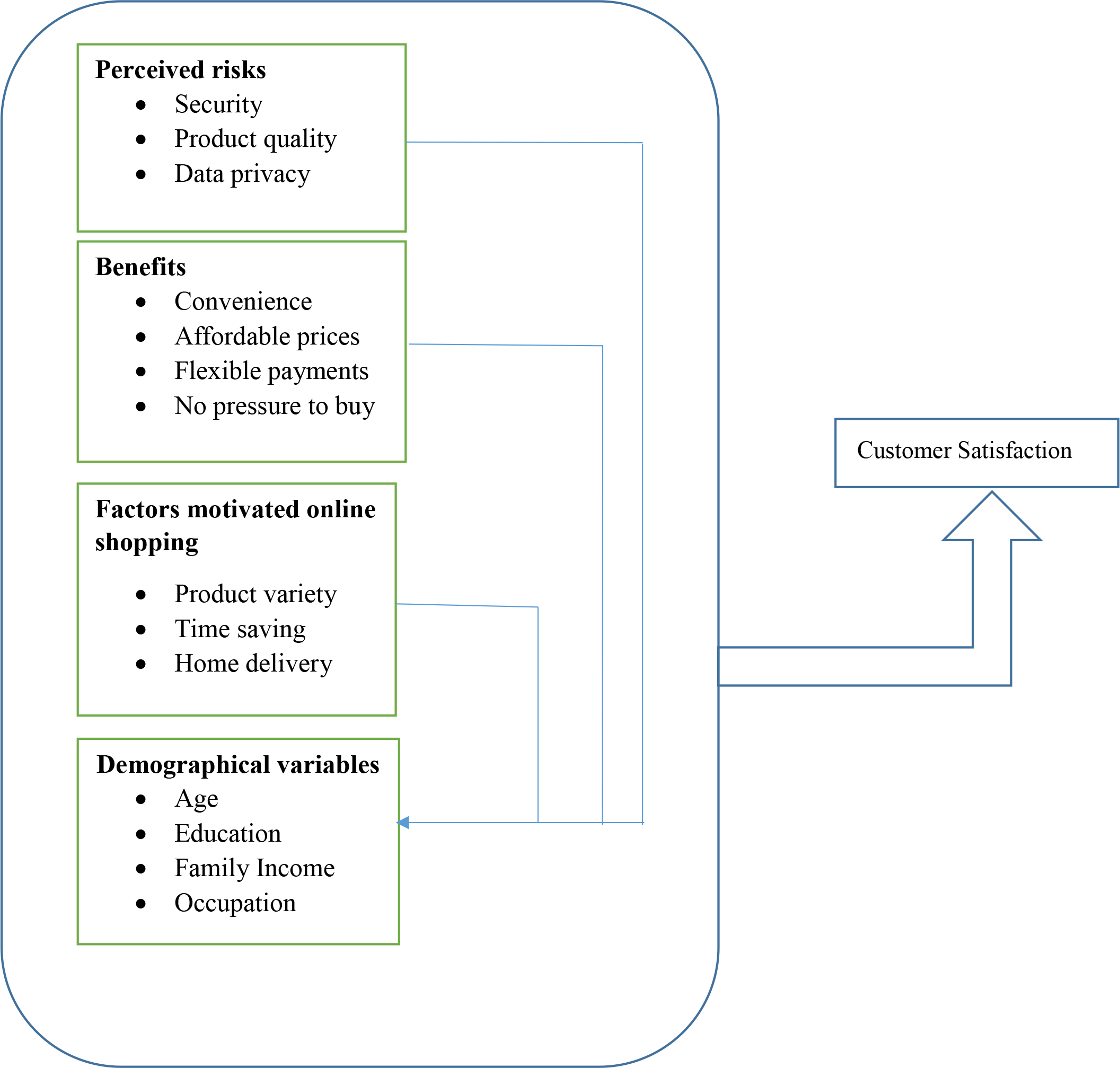
Here, the dependent variables are perceived risks and benefits, whereas customer satisfaction is an independent variable, and those factors that motivate people to shop online are acted upon as moderate variables.
The researchers have chosen the following list of hypotheses based on the extensive discussion and study the conceptual framework: H1 : There is a significant association between demographical variables and consumer opinions on the risks of online shopping. H2: There is a significant association between demographical variables and consumer opinions on the benefits of online shopping. H3: There is a significant association between demographical variables and factors motivating online shopping.
H3a: There is a significant association between demographical variables and variety of
products. H3b: There is a significant association between demographical variables and time saving. H3c: There is a significant association between demographical variables and home delivery. H4: There is a significant association between demographical variables and consumer satisfaction with online shopping
3. Methodology
The present research is a descriptive cross sectional study. A five part self-administered and well-structured questionnaire was distributed and collected data from 528 respondents by using stratified random sampling. The five part questionnaire covered the demographic profile of the respondents in part one, and the remaining parts two, three, and four inquired about the risks, benefits, and factors motivating online shopping. Finally, in the fifth part, the researchers attempted to identify the factors that lead to online customer satisfaction. The Cronbach’s alpha was used to check the internal consistency and validity of the questionnaire. The collected data was formulated and evaluated statistically, applying the Chi-square test, correlation, and regression. Predominately, by managing the comprehensive collected data with Microsoft Excel, the researchers completed the cleaning process partially before carrying the data into the different statistical tools. Along with the questionnaire, the researchers conducted personal interviews with online shoppers to find out the risks and benefits, consumer satisfaction, and other important factors (variety of products, time savings, home delivery) that would motivate them to shop online.
Chronbach’s Alpha
Table3.1: Results
Dimension Cronbach’s Alpha No of Items Risks of online shopping .931 10 Benefits of online shopping .941 10 Factors motivating online shopping (variety of .906 10 products, time savings, home delivery) Consumer satisfaction on online Shopping .955 11 The alpha values for the above variables—risks, benefits, factors motivating and consumer satisfaction with online shopping—are 0.931, 0.941, 0.906, and 0.955, respectively. These values are very reliable and greater than 0.7, which indicates very strong internal consistency among the given item
4. Results
By applying chi-square test for risks of online shopping with demographic variables the following results are obtained.
Relationship between family income and the risks of online shopping
H0: There is no significant association between Family income and risks of online shopping Value Approximate Sig. Table: 4.1 Nominal by Nominal Phi 0.274 0.001 Cramer’V .139 0.001 Contingency Coefficient .263 0.001 N of Valid cases 528 There is a significant association between income and risks of online shopping.
Relationship between occupation and the risks of online shopping
H0: There is no significant association between occupation and risks of online shopping Value Approximate Sig. Table: 4.2 Nominal by Nominal Phi 0.306 0.00 Cramer’V .151 0.00 Contingency Coefficient .290 0.00 N of Valid cases 528 There is a significant association between occupation and risks of online shopping
Relationship between education and the risks of online shopping
H0: There is no significant association between education and risks of online shopping Value Approximate Sig. Table: 4.3 Nominal by Nominal Phi 0.225 0.04 Cramer’V .113 0.04 Contingency Coefficient .218 0.04 N of Valid cases 528 The opinions on risks of online shopping is dependent on education.
Relationship between age and the risks of online shopping
H0: There is no significant association between age and risks of online shopping Value Approximate Sig. Table: 4.4 Nominal by Nominal Phi 0.242 .014 Cramer’V .122 .014 Contingency Coefficient .245 .014 N of Valid cases 528 The opinions on risks of online shopping is dependent on age. By applying the chi-square test for the benefits of online shopping with demographic variables, the following results are obtained:
Relationship between family income and the benefits of online shopping
H0: There is no significant association between family income and benefits of online shopping Table: 4.5 Value Approximate Sig. Nominal by Nominal Phi .307 .00 Cramer’V .152 .00 Contingency Coefficient .294 .00 N of Valid cases 528 . It shows that opinions on benefits of online shopping is dependent on family income
Relationship between occupation and benefits of online shopping
H0: There is no significant association between occupation and their opinions on benefits of online shopping. Table 4.6: Chi-Square Tests Value df Asymptotic sig(2 sided Pearson chi square 66.12 20 0.00 There is a significant association between occupation and their opinions on benefits of online shopping. So, opinions on benefits of online shopping is dependent on occupation.
Table 4.7:Symmetric Measures Value Approximate Sig. Nominal by Nominal Phi .354 0.00 Cramer’V .167 0.00 Contingency Coefficient .331 0.00 N of Valid cases 528
Relationship between education and benefits of online shopping
H0: There is no significant association between education and their opinions on benefits of online shopping Table 4.8:Chi-Square Tests Value df Asymptotic sig(2 sided Pearson chi square 29.87 16 0.019 It means that opinions on benefits of online shopping is dependent on education.
Table 4.9:Symmetric Measures Value Approximate Sig. Nominal by Nominal Phi 0.247 0.019 Cramer’V .117 0.019 Contingency Coefficient .230 0.019 N of Valid cases 528
Relationship between age group and benefits of online shopping
H0: There is no significant association between age and benefits of online shopping Value Approximate Sig. Table:4.10 Nominal by Nominal Phi 323 0.00 Cramer’V .162 0.00 Contingency Coefficient .308 0.00 N of Valid cases 528
Relationship between family income and factors motivated (variety of products, time
saving and home delivery) to online shopping
H0: There is no significant association between family income and their opinions on factors motivated towards online shopping Table 4.11:Chi-Square Tests Value df Asymptotic sig(2 sided Pearson chi square 45.0 16 0.00 It means that opinions on factors motivated to online shopping is dependent on family income. Table 4.12:Symmetric Measures Value Approximate Sig. Nominal by Nominal Phi 0.28 0.00 Cramer’V .146 0.00 Contingency Coefficient .281 0.00 N of Valid cases 528
Relationship between occupation and factors motivated (variety of products, time saving
and home delivery) to online shopping
H0: There is no significant association between occupation and their opinions on factors motivated to online shopping Table 4.13:Chi-Square Tests Value df Asymptotic sig(2 sided Pearson chi square 52.5 20 0.00 It shows that opinions on factors motivated to online shopping is dependent on occupation.
Table 4.14:Symmetric Measures Value Approximate Sig. Nominal by Nominal Phi 0.31 0.00 Cramer’V .148 0.00 Contingency Coefficient .310 0.00 N of valid cases 528
Relationship between education and factors motivated (variety of products, time saving
and home delivery) to online Shopping
H0: There is no significant association between education and factors motivated to online shopping Table 4.15:Chi-Square Tests Value df Asymptotic sig(2 sided Pearson chi square 23.2 16 0.10 It shows that factors motivating online shopping are independent of education .
Relationship between age group and factors motivated (variety of products, time saving
and home delivery) to online shopping
H0: There is no significant association between age group and their opinions on factors motivated to online shopping Table4.16:Chi-Square Tests Value df Asymptotic sig(2 sided Pearson chi square 67.7 16 0.0 It means that opinions on factors motivated to online shopping is dependent on age group.
Table 4.17:Symmetric Measures Value Approximate Sig. Nominal by Nominal Phi .346 0.00 Cramer’V .169 0.00 Contingency Coefficient .326 0.00 N of Valid cases 528
Relationship between family income and consumer satisfaction on online shopping
H0: There is no significant association between family income and their opinions on consumer satisfaction on online shopping. Table 4.18:Chi-Square Tests Value df Asymptotic sig(2 sided Pearson chi square 69.6 16 0.00 It shows that opinions on consumer satisfaction on online shopping is dependent on family income. Table 4.19:Symmetric Measures Value Approximate Sig. Nominal by Nominal Phi 0.36 0.00 Cramer’V .182 0.00 Contingency Coefficient .341 0.00 N of Valid cases 528
Relationship between occupation and consumer satisfaction on online shopping
H0: There is no significant association between occupation and their opinions on consumer satisfaction on online shopping
Table:4.20 Chi-Square Tests Value df Asymptotic sig(2 sided Pearson chi square 65.0 20 0.00 It shows that opinions on consumer satisfaction with online shopping are dependent on occupation. Table:4.21 Symmetric Measures Value Approximate Sig. Nominal by Nominal Phi 0.350 0.00 Cramer’V .175 0.00 Contingency Coefficient .330 0.00 N of Valid cases 528
Relationship between education and consumer satisfaction on online shopping
H0: There is no significant association between education and their opinions on consumer satisfaction on online shopping Table:4.22 Chi-Square Tests Value df Asymptotic sig(2 sided Pearson chi square 22.9 16 0.11 Hence we can say that opinions on consumer satisfaction on online shopping is independent on education.
Relationship between age group and consumer satisfaction on online shopping
H0: There is no significant association between age group and their opinions on consumer satisfaction on online shopping
Table:4.23 Chi-Square Tests Value df Asymptotic sig(2 sided Pearson chi square 89.77 16 0.00 It means that there is a significant association between age group and their opinions on consumer satisfaction on online shopping.
Table 4.24:Symmetric Measures Value Approximate Sig. Nominal by Nominal Phi 0.412 0.00 Cramer’V .205 0.00 Contingency Coefficient .380 0.00 N of Valid cases 528
The chi-square test for association between family income and consumers opinions on risks, benefits, factors motivated to online shopping (variety of products, time saving, and home delivery), and consumer satisfaction with online shopping revealed that there is a significant association between them. At the same time, for occupation, the chi-square test sig value 0.00 level of significance is less than 0.05. So occupation has influenced the factors of risks, benefits, motivation, and customer satisfaction in online shopping. Whereas the chi-square test for association between education and risks, benefits, factors motivated, and customer satisfaction with online shopping revealed that these are independent of education. Age has a
strong influence on factors like risks, benefits, factors motivated towards, and consumer satisfaction with online shopping.
Regression analysis
Table:4.25 Model Summary Std. Error of the Model R R Square Adjusted R Square Estimate 1 .727 .528 .523 .7678 a. Predictors: (Constant), benefits , risks , factors motivated towards( variety of products,
time saving and home delivery) online shopping
Table4.26 :ANOVA -Regression analysis Model Sum of Squares df Mean Square F Sig. 1 Regression 344.04 5 68.80 116.703 .00 Residual 307.774 522 .590 Total 651.816 527 a. Dependent Variable: consumer satisfaction on online shopping b. Predictors: (Constant), Benefits , Risks , factors motivated towards( variety of products,
time saving and home delivery) online shopping
F value is significant as the significant value is less than 0.05 and hence it means dependent variable ( Consumer satisfaction on online shopping ) is more reliable.
Table 4.27: Coefficients Unstandardized Standardized Collinearity coefficients coefficients statistics Std. Model B Error Beta t Sig. Tolerance VIF
1 (Constant) .469 .153 3.059 .002
Risks of online .051 .036 .053 1.417 .157 .648 1.54 shopping Benefits of online .070 .043 .065 1.573 .116 .510 1.96 shopping
Factors motivated .212 .046 .207 4.593 .000 .437 2.23 to online shopping( variety of products, time saving and home delivery) a. Dependent Variable: consumer satisfaction on online shopping
The impact of consumer satisfaction on online shopping was investigated using a regression model. We observed that the standardized beta for factors motivated (β = 0.207, P = 0.00) showed a very strong and significant impact on dependent consumer satisfaction with online shopping. Whereas the standardized beta for risks (β = 0.053; P = 0.157) and benefits (β = 0.065; P = 0.116) shows very little impact on the dependent variable of consumer satisfaction with online shopping. The VIF of all the independent variables is less than 3, which shows that collinearity exists, and hence, these predictors are influencing the dependent variable, customer satisfaction with online shopping.
Correlation Analysis
Consumer satisfaction Risks of Benefits of Factors on online online online motivated to shopping shopping shopping online shopping Consumer Pearson ** ** ** 1 .452 .507 .617 satisfaction on correlation online Sig. (2-tailed) .000 .000 .000 shopping N 528 528 528 528 Risks of Pearson ** ** ** .452 1 .488 .514 online correlation shopping Sig. (2-tailed) .000 .000 .000 N 528 528 528 528 Benefits of Pearson ** ** ** .507 .488 1 .605 online Correlation shopping Sig. (2-tailed) .000 .000 .000 N 528 528 528 528
** ** ** Factors Pearson .412 .527 .730 1 motivated to Correlation(vari online ety of products) shopping Sig. (2-tailed) .000 .000 .000 .000
** ** ** Pearson .526 .628 .570 1 Correlation(Ti me saving) Sig.(2 -tailed) .000 .000 .000 .000 ** ** ** Pearson .678 .538 .670 1 Correlation(Ho me delivery) Sig.(2 -tailed) .000 .000 .000 .000 N 528 528 528 528 From the above correlation analysis, it is clear that consumer satisfaction with online shopping is positively significantly correlated with the risks of online shopping (0.452), the benefits of online shopping (0.507), and there is a positive correlation between customer satisfaction product variety, time savings and home delivery.
Discussion
5.
From the chi-square test, we observed that family income has a strong influence while considering the factors of risks and benefits of online shopping, factors motivated, and satisfaction with online shopping. Hence, marketers need to focus on the range of products so that consumers can easily identify their needs based on their earnings. Education and consumers’ opinions on risks, benefits, factors motivating them, and consumer satisfaction with online shopping have a more significant association between them. Also, we can find that factors motivated by online shopping and customer satisfaction are independent of education. However, to maintain the long-term potential of the e-commerce industry, each firm has to take on the responsibility of generating primary demand through increased awareness and education about online shopping (Saeed, K. et al., 2005). They must use different types of mass media, undertake promotional campaigns, and change consumer attitudes in favour of the industry. Social media is a new way of targeting consumers, as it is a great way of knowing the attitudes
of consumers based on their likes and dislikes. Therefore, it is suggested that online stores make use of social media as an advertising tool for information about products and changes taking place on their sites. From the regression analysis consumer satisfaction on online shopping. We observed that the standardized beta for factors motivated (β = 0.207, P = 0.00) showed a very strong and significant impact on dependent consumer satisfaction with online shopping. Whereas the standardized beta for risks (β = 0.053; P = 0.157) and benefits (β = 0.065; P = 0.116) shows very little impact on the dependent variable of consumer satisfaction with online shopping and hence, there is positive correlation between risks, benefits and factors motivated , customer satisfaction with online shopping. So, online stores have to strengthen their delivery services in rural areas, which in turn will help them expand their business. Sometimes shipping charges or some hidden charges that are not shown at the time of visiting a website may create negative feelings among consumers, and in the future, they may discontinue transactions with the same company. Therefore, online websites have to provide all the necessary information before making an order. Customer reviews regarding the products and brand authorization should be taken into account while buying any product or service. While making payment for an order, it is important to save all the necessary information regarding the order. In cases of fraud, consumers can complain immediately to the cybercrime cell situated in all districts. It is suggested that online retail stores stick to their delivery schedules and display the availability of required products at the time of purchase. Online stores have to be truthful about their advertisements regarding product information and quality. Online stores have to respond quickly to the complaints given by consumers regarding the damage of the products in transit by replacing and taking back the product (Mollenkopf D et al., 2007). Further, it is suggested that online transactions should be safe, and proper security must be assured to consumers making online purchases. E-commerce companies should educate and take measures to protect online buyers from hackers.
6. Conclusions
Online shopping is a relatively new experience and has greatly impacted the lives of Indians in its short time of emergence. With around 70 percent of the Indian population below the age of 35, millennials are expected to drive the e-commerce revolution, and it is expected to grow constantly in the years to come with revolutionary advancements in technology. The online business is a boon to trade, industry, and commerce in India. Consumer perceptions towards
online shopping have improved in India over the past decade. Maximum numbers of consumers felt that online shopping was an easy indulgence and liked to look at a wide variety of products, the lower price of the products, various modes of payment, etc. (Tandon et al., 2018). Most consumers think that the availability of online information about products and services is excellent. Companies can use the web to see online product information, service, and support. It also creates positive interactions with customers that can serve as the foundation for long-term relationships and encourage repeat purchases. The internet is fast enraging as a domain sales channel. The internet is ever-expanding due to the mobile revolution, which is influencing consumer behaviour. Online fraud is an important matter of concern for online shoppers (Ha, H., & Coghill, K. 2008). To handle security and trust concerns, e-commerce companies can offer a free trial period, money-back guarantees, etc. These approaches would help to reduce the fear of buying from a new website. Further association with rating agencies would help to gain trust and acceptance. It has changed the way product awareness is created and developed new modes of product introduction. It also creates new means of purchasing products. This has brought new opportunities, challenges, and threats to both existing and new businesses. With internet penetration improving in the country, smart phones becoming affordable, and life styles becoming hectic, the way people used to shop is changing. Also, with a huge chunk of the young and working population, Indian demographics are a delight for e-commerce retailers (Singh, A. K., & Ajmani, A., 2016). Price, offers, and discounts are among the major criteria for consumers’s preference to buy online. Appropriate offers should be planned and communicated well. Since information search and social media usage are important activities for respondents, search engines and social media are identified as the major factors that prompt them to identify the new website for online shopping. A good shopping experience and value for money become the initial motivation for choosing a shopping destination (Prebensen N et al., 2013). With the rapid advancement of technology, the connectivity of customers to the internet has become very easy. With a lot of benefits in comparison to in-store shopping, customers started purchasing online. Price and offers became the first most important factors in attracting customers to shop online. The customer also seeks convenience in online shopping, which includes shopping at home, saving time, a wide variety, prompt delivery, cash on delivery, money-back guarantees, and customer service. However, the limited number of personal computers and broad band penetration have necessitated the use of mobile phones as the primary means of internet access for many consumers beyond the major cities of India. The
young demographic supported by raising income levels, internet penetration, and smart phone sales are the drivers for the growth of e-commerce in small towns in Andhra Pradesh (Gnanasambandam, C. et al. 2012). Convenience and greater access to a wide range of product offers, price discounts, cash on delivery modes of payment, and money-back guarantees are the triggers of e-commerce adoption.
. Limitations of the Study
The following are the major limitations of the present study:
- It is limited to selected cities in India. Hence, if they had been covered, the inferences drawn
might have been different.
- The researcher has used the convenience sampling technique. Therefore, it is not possible to
make an estimate of sampling error based on the difference between the sample estimate and the population parameter, which is not known both in terms of magnitude and in terms of direction.
- However, the size of the sample was appropriate for the research carried out, but the
larger responses would have built stronger statistics.
- A few respondents did not give their complete personal details, i.e., income, address, and
age. Many showed their disinterest in filling out the questionnaire, stating that they could not spare their valuable time for the same. Some people still do not shop online. A few did not fill out the complete questionnaire.
- As the researcher lacks good experience in conducting research and producing
academic papers of such large size individually, the scope and depth of discussions in the study are compromised at many levels compared to the work of experienced scholars.
- The data and opinion of the consumer collected can be considered only at the time of
data collection. It may vary according to situational changes.
8. Managerial Implications
Findings from the current research provide online retailers with insight to evaluate product range, time and cost savings, and deliver products to customer satisfaction. Based on the recommendations of the prior research, the inclusion of different products, time and cost savings, and home delivery as key customer influencing factors in future studies. This article contributes to existing knowledge on consumers’ online shopping behaviour, thereby revealing and sharing insights into individuals that may be relevant to online marketers in emerging
economies such as India. Also, e-marketers need to pay more attention to product delivery, such as correct order, on time would enhance customer satisfaction.
References:
Sharma, G., & Lijuan, W. (2014). Ethical perspectives on e-commerce: an empirical investigation. Internet Research, 24(4), 414–435.
Kushwaha, B. P. (2020). Personalized digital marketing perspectives and practices in the tourism industry. PalArch’s Journal of Archaeology of Egypt/Egyptology, 17(6), 2029– 2041.
Erevelles, S., Fukawa, N., & Swayne, L. (2016). Big Data, consumer analytics, and the transformation of marketing. Journal of Business Research, 69(2), 897-904.
Wedel, M., & Kannan, P. K. (2016). Marketing analytics for data-rich environments. Journal of Marketing, 80(6), 97–121.
Lohse, G. L., Bellman, S., & Johnson, E. J. (2000). Consumer buying behavior on the Internet: Findings from panel data. Journal of Interactive Marketing, 14(1), 15–29.
Burke, R. R. (1997). Do you see what I see? The future of virtual shopping. Journal of the Academy of Marketing Science, 25(4), 352-360.
Rao, B. (1999). The Internet and the revolution in distribution: a cross-industry examination. Technology in Society, 21(3), 287–306.
Womack, J. P., & Jones, D. T. (2015). Lean solutions: how companies and customers can create value and wealth together. Simon and Schuster.
Grewal, D., Iyer, G. R., Krishnan, R., & Sharma, A. (2003). The Internet and the price- value-loyalty chain. Journal of Business Research, 56(5), 391-398.
Ziegeldorf, J. H., Morchon, O. G., & Wehrle, K. (2014). Privacy on the Internet of Things: threats and challenges. Security and Communication Networks, 7(12), 2728–2742.
Vegiayan, K., Ming, C., & Harun, M. L. (2013). Online shopping and customer satisfaction in Malaysia. International Journal of Marketing Practices, 1(1), 43-51.
Rajesh, M., & Purushothaman, G. (2013). Consumer perception towards online shopping in Kanchipuram. International interdisciplinary research journal, 1(2), 36-44.
Khanh, N. T. V., & Gim, G. (2014). Factors affecting the online shopping behavior: An empirical investigation in Vietnam. International Journal of Engineering Research and Applications, 4(2), 388-392.
Kothari, P. P., Maindargi, S. S., Pritam, K. P., & Shivganga, M. S. (2016). A study on customer’s attitude towards online shopping in India and its impact: With special reference to Solapur City. International Journal of Advance research, Ideas and Innovations in Technology, 2(6), 1-10.
Rajarajan, M., & Vetriveeran, R. (2016). Customer satisfaction toward online marketing- an empirical study. International Journal of World Research, 1, 72-78.
Bhatti, A. S., Wang, G., Ullah, W., Ullah, S., Fiifi Tawia Hagan, D., Kwesi Nooni, I., … & Ullah, I. (2020). Trend in extreme precipitation indices based on long term in situ precipitation records over Pakistan. Water, 12(3), 797.
Jain, K. (2020). Study of Consumer Buying Behaviour towards Online Shopping in Selected Major Cities of India.
Jiang, P., & Rosenbloom, B. (2005). Customer intention to return online: price perception, attribute-level performance, and satisfaction unfolding over time. European Journal of Marketing, 39(1/2), 150–174.
Akar, E., & Topçu, B. (2011). An examination of the factors influencing consumers’ attitudes toward social media marketing. Journal of Internet Commerce, 10(1), 35–67.
Saeed, K. A., Grover, V., & Hwang, Y. (2005). The relationship of e-commerce competence to customer value and firm performance: An empirical investigation. Journal of Management Information Systems, 22(1), 223-256.
King, R. A., Racherla, P., & Bush, V. D. (2014). What we know and don’t know about online word-of-mouth: A review and synthesis of the literature. Journal of Interactive Marketing, 28(3), 167–183.
Mollenkopf, D. A., Rabinovich, E., Laseter, T. M., & Boyer, K. K. (2007). Managing internet product returns: a focus on effective service operations. Decision Sciences, 38(2), 215-250.
Tandon, U., Kiran, R., & Sah, A. N. (2018). The influence of website functionality, drivers, and perceived risk on customer satisfaction in online shopping: an emerging economy case. Information Systems and e-Business Management, 16, 57–91.
Ha, H., & Coghill, K. (2008). Online shoppers in Australia: dealing with problems. International Journal of Consumer Studies, 32(1), 5–17.
Singh, A. K., & Ajmani, A. (2016). Future of B2C e-commerce (buyers perspective) in India: An empirical analysis. Asia-Pacific Journal of Management Research and Innovation, 12(3–4), 203-216.
Prebensen, N. K., Woo, E., Chen, J. S., & Uysal, M. (2013). Motivation and involvement are antecedents of the perceived value of the destination experience. Journal of travel research, 52(2), 253-264.
Gnanasambandam, C., Madgavkar, A., Kaka, N., Manyika, J., Chui, M., Bughin, J., & Gomes, M. (2012). Online and upcoming: The Internet’s impact on India. Bangalore: McKinsey & Company.
PART-A (Demographic Factors)
Name: ________________________
- Gender
a) Male b) Female b) Others
- Age
a) Below 20 b) 21-30 c) 31-40 d) 41-50 e) Above 50
- Area of Residence a) Rural b) Urban
- Educational Qualifications
a) SSC below b) SSC c) Intermediate d) UG e) PG and Above
- Occupation
a) Government Employee b) Private Employee c) Student d) Business e) House hold f) Others
- Marital status
a) Unmarried b) Married
- Family Income (Lakhs/ year) a) 0-5 b) 5-10
c) 10-15 d) 15-20
e) 20 and above
- Size of the family (Number of Persons)
a) 2 b) 3
c) 4 d) 5
d) Above 5
- What are your general buying requirements? a) Home needs b) Children needs c) Special Occasion d) Services e) Shopping items
- Who makes purchase decision in your family?
a) Husband b) Wife
c) Children d) Parents
- Who influence the purchase decisions?
a) Family members b) Friends
c) Neighbors d) Peer group e) others
- What are the payment methods used for online shopping?
a) Debit card b) Credit card
c) Cash on delivery d) internet banking
e) Others
- What is the source of information for online shopping?
a) Digital marketing b) Search Engine
c) Social media d) Newspaper/TV
e) SMS alerts
PART-B
Please put a (√) mark to the appropriate box on the right side of the statement
5. Strongly Agree 4.Agree 3.Neutral 2.Disagree 1. Strongly Disagree
I. Risks of Online shopping
S. No Statements 5 4 3 2 1
1.1 Security 1.2 Quality of products/services 1.3 Data privacy 1.4 Return policy of the product 1.5 Product trial/Fitness 1.6 Post delivery services 1.7 Company own brands 1.8 Order tracking 1.9 Fake apps 1.10 Price comparison is easy
II. Benefits of Online shopping
S. No Statements 5 4 3 2 1
2.1 Convenience 2.2 Affordable prices 2.3 Payment options 2.4 No pressure to buy 2.5 Special sale events 2.6 Verification of product information 2.7 Latest products/brands 2.8 Offers and Discounts 2.9 Authenticity 2.10 Easy refund process
III. Factors motivated to online shopping
Please put a (√) mark to the appropriate box on the right side of the statement
5. Strongly Agree 4.Agree 3.Neutral 2.Disagree 1. Strongly Disagree
S.No Statements 5 4 3 2 1
4.1 Availability of Variety of Products / Services
4.2 Time saving 4.3 Home delivery 4.4 Pleasure / Enjoyment 4.5 Availability of Various payment methods 4.6 Home Delivery Facility 4.7 Possibility of Customization 4.8 Visual search 4.9 Customer reviews 4.10 Free shipping
Consumer Satisfaction on Online Shopping
IV.
5.
Very satisfied 4.Satisfied 3. Neutral 2.Dissatisfied 1 . Very Dissatisfied
S No Statement 5 4 3 2 1
8.1 Prompt delivery of the product 8.2 Online shopping saves time and money 8.3 Price of products are below the price of the traditional market 8.4 Affordable price of products 8.5 Product quality and descriptions match with orders received 8.6 Payment procedure is secured 8.7 Assuring product quality 8.8 After sales services are satisfactory 8.9 Willing to go for repeat online purchase 8.10 Recommended buying online shopping to others (Friends/Relatives/Peers…etc.)