






An Assessment Framework of Impact Factors using Multi-Criteria Decision Making System – A Tourism Case Study of Garhwal Region, India
Adarsh Jaiswal, Mahima S, Munivel S*
Christ (Deemed to be University), Bangalore – 560029, Karnataka
Abstract:
Tourism is one of the growing sectors in India,especially the Garhwal Himalayan region,which contributesto socio, cultural and economic importance. The hills, valleys, and rivers of the place attract tourists all around the world. Despite facing various calamities andclimatic instabilities, it mesmerizes globetrotters. This study proposes a variant of Multi-Criteria Decision-Making Algorithm named TOPSIS which delivers the result of parameter prioritization using various dynamic criteria in different situations. In order to overcome the pitfalls of existing decision-making algorithms, various other methods are probed and compared. Performance analysis proves that the TOPSIS which is a combination of decision making and Machine Learning algorithms. This research work measures the importance of tourist spots and categorizes them under different themes. The result suggests a priority list contains criteria that can be focused on the management plan. Multi-Criteria Decision Making System methodology named “Technique for Order PreferencebySimilaritytoIdealSolution”alsoknownasTOPSIS,isusedtocreatetheprioritylist.Resultantlist says Awareness of Solid Waste management among local communities should be treated as the top priority. Next is identifying the employment source and income of the local community, and the list contains nine selectivecriteriaframedconcerningthetheme oftouristspots.
Keywords: Multi-Criteria Decision MakingSystem, TOPSIS, Uttarakhand, GarhwalHimalayas, Tourism
Introduction
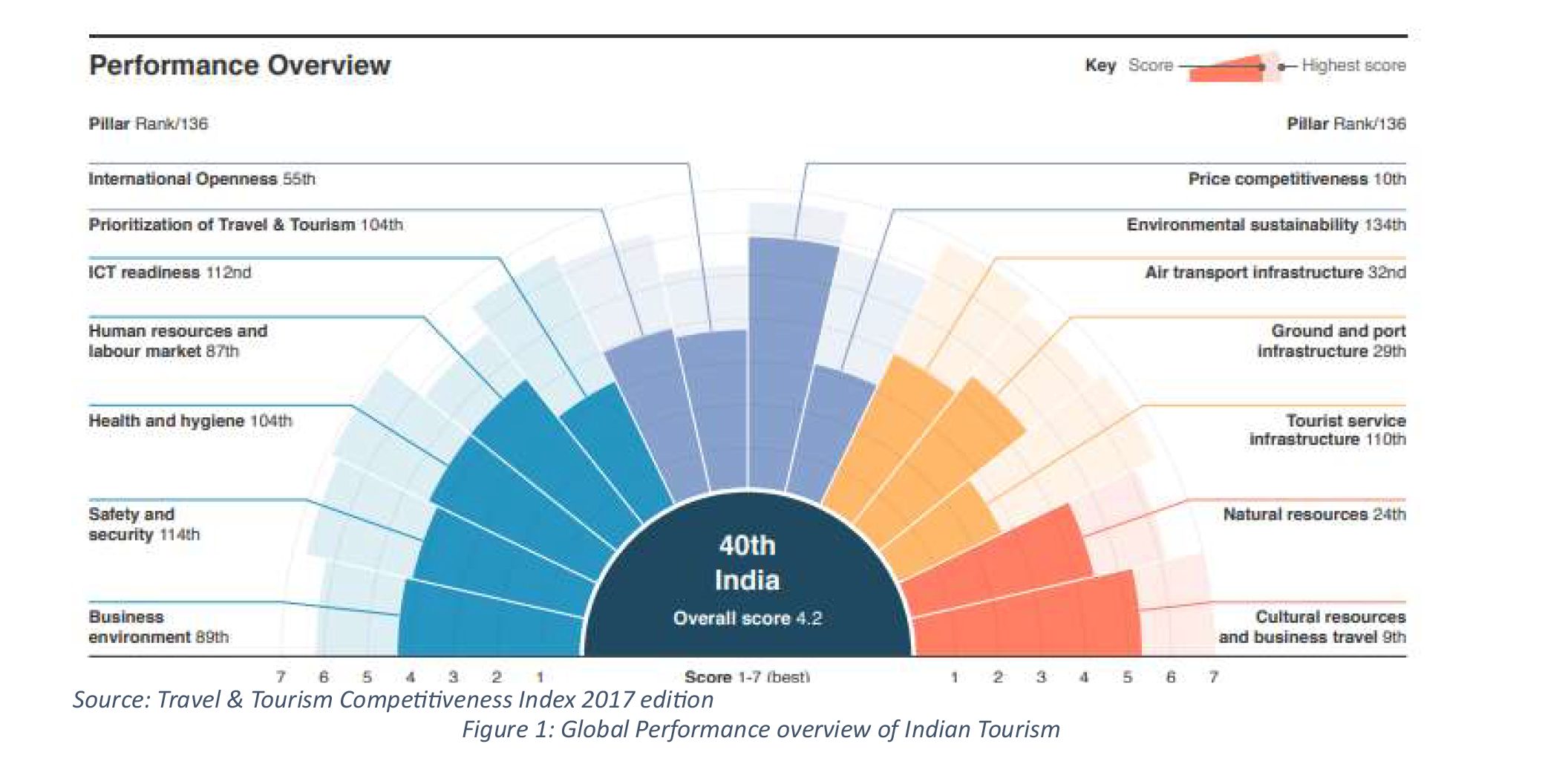
Tourism plays a crucial role in building up a country’s economy by promoting employment opportunities, which pave the way for generating income and foreign exchange earnings. The competitive indexof Traveland Tourism of theyear 2017 ranks India 40 position out of 136 countries th globally as shown in figure 1, with a growing score of 3.86%, which is an escalation of twelve places, whencomparing the 2015 ranking index. India has several socio-economic, cultural sites spread across its vicinity, which attracts more global trotters. This case study is about the Uttarakhand region of India as it has several tourist hubs, and despite various calamities, its cultural importance hasthe capabilityofattractingpilgrims.
Source: Travel & Tourism Compe veness Index 2017 edi on Figure 1: Global Performance overview of Indian Tourism The case study categorizes the theme of tourist spots into five based on guidelines of the Uttarakhand government and literature works (Dhiraj et al., 2017), (Bansal and Amit, 2010). The categories are 1. Adventure sports include Trekking of several mountain regions, 2. The Pilgrimage consists of Kedarnath, Badrinath, etc.,
Sightseeing includes Valley of flowers, Parks, 4. Health consists of the place for rejuvenation, 5. Rural Area tour, Figure 2 shows sub-region of the Uttarakhand stateof India.
Review of Literature
Some pertinent literature works help derive key indicator factors from being focused on forthebetterment oftourism atUttarakhand. (Kala, 2013) discusses the efforts of the Government of Uttarakhand to promote eco- tourism, like establishing Dhanolti eco-park, and suggests an excellent model retain eco-friendly tourism. The author also insists the benefits of established Dhanolti eco-park, such a solution for unemployment, persisted among local communities by providing them income generation strategies from tourists by attracting themforvariousparticipatoryactivitieslikerenting bamboo eco huts for stay, adventure sports facilities, and others, handling deforestation activitiesbyhoteliersand locals. (Pandey et al., 2016) discussed how natural disasters like cloud bursts, debris flow, landslides, and flash floods impact hydrological hazards in
Alakananda Basin, Uttarakhand. The study detailed the causes and consequences of Anthropogenic activities like establishing mining and power projects in rivers valleys. Adapting technical skills to handle the disaster and risk reductionissuggested.
Figure 2: sub-region of the U arakhand state of India (Rana, 2013) The history of flood occurrences in the Himalayan region of the Alakananda basin is described in detail in the literature, starting from 1994 to 2013. Authors commented that the damage increases as the human intervention and ignorance to warning of nature. Flashfloodsthatoccurredin1894and1970 caused more damage tolives. (Sati, 2010) has done a detailed study on livelihood analysis of local communities, primarily based on agriculture, tourism,hydroprojects. (De Lone et. al. 1992) has analyzed from pertinent literature and presented the features of Information systems’ success in six dimensions namely –Quality of the System, Quality of the Information, Usage, Satisfaction of the user, Impact on individual and Impact of Organization. The quality of the system and information has

various metrics such as Convenience of access, Flexibilityofthesystem,Integrationofthesystems, Response time, Ease of learning, Reliability, Resource Utilization and Investment Utilization, stored record error rate. The information quality includes accuracy, precision, currency, timeliness, reliability, completeness, conciseness, format. Relevance to decisions. User satisfaction measure includes use or nonuse of computer-based decision aids, Use of information system to support production, use of numerical and nonnumerical information, Frequency of requests
for specific reports, Voluntariness of use, Extent of use, regularity of use, Hardware satisfaction, software satisfaction and enjoyment. Individual impact includes, user confidence, quality of decisionanalysis,efficientdecisions,Timetoarrive at decision using provided data and system provided by the system, Time taken to complete a task,timetomakepricingdecisions,Interpretation accuracy, Decision quality, forecast accuracy. Though there are six dimensions, all are interrelated components, they can be combined focused on the expected outcome. This detailed study of the authors shared a baseline idea about projectinformationmanagementsystem. (Abbas et. al. 2015) This review article reviews different domains such as such as energy, environment, sustainability, supply chain management, quality management, GIS, construction, project management, safety, risk management, manufacturing, technology management, operations research, strategic management, knowledge management, production management, and tourism where Multi criteria Decision Making Systems like AHP, PROMETHEE, ANP, VIKOR, TOPSIS, DEMATEL, ELECTRE I, II, III are used predominantly. There are hybrid and modular methods combining well- known techniques with fuzzy and grey number theory. Recent methods like COPRAS, ARAS-F, MOORA, MULTIMOORA, SWARA, and WASPAS are rapidly developed and applied to real-life problems. (Chaghooshi et al 2016) The fuzzy hybrid approach effectively addresses the complexity of project manager selection by providing a systematic and accurate decision-making framework.Thestudyhighlightstheimportanceof personal qualities in project manager selection and demonstrates the applicability of the proposed model. Future research could compare this approach with other FMCDM methods like FTOPSIS and FAHP. (Clark et. al. 2000) strongly points out that the software is just assisting components in project management. There are
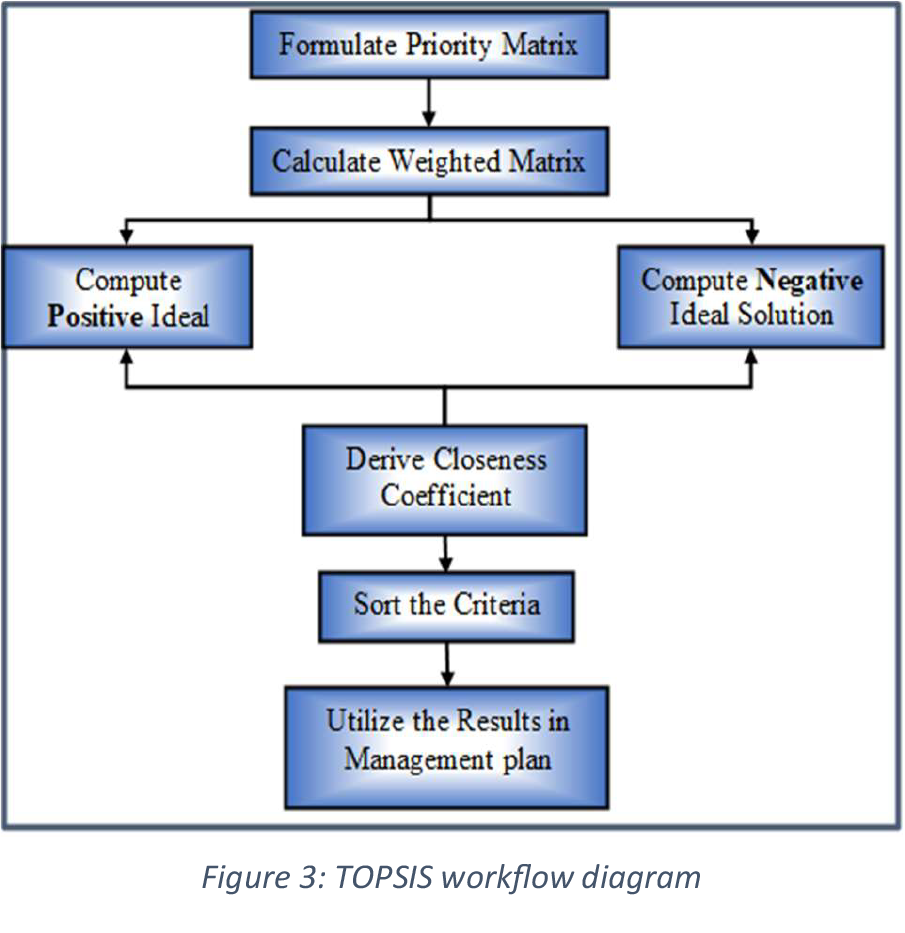
Figure 3: TOPSIS workflow diagram
four dimensions are highlighted ( i. e) Project planning which aligns with the organization’s strategy, Project Portfolio Management which is about managing and prioritizing, Competencies like skills, content expertise, and human performancemanagementandthe lastdimension mentioned is Human Performance Environment, which provides necessary resources, setting clear expectation, effective feedback mechanisms. To deliver a good project, a balanced approach to software tools as well as a well-structured framework isessential. (Bhatt et al. 2018) Employment opportunities created by tourism spot at Garhwal Himalayas is discussed in detail, and potential tourist attraction spots are highlighted opportunities for local communities. (Masiero et al., 2012) Price sensitivity factors are listed concerning specific properties in local communities. Selective impact factors from the literature arechosenforthestudyareasfollows:
Societal Impact (C1), Destination Significance (C2), Economic Impact (C3), Awareness of Solid Waste Management (C4), Infrastructure (C5), Planning and Management (C6), Product Marketing (C7), Knowledge of Renewable Energy (C8), Source of Income and Employment (C9). Societal impact denotes the Socio-Cultural implications of a particular place, e.g., Pilgrimage plays a leading role when comparing trekking and sightseeing categories. Destination Significance represents the importance of the site, and followed by factors are assigned ranks based on statistics department of Tourism,Uttaranchal.
Methodology
Multi-Criteria decision-making system (MCDM) is one of the systematic approaches to make a better decision. There are many MCDM techniques like Analytical Hierarchical Processing, TOPSIS, Min-Max, Fuzzy Intuitionistic algorithm, etc. The study utilizes TOPSIS, which can be expanded as “Technique for Order Preference by Similarity to Ideal Solution” (Triantaphyllou and Chi-Tun1996). The significance of TOPSIS is to rank the given attributes based on given criteria and priority, and it can handle multiple criteria for each feature. Although several decision-making algorithms are available, the ability of TOPSIS to handle numerical priority values makes it outperform. Asaninitialstep,thefactors(C1toC9) are mapped with theme categories (A1 to A5) as stated in the literature review section. This mappingisdonebyassigningpriorityvaluesbased on literature and relevancy between factors and categories. For instance, Product marketing criterion is given high priority and given maximum scorewhenRuralAreatourasproductmarketing is required to befocused at ruralmarkets topromote the attraction of tourists. In this way, all the criteria are mapped meticulously with different categories.Theycanbefound intable 1below. Table 1: Priority matrix A1 A2 A3 A4 A5 A5 C1 3 1 2 3 3 2 C2 4 4 5 5 3 1 C3 3 4 3 2 3 5 C4 4 3 5 5 3 4 C5 4 2 1 3 1 4 C6 2 5 4 3 3 2 C7 3 3 1 4 3 5 C8 2 1 1 1 2 3 C9 4 3 2 3 4 5
The theme categories are Adventure sports (A1) Pilgrimage (A2) Nature (A3) Sightseeing (A4) HealthandRelaxation (A5) Rural Area tour (A5) (d) is In the next step, Weighted normalized matrix created using equation (1); corresponding d elements ( ) are represented with their row (i) and ij column(j).
𝑑 = (1) ∑
i ϵ M and j ϵ N where
Positive Ideal Solution (P ) and Negative Ideal + Solution (P ) are calculated with the help of point – distance measurement formula as stated in equations(2a)and(2b). Thenegativeidealsolution finds the difference between Zero Matrix and Weighted normalized matrix (wd ), whereas + Positive Ideal Solution finds the difference between unit matrix and Weighted normalized matrix(wd ). –
𝑃 = {𝑤𝑑 , 𝑤𝑑 , … 𝑤𝑑 } (2a)
𝑃 = {𝑤𝑑 , 𝑤𝑑 , … 𝑤𝑑 } (2b)
This principle assumes that the matrices are points and plotted in a line graph. The difference between the points and ‘0’ and the difference between ‘1’ and matrix points are calculated and presented as Positive and Negative Ideal Solution. These positive and Negative matrices are used to find the closeness coefficient, which determines the closeness of the values concerning the resultant point. Closeness (CC) or Relative Closeness values Coefficient ranges from‘0’to‘1’.
𝐶𝐶 = iϵ M where (3)
‘D ’Valuesarethesummationvaluesof The + ‘D-’ Positive Ideal Solution for each criterion, and Values are the summation values of Negative Ideal Solutionforeachcriterion.
Result and discussion
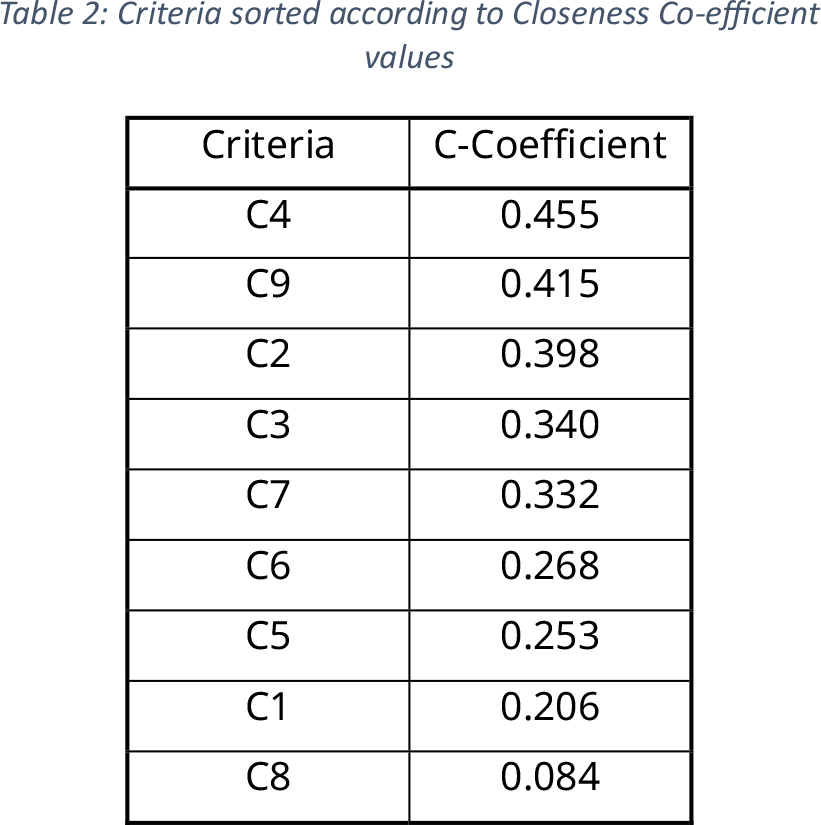
According to Table 2, resultant matrix of closeness coefficient values, Awareness of Solid waste management should be at the top of the focus in tourism to preserve continuous growth. Source of EmploymentandIncomegenerationshouldbethe next priority as ithelps the economy move forward in getting foreign currencies by attracting internationaltourists.Destinationsignificanceisin the third place as the advertisement and publicity of particular sight has to be done to promote tourism. Economic impact criteria can be defined as assessing the economic impact as the next area to be focused on. Product Marketing and Planning &managementlie inthefifthplacetobefocusedas there are already fair disaster planning and mitigation procedures are in practice. So these criteria require average attention. In the last three positions, Infrastructure, Societal Impact, Knowledge of Renewable energy are listed. Infrastructural development (i. e) Increase the number of constructions infrastructures, especially in the hilly region, is deadly (Rana, 2013), and it is not advisable for the local communities. Societal impact may not be assessed frequently as the tourist spots in Uttarakhand are not human- made hotspots. The knowledge of renewable energy is at the bottom of the list as it requires meager importance. The assessment is only limited to the tourist spots of Uttarakhand. The scope of the work is to make similar impact assessments through India and suggest management plans to climb up the excellent position in tourism globally.
Conclusion
There are several parameters to be focused on to develop tourism in a country as tourism is one of the booming sectors. These parameters are considered to index world countries to rank their performance globally. This case study focuses on providingsuggestions toimprovecriticalfactorsof tourism in Uttarakhand, India. Some significant factors are listed, and they are prioritized using a
Multi-Criteria decision-making system called TOPSIS.Theresultssuggestthatawarenessofsolid waste management and employment opportunities&source of income aretobefocused more, and this assessment framework is limited onlytospecifiedstudyareas.
References
Bansal S. P and Amit Gangotia, “Perception of Tourist: A case study of Uttrakhand,” International Journal of Hospitality & Tourism Systems,Volume 3(1),55-63, 2010.
Chandra Prakash Kala, “Ecotourism and Sustainable Development of Mountain Communities: A Study of Dhanolti Ecopark in Uttarakhand State of India.” Applied Ecology and Environmental Sciences 1, no. 5 (2013): 98- 103.DOI:10.12691/aees-1-5-5.
Chaghooshi, A., Arab, A., & Dehshiri, S. (2016). A fuzzy hybrid approach for project manager selection. Decision Science Letters, 5(3), 447- 460.
Abbas Mardani, Ahmad Jusoh, Khalil MD Nor, Zainab Khalifah,Norhayati Zakwan & Alireza Valipour (2015) Multiple criteria decision-making techniques and their applications – a review of the literature from 2000 to 2014, Economic Research-Ekonomska Istraživanja, 28:1, 516-571, DOI: 10.1080/1331677X.2015.1075139
Dhiraj Pathak, Indu Tiwari, Shashi K Tiwari TOURISM IN UTTARAKHAND: AN INTROSPECTION, International Journal of Advance Research in Science and Engineering, Vol.No.6,Issue No.05,May2017.
Evangelos Triantaphyllou and Chi-Tun Lin, Development and evaluation of five fuzzy multi-attribute decision-making methods, International Journal of Approximate Reasoning 14(4):281-310, May 1996, DOI: 10.1016/0888-613X(95)00119-2 .
Masiero L, J.L. Nicolau, Price Sensitivity to Tourism Activities: Looking for Determinant Factors, Tourism Economics, Quaderno n. 11-01, August 2012.
Naresh Rana, Sunil Singh, Y. P. Sundriyal and Navin Juyal, Recent and past floods in the Alaknanda valley: causes and consequences, Current Science, Vol.105,No. 9,10,November2013.
Pandey B W and Abhay Shankar Prasad, Anthropogenic Impact on Hydrological Hazards, Landslides and Soil Erosion in Alaknanda River Basin of Garhwal Himalaya, Uttarakhand, India Geoanthropogenic EnvironmentAnappraisal, 110–126.
Vaibhav Bhatt, Shivam Prakash Bhartiya, Rashmi Dhodi And Rakesh Dhodi, Impacts of Nature Tourism in a Destination: A case Study of Bhilangana Valley in Garhwal Himalaya, South Asian Journal of Tourism and Heritage, January 2018,Vol.11,No.1
Vishwambhar Prasad Sati, Indian Council of Social Science Research Report – The Alaknanda Basin (Uttarakhand Himalaya): A Study on Enhancing and Diversifying Livelihood Options in an EcologicallyFragileMountainTerrain.2017
De Lone, W. H., & McLean, E. R. (1992). Information systems success: The quest for the dependent variable. Information systems research, 3(1), 60-95.
Clark, C. W. (2000). Software packages do not manage projects—people do! Paper presented at Project Management Institute Annual Seminars&Symposium,Houston,TX.Newtown Square,PA: Project ManagementInstitute.