







Course Relevance: Artificial Intelligence, Data Analytics, Web Programming, Computer Science (BCA & MCA)
Academic Concepts:
Fuzzy Logic is an Artificial Intelligence technique that allows computers to make decisions based on approximate or uncertain information rather than strict true/false values. Unlike traditional Boolean logic, Fuzzy Logic works with degrees of truth, making it suitable for solving real-world problems where information is incomplete or imprecise. It is widely used in intelligent control systems, decision support systems, robotics, automation, healthcare, and smart consumer devices.
Teaching Note:
Fuzzy Logic helps BCA and MCA students understand how intelligent systems can mimic human reasoning when dealing with uncertainty. By learning Fuzzy Logic, students gain practical knowledge of AI-based decision-making techniques that are used in smart appliances, autonomous systems, traffic management, medical diagnosis, and industrial automation. It also strengthens problem-solving skills by enabling students to design systems that make intelligent decisions using linguistic variables instead of rigid rules. This knowledge forms a strong foundation for advanced topics such as Machine Learning, Expert Systems, Intelligent Automation, and Data Analytics.
Learning Objectives:
The topic of Fuzzy Logic demonstrates that:
- Fuzzy Logic enables computers to make intelligent decisions in uncertain and real-world situations.
- It bridges the gap between human reasoning and machine decision-making through degrees of truth rather than binary values.
- Fuzzy Logic has wide-ranging applications in AI, robotics, healthcare, smart devices, industrial automation, and decision support systems, making it a valuable concept for future software professionals.
INTRODUCTION
I’ll be upfront — when I first came across the term ‘fuzzy logic’ in an AI course, I assumed it was one of those theoretical concepts that sounds interesting in a lecture and then never appears again in practice. The name alone sounds almost self-deprecating. But the more I read, the more I noticed how often it quietly shows up in everyday life. Think about describing the weather during Mumbai’s pre-monsoon weeks: not quite hot enough to justify running the AC all day, not cool enough to sit comfortably without a fan — somewhere in that familiar, sticky in-between. That kind of approximate, context-loaded language is completely natural to us. For decades, though, it was something machines simply couldn’t process. Fuzzy logic was built to fix that.
Unlike standard binary computing — which forces every input into a rigid yes-or-no answer — fuzzy logic acknowledges that the real world rarely cooperates with neat categories. Gray zones exist. The ‘kind of’ and ‘more or less’ territory that defines most human judgment is treated here as something worth modeling, not something to be rounded away.
The concept was first introduced by Lotfi A. Zadeh in a landmark 1965 paper — ‘Fuzzy Sets,’ published in Information and Control, vol. 8, pp. 338–353 — while he was a professor at UC Berkeley. The reception wasn’t warm. Much of the computing community found the idea uncomfortably imprecise for what was supposed to be a rigorous discipline, and some prominent researchers openly dismissed it. Frankly, I think that skepticism is understandable — it does sound strange to claim that something can be ‘partly true.’ But the idea proved far more durable than its early critics expected. Fuzzy logic is now recognized as a proper superset of Boolean logic: everything Boolean can do, fuzzy logic can do, and then some.
Why Traditional Logic Falls Short
Binary logic is, in its own way, beautiful. A value is 0 or 1; a statement is true or false. Clean. Unambiguous. And for enormous stretches of computing — arithmetic, database queries, sorting, encryption — it works brilliantly. The problem arises the moment you ask it to model how people actually experience the physical world, and that’s where things get complicated fast.
In Boolean logic, all information is encoded using just two values: 0, meaning completely false, and 1, meaning completely true. No spectrum, no middle ground — it’s a strictly discrete system and, by design, it doesn’t do gradients. Which is fine, until your inputs aren’t discrete either.
Take something as ordinary as describing traffic speed on the Delhi–Meerut Expressway. Is 68 km/h ‘fast’? At 3 AM with an empty road, most people would say no. During the morning rush, with trucks on both sides? It might feel borderline reckless. Same number; completely different judgment depending on context. Boolean logic has no mechanism for that. It demands a fixed threshold, and wherever that line gets drawn, absurd edge cases pile up immediately on both sides. A speed of 39.9 km/h: slow. Nudge it to 40.1 km/h: fast. Nothing physically meaningful changed — a classification boundary was simply crossed. For a light switch, that’s acceptable. For a real-time control system? That kind of binary snap is a genuine engineering problem.
What Is Fuzzy Logic?
Fuzzy logic takes a fundamentally different tack. Rather than forcing inputs into hard categories, membership values are assigned — decimal numbers anywhere between 0 (completely false) and 1 (completely true) — that express how strongly something belongs to a given set. A road can be 0.6-slippery. A lecture can be 0.4-too-long. These aren’t failures of precision; they’re honest descriptions of how reality actually behaves, rather than how a tidy model wishes it would.
This maps quite directly onto how natural language works — something I find genuinely interesting about the theory. When someone says ‘I barely slept’ or ‘the match went on a bit too long,’ no precise quantity is being communicated. The meaning floats somewhere in context-dependent space; two people hearing the same words will picture entirely different amounts. That’s not a bug in human language. That’s just how it works.
Standard Boolean logic simply can’t accommodate that ambiguity — it demands exact inputs and collapses when they aren’t available. Fuzzy logic was developed specifically to model vagueness in a mathematically rigorous way, treating uncertainty not as a flaw to be removed, but as a property of the real world worth representing accurately. That’s a meaningful philosophical shift, not just a technical adjustment.
Real-Life Example
The air conditioner example is probably the clearest illustration I’ve come across, and it’s particularly relevant in the Indian context. Under a Boolean control system, the AC switches to full cooling at, say, 26°C and cuts off the moment temperature dips below 25°C. What actually happens: the unit cycles on and off repeatedly, burning electricity and never quite stabilizing the room. Not comfortable, and not efficient — especially given India’s power tariff structures, where every unnecessary kilowatt-hour has a visible cost on the monthly bill. A fuzzy-controlled air conditioner eases its output up and down gradually, based on how warm the room actually feels. The result is more stable comfort and measurably lower energy consumption. It’s one reason fuzzy-based appliance controllers became commercially widespread in Japan during the late 1980s — and why the technology found a receptive market in South and Southeast Asia shortly after.
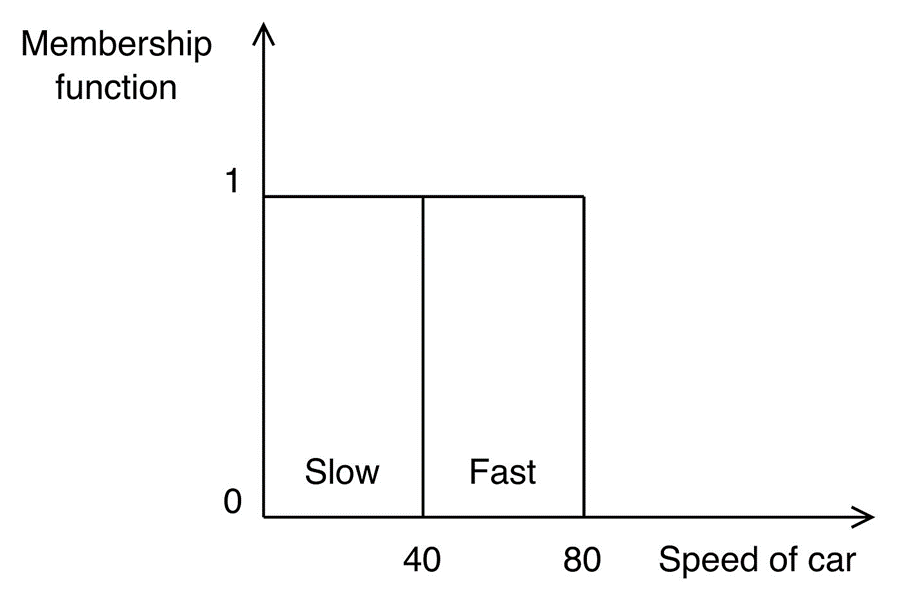
Car speed offers another clean illustration. Say the system classifies 0–40 km/h as ‘slow’ and 40–80 km/h as ‘fast.’ Under Boolean rules, 39.9 is slow and 40.1 is fast. Two-tenths of a kilometre per hour separates the two categories. A category flip.
For a driver, the distinction is practically meaningless — both speeds feel identical; neither prompts a different physical response. But an automated braking or throttle system classifying speed in real time will behave erratically right at that boundary, oscillating between responses as the input hovers near the threshold. In safety-critical systems, that instability isn’t just inefficient — it can be dangerous.
How Fuzzy Logic Works
The mechanics, once you sit with them, are less intimidating than the name suggests. Numerical inputs are taken in, mapped to linguistic categories — slow, fast, warm, cold, heavy, light — and a set of human-readable if–then rules is then applied. The aggregated outputs produce a final decision. Crucially, clean data isn’t a requirement. The whole system was designed to operate under uncertainty; that’s the point of it.
Instead of a hard flip from ‘slow’ to ‘fast’ at a fixed threshold, a membership value is assigned to each input — a decimal between 0 and 1 that represents partial belonging. A value of 0.2 means ‘barely fast.’ A value of 0.8 means ‘quite fast, but not entirely.’ Boolean logic has no mechanism to express that gradation; it simply isn’t built to.
Values like 0.1, 0.3, 0.5, and 0.9 all carry distinct meaning in this framework; they represent degrees of category membership that binary logic, with its strict 0-or-1 constraint, cannot encode at all. The outcome is a data representation that’s considerably closer to how real physical phenomena actually vary — smoothly, continuously, without sharp jumps.
Membership functions are the mathematical backbone of the whole system. Consider a universe of values — {1, 2, 3, 4, 5} — and a subset {1, 2}. In classical Boolean set theory, an element either belongs (membership = 1) or it doesn’t (membership = 0). No exceptions. In fuzzy set theory, membership can sit anywhere in the interval [0, 1] — an element can half-belong, or belong to degree 0.7, or 0.3. One change. But in my view, that single shift is the conceptual heart of why fuzzy logic matters: it finally gives mathematics a way to honestly represent the world as it actually is, rather than as a simplified model of it.
And it isn’t just a theoretical nicety. Smooth, gradual decisions instead of abrupt category jumps — that’s what real control systems need. Simple idea. Significant consequences.
Applications of Fuzzy Logic
The applications are wider than most introductory treatments acknowledge. Washing machines use fuzzy logic to calibrate water levels and cycle durations based on fabric type and load weight; camera autofocus systems use it to handle the ambiguous space between ‘in focus’ and ‘slightly blurry.’ Anti-lock braking, HVAC controls in commercial buildings, and certain clinical decision-support tools have all drawn on it. Closer to home, adaptive traffic signal systems piloted in Bengaluru and Pune have experimented with fuzzy-based controllers to manage the kind of highly variable, hard-to-predict traffic volumes that fixed-timer systems handle poorly — particularly relevant in Indian cities, where traffic density can swing dramatically within the same hour.
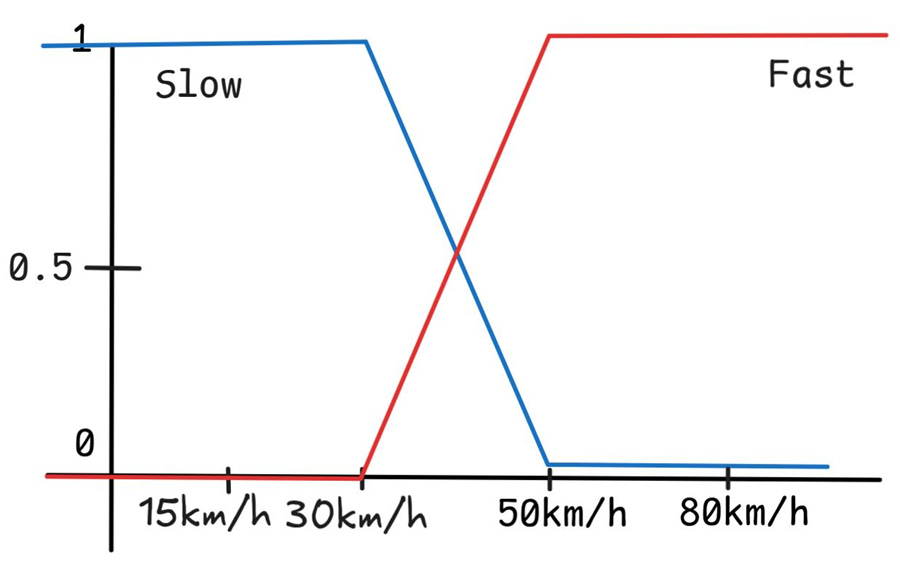
The degree of ‘fastness’ for a given speed can be computed directly from the membership function:
(X − 40) / 10
Running a few values through it makes the behavior clear:
- A speed of 42 km/h produces a membership value of 0.2 — barely fast
- A speed of 45 km/h produces 0.5 — genuinely in the middle; neither clearly slow nor clearly fast
- A speed of 48 km/h produces 0.8 — mostly fast, though not entirely
No sudden jump. The membership value climbs gradually — which is, honestly, how a human driver thinks about speed too. The math and the intuition align. That doesn’t happen as often as one might hope in engineering, so when it does, it’s worth noting.
Graphically, this produces a smooth ramp: the X-axis carries speed values, the Y-axis shows membership. The curve sits at 0 between 0 and 40, then rises steadily to reach 1 at 50. A ramp, not a step. That single visual communicates the essential difference between Boolean and fuzzy approaches more clearly than a paragraph of explanation usually does.
What that graph is really showing is that fuzzy logic didn’t introduce vagueness into the system — the vagueness was already there, in the real-world data. Binary logic was just choosing to ignore it, which worked well enough for many purposes but left a genuine gap for applications that needed to model continuous, context-sensitive phenomena.
Why Fuzzy Logic Still Matters
Something I think doesn’t get said enough: fuzzy logic is genuinely underappreciated in the current AI landscape. Deep learning and large language models dominate the conversation right now — and to be fair, they’re remarkable. But they’re also notoriously opaque. Ask a trained neural network why it produced a particular output, and it typically can’t give you a clear, auditable answer. Fuzzy logic’s rules, by contrast, are human-readable: they can be inspected, modified, and explained to a regulator, a clinician, or a non-technical manager without requiring a statistics degree. In healthcare, aviation, and industrial process control — domains where explainability is often legally required, not just desirable — that transparency has real, practical value. It’s also worth being honest about the limitations. Fuzzy logic doesn’t learn from data the way neural networks do; its rule sets have to be built by a human expert, which can become a bottleneck. For complex pattern recognition, it falls well short of modern deep learning. But for embedded control systems, edge devices, and any context where computational efficiency and interpretability matter more than raw predictive power, it remains a very practical choice. Not everything needs a GPU.
Conclusion
I came into this topic expecting dry theory. What I found instead was a framework that, once you understand it, changes the way you think about classification and decision-making more broadly. The core insight — that good decisions don’t require precise inputs, and that uncertainty can be modeled rather than eliminated — sounds almost obvious when stated plainly. But formalizing that insight mathematically, as Zadeh did in that 1965 paper, was far from obvious at the time.
By allowing partial truth values and smooth transitions between categories, fuzzy logic sidesteps the brittleness that comes with pure Boolean thinking and gives intelligent systems a more honest foundation to operate from. Not perfect — no single framework is. But then again, neither is the world it’s trying to model. Nearly six decades after that paper appeared in Information and Control, the idea is still earning its place; in a discipline that discards old frameworks quickly, that kind of staying power is worth something.
Discussion Questions:
- Why is Fuzzy Logic considered more suitable than traditional Boolean Logic for solving real-world problems?
- Can you identify any everyday devices or applications that use Fuzzy Logic? Explain how it improves their performance.
- How does Fuzzy Logic help AI systems make decisions when information is uncertain or incomplete?