

Department of Business Administration,
University of Sri Jayewardenepura
Abstract:
The main purpose of this paper is to explore and uncover the contextual realities of making decisions and allocating resources by women in Women’s collectives in Sri Lanka. It’s built on the corporative society concept and a self -sufficient membership orga nization that is run solely by underprivileged women in Sri Lanka. With a view to getting a deeper understanding of the practical wisdom in the decision -making of women’s collective, a qualitative methodology was adopted. Primary data came from in -depth interviews with 10 leading characters of Sri Lankan Women’s collectives. The findings of this study reveal that the women’s thinking and their maximizing and satisficing behaviors of decision making and resource allocation are embedded with different Social meanings of their day -to-day life experiences and mutual understanding of their group members. Way of decision -making and way of resource allocation were identified as the main themes of the study and Happiness, Trust, Honesty, Equity and equality, E thics, Self-discipline, Life security, Management skills, and Social concern are the sub -themes derived from the interviews. The utilitarian perspective of ethics seems to be noticed. And also this study will assist readers and policymakers in learning ab out the ideas and practiced of women’s collectives at the grass root level and how it benefits the growth of women’s lives and their families, and open the path for taking policy decisions with regard to rural women’s wellbeing.
Key Words: Community Driv en Project, Decision making , Economic Development,
Empowerment, Women’s collectives
Introduction
The family is the smallest and most important social unit, with unique values that have become the foundation of civilization. The community will grow and enable the expansion of the Community as a whole based on the family’s values and beliefs. The mother plays a significant role in the family’s financial and policy decisions, and she contributes these skills and traits to the entire neighborhood. The issue is that the economic indices do not adequately reflect their contribution to the Sri Lankan economy. Accordingly, the estimated economically active population is about 8.8 million in the first quarter of 2022. Of which 64.6 percent are male and 35.4 percent are female. The economically enactive population is about 8.3 million. Out of the economically enactive 26.6 percent are male and 73.4 percent are females (Sri Lankan Labour Force Survey, 2022). It is evident that Sri Lanka lags behind in women’s participation for the workforce especially compare to other middle-income countries. Culture, religion, history, and the legal and political system of the country are the main factors which were influenced women’s current f status in society. In the competitive world of work men and women need to be equally empowered to win the world tomorrow. Therefore, the solutions must be deeply just explored to solve the issues that we have on our hands. Rural poor women are the main part of this issue. Because they are suffering from many economic and social issues due to poverty. By using the underutilized contribution of women, women’s empowerment may be employed as a tactical solution to this problem. The Women’s Bank is a cooperative society built as a women’s collective in Sri Lanka which is owned and operated by and for poor women in Sri Lanka. It was incorporated under the corporative society’s law in 1991 as the Sri Lankan Women’s Development Services Cooperative Society Ltd. It is engaged in a mission to put resources, ideas and support of its own members to solve their own problems using the corporative principle s of self -help and mutual aid. Further it has established a unique management structure to ensure transparency and accountability at every point of its operations.
Purpose of the study
The main purpose of this paper is to explore and uncover the contextual realities of making decisions and allocating resources allocated by women in Women’s collectives in Sri Lanka.
Literature Review
There are several researches regarding the steps that should be followed in the decis ion-making process. According to Harrison (1999) decision-making is vital for any kind of organizations and Was generally understood as a process of problem solving process mainly targeted to achieve organizational goals and objectives. To achieve these goals and objectives a set of alternatives is generated and evaluated each one and select the best alternative. Further implementation and follow-up aspects are also included. if the results are not completely satisfactory a new cycle needs to be commenced. Sousa et al. (2015), state that the decision-making process has to be planned. In order to handle new or recurring issues, this planning may entail more control over the procedure and a focus on the decision’s key components—the problem, the purpose, the alternative, and the repercussions. The problem, objectives, options, evaluation, and decision execution are all part of the decision-making process (Shimizu, 2010). The abilities and knowledge a leader processes can be impacted by features or traits, such as beliefs, values, ethics, and character, according to Sharma and Jain’s (2013). While the other aspects provide the leader certain qualities that make him or her special, knowledge and skills immediately contribute to the process of leadership. According to Herbert Simon (1982) Bounded Rationality model, humans have a limited capacity for rational thinking; they generally construct and analyses a simplified model of a real situation by considering fewer alternative criteria or constraints than actual exist. Rationality is bounded not Only by limitation on human processing capacities, but also by individual differences such as age, education, knowledge and attitudes. Intuition also is a critical factor that decision maker use in solving unstructured and semi structured problems and economic man always motivated to maximize his utility and mainly he has introduced two types of decisions; program and non – program decisions (Herbert Simon (1982). Keeney (2020) states that the mos t people never formally learn to be effective decision makers and have little practice in those skills . Howard (1988) sated that decision quality consists of seven elements; proper framing, information excellence, creative alternatives, clear values, integ ration and evaluation with logic, balance of basis and commitment to action. Resource allocation is an interconnected process of decisions about how to allocate funds to different assets, often driven by legal requirements or a desire for better accountability. Resources Allocation process answer to three questions; one is what resources are required and how should they be distributed over time to best meet the long-term goals and objectives; Second one is whatperformance targets are achievable given avail able resources; and third one is how shouldresources be used in the short term to best support the goals and objectives. Michael (1976) saidThat organizational structure specifies relationship between individuals which affect the way inwhich organizational resources are allocated. Guido and Michael (2010) explained the best optionmay be to allocate resources by managerial authority and commun ication is necessary input into efficient resources allocation. Further Daniel (2017) pointed out organizational resources allocation process mediating by mainly opportunities and opportunity cost, belief and perspectives of the resources allocation process and time. Smith and Mitton (2013) said that historical pattern, fairness, ethical nature and transparency are important aspect of resource allocation. In community base project personal, cultural, and system context factors, person’s preference, living circumstances, and availability of informal care are shaping resource allocation process. Torrance and Daniel practical wisdom is defined as a master virtue that allows one to be morally perceptive, to deliberate between courses of action, and to make a reasoned choice that is aligned with worthwhile ends. It guides individuals towards human excellence by exerting our strengths in moderation to establish good habits, which ultimately forms a good character. Practical wisdom is needed to help individuals de liberate between internal and external goods and to find balance between conflicting aims (Torrance & Daniel, 2015). Mele (2010) stated that practical wisdom is Essential dimension for making of decisions. Because of every decision has an ethical aspect. According to core (2013) practical wisdom knows how to live well in the sense of knowing how to conduct oneself (cited in Tasi, (2022).
Methodology
This study plans to explore and uncover the contextual realities of making decisions and allocating resources by women in Women’s collectives in Sri Lanka. Women’s collectives consist of a lot of human activities and the woman is a prominent character in this social collectives; she always interacts with human beings and plays a complex role in the society as well as in the collectives. As human behavior is a subjective matter, subjective realism is important to achieve the intended result of the study. Further, experience and interpretation of women’s collective works, decision making and allocating resources are important to understand and also need to be explored their innerfeelings. To explore the contextual reality is needed to look at the holistic picture of the issue underinvestigation. Therefore, a closer interaction between participant and researcher was needed toReveal deep contextual insights into this complex phenomenon. Hence, qualitative approach is usedfor the study to exploration of contextual and underlying reality of the study under investigation.The purposive sampling method was selected to collect primary data for the study. Ten women are purposively selected for the in-depth interviews specially based on their socio demographic profile and specially, their collective work experience was concerned. However, collection of data and analysis of data are rep eated until theoretical saturation . The researcher is working while keeping an eye on the environment to perform this investigation in a natural setting. Instead, the researcher observes and records particular behaviors or events without making any changes to the environment. It was discovered that this inquiry was longitudinal in nature. The researcher repeatedly watches the same participants over a period of time. Because the study’s foundation is non -numeric data and thematic analysis was used in the data analysis.
Data Analysis
Interview data were analyzed thematically by using reading and rereading the recordings and field notes. As per Interviewee one stated that the requirement of insurance cover for the members. Further she said that, “As the first step of this process is opening a “Subhani Account” by members.. . It insured their husbands. Initially members have to pay only LKR 11,250 as the premium and sum insured covers under this policy is LKR 100,000. After three months you have to obtain a insurance scheme called as “Rakitha Insurance”., then need to open “Surakitha Insurance” which covers the member…. Then we insure our husbands based on his age category. Less aged once needs to pay LKR 12,500 and if he is 60 years old then need to pay LKR 60,000. We called it” Pathi Insurance” …. With regards to the loan, members are entitled for apply loans after 14 months completed as a member. But in between you can apply for small loans such as LKR 500, 1000, 2000. Then you can go for loans starting from LKR 50000 but to get that at least you need to start Subhani account. Then no need to be afraid. That’s why I said that even though we take loans we are not afraid as we were protected from the insurance schemes. In order to obtain the loan facility, it is required toconsent and agreement of every member of your group…”When it comes to our projects, “we have separate group which represent a separate section likeCommunity development section(Subasadaka), Insurance section, cultural section,Entrepreneurship section, Disaster section ( Apada) likewise there are 11 sections. Those 11sections do the respective projects throughout the year.” Above fact with regards to the insurance reveals that this woman collective aware the risk embedded with their lives. In order to mitigate identified risk of their members lives the above insurance schemes has been developed and introduced among the members. It is reflected the women collective protect their members a nd encourage them to take proactive decisions. These women collective have trained and empowered its members to take proactive decisions, which support to safe guard members as well as their families. The above mention funding scheme also trained its mem bers to take risk step by step with the agreement of other members of the group. That is why these women collectives provide a small loan initially in order to get the experience of resource utilization. Subsequently, when the first loans settle in full the member is eligible for the next loan which is higher than the previous loan likewise these members are being trained to go for the higher number gradually. When they reach the last stage those members have gain adequate experience and exposure resource allocation and fund utilization. Further, this types of systems support to improve inter-personal relationships, risk sharing, helping to each other and building team sprit among their members. It is evident that trust and the honesty of the members are the key factors behind the success of the women collectives. According to interviewee five; I am one of the active members of this society and have 7 years’ experience…at present, I am the group leader of my five-member group… when I was taking decisions previously I did not think dee ply and I took the decisions… but now when I am taking decisions I think deeply and analyzed them befor e making the final decisions… I have realized that the decisions, which I am taking now are more succeeful than the previous decisions…. Most of the decisions taken by me previously were not successful and could notachieve successful results as well… the main reason for that was the lack of knowledge,experience, etc. We meet once a week and discuss matt ers related to business, family, children’seducation, health, savings, managing resources etc., and shared each other’s personal experiencestoo……. because of these types of activities, we acquire different exposures and enhance ourknowledge….
All five members of my group have taken loans from this collective… they are paying loan installments regularly…. as a group leader timely I remind the loan installment… Interviewee eight (chairperson of the group) she explained that, we have maintained event colander for the entire group… accordingly one of he main events of this is an organizing fair in order to support our women members to enhance their financial strength, develop inter relationships, entrepreneurial skills, improve marketing abilities, identify opportunities, environment analysis, to identify and recognize their strength and weaknesses, learn how to maximizing profit, taking decisions and allocating resources etc… We believe that conducting fair is active engagement project and it will be befitted to our members to get the practical experience and knowledge of matters which we discuss at the regular meetings. Hence this type of event is more successful… Insights of this statements clearly explain that the ability of resource allocation and decision making pattern of women who are attached to the women collectives. Decision making and resource allocation are common to each and every business organizations and every human being. In the process of decision making and resources allocation b usiness organizations use expertise knowledge, latest technologies and currently AI as well. People who have the very good educational and professional back ground also take decision using their knowledge and experience to meet their expectations. Simultan eously women attached to the women collective are also involved in decision making and resource allocation. Even though, they do not have such a big experience and educational background these women are also engaged in the process of decision making and resource allocation. They also meet their expectations successfully.
Theoretically there are two types of decision one is program decisions and other one is non -program decisions. Taking programed decision is comfortable than taking non program decision.Because program decisions are being taken repeatedly based on the existing rules and regulationsbut non programs are novel decisions with carries a risk. Those decisions are being taken byanalyzing the current facts and figures. When it comes to women coll ective they also engage intaking both types of decisions. Interview data reveals that most of the women have started new business which can be identified as non-program decision. Further reveal that most of businesses are very successful and they have met their expectations as well. Main reason for that was the empowerment, exposure and the experience, gain from the women collectives. Further she explained “I work in the audit branch. In other words, it contains two portions. The management committee is one. The audit section is the alternative. We review all of the management committee’s work. It implies that they are performing things correctly and precise ly, with no deviation of even fifty cents. We review all of the management committee’s daily work here, just as we do at the banks.Following an examination, we create the trial balance by adding up the money flow ins and outs. We do every day. We verify that they made it properly. There can be neither an excess nor a deficit of even fifty cents”.
It is evident that women collectives appoint leaders for each group and they train leaders for accounting work, audit work, analyzing risk, and a lso organizing events. Further, these projects will be benefited for their members to enhance their management skills to win the life tomorrow.
According to the categories given above, rural women engage in activities related to health, housing loans, improving children’s education, etc. All of the aforementioned committees are made up of rural women involved in the women’s banking project. The management committee is in charge of creating the financial statements and yearly reports for the audit committee, which comprises of the audit section and management committee. They visit their pradeshika every day to handle business dealings. The audit division will then review the management committee’s work to ensure their correctness.
As per Interviewee four,I have ten years’ experience now….”Began as little groups”. A small group can function with asfew as 5 people and as many as 15 people. Within those 15 members, they began giving LKR 5,and as of this writing, we have divided LKR 10,000 or 15,000 among ourselves each year. AlreadyI have nearly 2 LKR as my deposit…The women’s collectives have assisted us at all stages of ourlives, both joyful and unhappy” I have taken 1 LKR loan from this and I pay my loan gradually… and manage my funds properl.. . First I discuss my loan need with my group members and they agreed with me and through my group leader I made my request…. After that executive committee has approved my loan…. If any delays to send my loan payment my group members encourage me to pay that…. Insights of this statement explain the decision making pattern of the small group and their pattern of allocating and managing resources while balancing the day to day life expenses. As stated above, they connect with banking initiatives financially by creating financial assets for their small member groups. To carry out the financial activities, they form their own groups where they can collaborate effectively and where they may grow in trust with one another. As they engage in these banking initiatives by creating and maintaining their own asset base, this is one of the best practices they have created. It is evident that women in this collectives managing resources and allocate resources in properly to achieve their pre-determined goals and objectives “Team members must save money initially. They can borrow money from a bank (for dealing with financial matters they have separate system or unit called as women’s bank) using their savings if they have developed some financial discipline. Depending on the team member’s level of self – discipline, credit is provided against saving. After term, the first term financing is done depending on the frequency of the meetings and the participation of the participants. The first six months are intended for capacity development. Team members must first save, and saving decides the capacity of that specific self-help group to continue operating. Besides their decision-making and managing resources skills, trust and honesty and team work are the other prominent sub-themes that emerged. As per Interviewee two stated thatTen years ago I joined with this woman’s collective…I have no prior experience in communitywork …. but I like those work…. I like to help others….I studied up to grade 10 …. after that due to many financial issues for my parents, I stop mystudies… I married…. he works as a helper in carpentry work…. the main purpose was to help Myother two sisters with their studies…. but lost my dream due to financial issues …. I have three children and they are studying…. my family expenses can manage by my husband’s income …. but as a mother, I have dreams with regard to my family…. I wanted to start our own carpentry workshop adjoining my house…. but we have no idea how to do that…. we know we have enough confidence that we can do that… Once a week we met. I learned how to manage my day -to-day expenses and save money for the future…. we share our experiences and I learned fro m others … Already I have 3 LKS as my savings…. I obtained a 4 LKS loan from our collective and achieve my dream…. really now my husband has enough work and now we have no financial problems …. especially my group members gave their consent and agreemen t for my loan request… it is the basic requirement for approving the loan… The knowledge, experience, and support gained from this women collective were a great befitted for me to take decisions and allocate resources among different objectives in a s uccessful way in my personal life as well as my business … [ Smiled happily] At beginning of the each and every month I am preparing a document including cash inflows and outflows for a month and accordingly allocate money… Interviewee three stated tha ”I have faced many difficulties in my life. I have three children and they are studying. Bankers are not supporting women like us…. We have to take money from money lenders under the high – interest rate… [ took a long breathing] That is the main reason that I have joined this group… I have a group… Now I am so happy…. Now I can manage my life …. My family members are also so happy…. [Smiling] Actually, this happiness is one of the rewards that we have gained from thisgroup work. [ other women gave big claps for the statement]Above interview clearly indicated that inner capacities and abilities of rural women. Even thoughrural women have inner capacities and skills they are not equipped with other resources requiredto meet up with life challenges. However, these women collectives have supported to meet theirexpectations by way of providing financial support and other req uired assistance i .e. providing knowledge etc. Further this project has supported to make their family life happy and successful. Because if a family does not have sufficient source of income, social acceptance, inter relationship, minimum level of facil ities, it is very difficult to manage their family life satisfactorily. These women collectives have greatly supported to those families to make their happy and well-being.
As per Interviewee six, “Luck or happiness is not an easy thing to achieve…. After taking membership in this collective I realized happiness can be achieved ourselves… Really now I am so happy not only for myself but for my family members as well” [ smiling happy] very beginning I had many family issues …. my husband is doing labor work…. I learned a lot of things from this woman’s collective… By taking a loan I started a small retail shop at home…. All most all women’s ideas were in the same line of thinking. They have suffered many difficulties in their lives. They have not had happiness for them as well as their families due to social and economic issues. And also they have realized happiness can be achieved by themselves other than given by others. It is clear that happiness is one of the benefits tha t women gain from their collective work and happiness is intrinsic befits gained by the members through the women collective.
Further poor women in rural areas of Sri Lanka face many hazards and financial difficulties and interruptions in their day -to-day life. Under these circumstances, happiness is questionable. In most cases, women are taking the main responsibilities of their family life and men are addicted to smoking, gambling, and also alcohol. Thus these women collectives have created immensevalue in terms of happiness for poor women.As per Interviewee SevenIt has always instilled in women a habit of saving money. We are traveling quite slowly. It mustfirst come together as a group. For around eight months, one must remain in that group as a “Asritha member” (group name) and day by day develop team trust. I have three children and an elder son in grade 10. My husband has no permanent job. In our family both we collectively take Decisions. We have a plan to start our own business …. Because I can be sewing clothes…I have a plan to take a loan to purchase a sewing machine… According to the statement above, clearly emphasized the way she has taken decision find out solution for their current future issues. Further she has confidently taken the de cision to borrow from women collectives and to invest in their own business. They don’t just include the members in financial activity. Despite this, members must practice good money management before they can benefit from the women’s collectives. As a res ult, this may be used as a useful case study to demonstrate how women’s cooperatives teach its members how to manage money in a responsible manner rather than just forcing them into a profession in which they lack the necessary expertise.
This first prepar es the individual with internal qualities to manage finances, and only then will they have the potential to gain from women collective. It is clear that those women collectives are Empowering women to take decision, planning, and organizing controlling resources etc. in order to achieve their well-being. Interviewee 10 explained further; “Each group consists of five members and anyone can obtain a loan from the collectives with the consent of other members of the group. I took a loan very recently others gave their consent for me…. they trust me and they believe that I pay my loan gradually too. But I know if I do not pay my loan properly my other members cannot take loans from the collective……. we should maintain our self-discipline in the group” [others say yes… yes…. Yes….]
They have completed their task by using them. In addition, we have taken part in a number of thisproject’s initiatives. It refers to blood donations and other contributions to various initiatives.Everyone believes that the women’s banking project’s primary goals are to accumulate savings anddisburse loans. But it also engages in a wide range of social services, such as blood drives, medicalclinics, assistance with funerals, training programs for women, etc. All of these events are plannedby women, which helps to ensure their success. According to Interviewee nine “Members of our group have obtained welfare loans from the women collective . They have completed their task by using them. In addition, we have taken part in a number of this project’s Initiatives. It refers to blood donations and other contributions to various initiatives. Everyone believes that the women’s banking project’s primary goals are to accumulate savings and disburse loans. But it also engages in a wide range of social services, such as blood donations, medical clinics, assistance with funerals, training programs for women, etc. All of these events are planned by women, which helps to ensure our well-being…. Women collectives are significantly help to improve socio economic well-being of their members. Interviewee two stated further, ‘The team is also meeting individually. The squad meets once each week. The team meets every week, while the pradeshikaya committee meets every Wednesday to discuss. Top individuals meet in this manner. By coming together in this way, they may debate decis ions and problems. If they Receive a loan book, they choose whether or not to lend it. The committee will make all decisions pertaining to that. The husband must certify the loan when it is approved. There is a special aesthetic committee specifically for children called the children’s society. We’ve been employed here for 20 years now [laughs]” Honestly, I joined with this since I am only lounging around the house doing nothing. I believed that I wanted to integrate into the outside society…. We organize many social activities for interact with community….” As mentioned above, the majority of rural women do not have a steady employment, and 90% of them work in agriculture with their families. As a result, they are unable to advance in society and engage wit h the local community. But when they plan various programs and activities at thewomen’s collectives and, they may communicate with outside parties. Additionally, they have theopportunity to manage the financial aspect of the aforementioned initiatives. So they decided thatthe initiative on women’s collective was a good opportunity rural woman for interacti ng withoutside society.The concepts trust and honest are fundamental to any organization. Without trust and honestly life of the team or business will be a formidable challenge. Babalola, (2009, 2013) states that freedom of business to make profit is lim ited by the values of fairness, equal opportunities, honestly and truthfulness. Insights of these facts reflect that without inter personal relationships in terms of trust and honesty, organizational success is problematic. Because of, all women’s decisions are made and based on these relationships. However, align with trust and honesty will assist to develop effective team relationships and assure its ethicality. Very first her smiling face is reflecting happiness of their collectives. The justification given above demonstrates how women predominate in the decision-making process when it comes to financial difficulties and challenges. The committee follows a systematic process for approving loans. Additionally, if a woman needs a small loan for an urgent need—such as buying medicine for a family member, school supplies for her kids, or going to the weekly fair —she can present her request at a team meeting. If the request is fair and honest, the team leader will disburse money from the money box in accordance with the team’s agreement. They have team leaders in such committees. They are dressed in purple sarees here. (Showing various women wearing sarees in the color purple.) They are all team captains. They are distinguished by a different hue. The individu als in charge of those parts are those individuals. It indicates that there are 11 sections, including the Subasadaka Anshaya (welfare unit), Insurance Section, Cultural Section, Entrepreneur Section, and Disaster Section (Apada Anshaya). These 11 parts ac complish the required tasks. The financial secretary is the organization’s Development Section Head (Ayathana Sanwardena Anshaya). The financial secretary is comparable to the bank manager in a business bank. She is the woman present. the petite created woman. (Introducing the new finance secretary, a young woman.)
As mentioned above, it might be useful to ascertain how they distribute resources for their tasks.The distribution of human resources within their banking initiatives is the major emphasis of th edescription above. Every team in the banking project has a leader. They dress in a purple saree. ItShows how they intend to distribute their own resources among project teams. They will find itsimple to recognize their leaders and assign their duties a nd responsibilities when the colors arethe same. A team’s leader is the one who interacts with upper management and distributes their orders and authority to the other team members. They may easily accomplish their goals, missions, visions, and targets based on this form of preparation. One of the respondents also mentioned that these leaders are allocated to several departments, including the divisions on insurance, culture, entrepreneurs, and disasters. That distribution is made with the intention of org anizing the resources. Separate leaders and well defined tasks, duties, and responsibilities are present for each sector. Leaders will then be able to clearly identify their goals and work toward them.
Interviewee eight reveals that; “I had never given a speech on stage in front of a huge crowd before I started working on this project. But now I find it to be rather easy. I don’t need to start practicing for the speech early, and I’m really confident in my ability to talk quickly now….”. The study could tell how confident each participant was in their ability to deliver a speech based on observations of their meetings and their justifications. There was no need for assistance or direction. They said that because of their older members, they could hone thei r public speaking Abilities. They always deliver talks in the same style and with the same assurance. Each member of that community may feel more confident as a result of these activities. Decision-making styles were assessed by the General Decision-making Styles questionnaire (Scott & Bruce, 1995) with five subscales examining the five decision-making styles—rational, intuitive, dependent, avoidant and spontaneous. Accordingly, these women collectives the take decisions for achieving multipurpose and research findings explore that they exhibit different types of decision making styles like rational, intuitive, and spontaneous simultaneously. As per interviewee seven further reveals that “Do you understand why we joined this, when there is a death at our home, they donate Rs. 50,000, which is why we originally joined this. That was our major motivation for joining this. Following that, this has insurance plans. So we came together for them. But that’s why we initially got together. It is something that we require. This is a big benefit to us in the event of an unexpected death”. [all other members nodded their heads to approve the said statement] Like before, she also discussed the social services offered by the women’s banking enterprise. The decision-making process and resource allocation are the most crucial team activities in women’s Collectives. Therefore, when they are making organizational choices, they should follow established procedures. Has working in this presented any difficulties for you? Asked from interviewee three and she explained; “No issues of that nature. We have our “Widayakaya” to use if any problems should occur. Then comes our “Kalapa.” We may speak with the leader alone if necessary and explain our situation. She makes necessary arrangements to fulfill our needs…. It is clear from the aforementioned response how they are preparing for the decision -making process. They had no issues in their teams, as they had said. They have a systematic process in place to address any problems that may occur. There is a formal group of participants known as “Widayakaya,” and its duties include resolving interpersonal conflicts as well as other personal matters. It demonstrates the decision-making processes women intend to use in banking project operations. There are other committees inside the “Pradeshikaya,” including a health committee (Saukya Kamituwa) and a house committee (Niwasa Kamituwa). The health committee works on health-related issues including providing eyeglasses in clinics and various pradeshikas. In her 2017 article, Nicole Bohrer addressed how crucial it is for women to participate equally in decision-making for community -driven projects. The Women’s collective’s dat a show that a number of activities improve women’s capacity for decision -making. By creating distinct committees and designating heads for each group, they contribute. It will demonstrate how the management structures the decision-making process.
The aforementioned explanation places emphasis on how women arrange themselves in order tomake decisions on banking ventures. Other than financial activities, there are several value-addedactivities in banking projects. Health committee and disaster management ar e particularly crucialamong these duties. As a result, there are distinct committees for housing, disaster preparedness,And health activities. Women can thus assist the relevant committee in accordance with their needsand preferences. On the basis of many issues, it is crucial that their teams reach pertinent conclusions.
Interviewee three further explained that “We must take care of our women and their families. Annually we organized trip for our members as well as their families. We Organize annual pirith ceremony and Dana. Then they create a bond with the organization” The conceptualization and identification of well-being has varied across cultures and this has been measured from different perspectives. Accordingly, it is evident that well -being is a subjective inner quality. However, philosophers have formally defined the notion of good life in terms of what has final value for a person (Lakshmi, 2013). In the teaching of the Buddha it would help to develop spiritual life for the person. Utilitarian perspective of ethics means doing something for others without expecting a self-gain in return. Social activities of this nature done by women are not purely free from self-interest. They expect a self-gain by way of self-respect, social recognition or self-spiritual development through such acts while engaging in something that benefit others.
Discussion
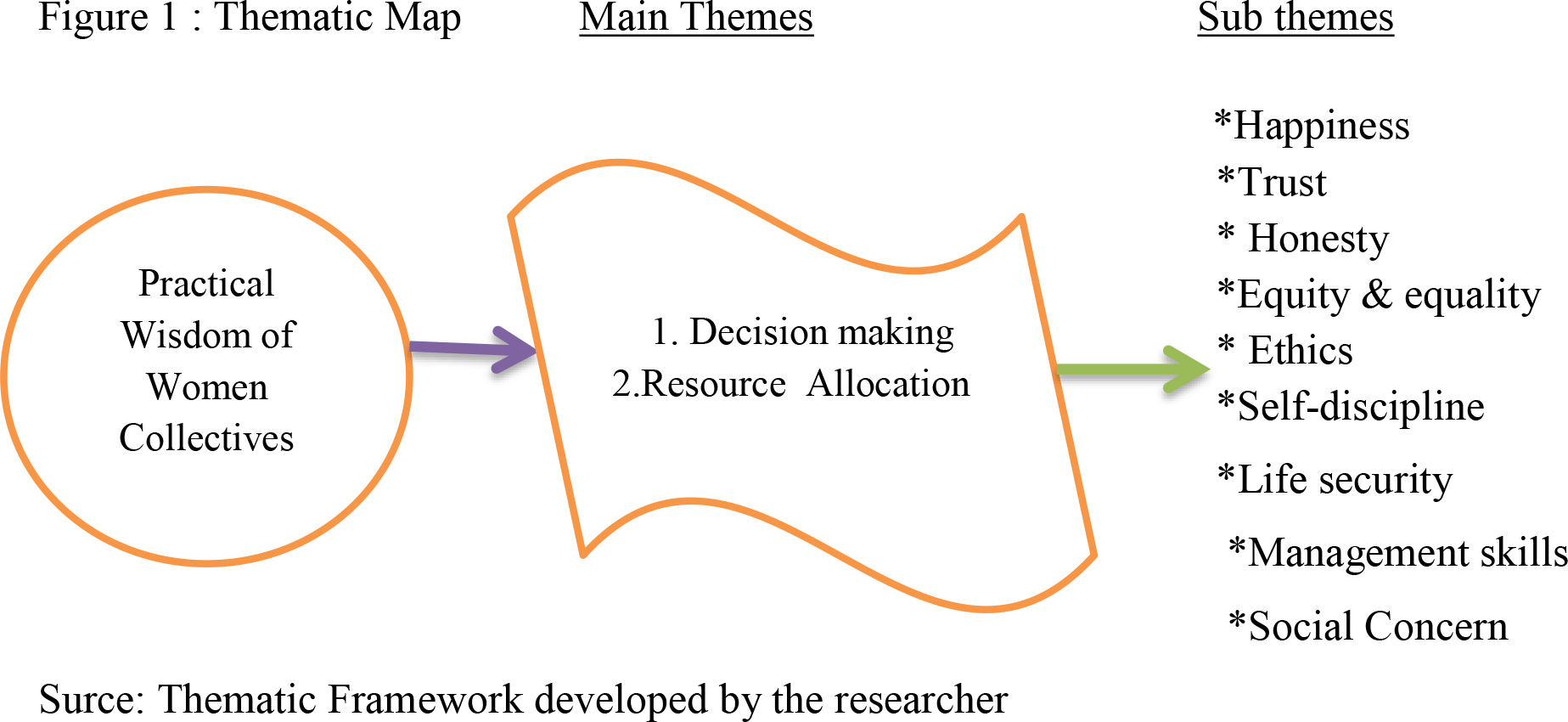
By practicing decentralizing authority to the local level, higher authorities of this concept has facilitated women’s access to decision -making arenas in terms of political and social empowerment. Additionally, they may help women’s voices be heard and create precedents for their involvement in planning and decision-making that may be repeated in other form. As a result, women should be encouraged to try new things and develop solutions that have the potential to deal with many unresolved poverty -related issues at the grassroots level. As a result, even their self-help organizations may be seen as one of the successful entrepreneurial attempts to assist them all rise beyond their current circumstances. As a result, using this concept of a “group”to handle societal issues is a smart idea rather than tackling them one at a time.Poor women in Sri Lanka, especially those wh o are household leaders or elderly, must strivemightily to guarantee the financial survival of their families. According to macro statistics andmicro research, women have been forced into low-skilled, low-paying positions as a result of risingliving costs over the past two decades, which has negatively impacted their quality of life and work circumstances. As in the past, rural women are fighting to make their nation less impoverished in order to provide a more prosperous future for their children. They may launch women collective as a group effort of rural women as a remedy. Based on the in-depth interviews with remote village women enrollments in the women collectives mainly identified two main themes one is decision making pattern and other theme is allocating resources.
Figure 1 : Thematic Map Main Themes Sub themes
*Happiness
*Trust
* Honesty
*Equity & equality
* Ethics
*Self-discipline
*Life security
*Management skills
*Social Concern
Surce: Thematic Framework developed by the researcher Happiness, Trust, Honesty, Equity and equality, Ethics, Self-discipline, Life security, Management skills and Social concern are the sub themes derived from the interviews. Main source of social barriers is the patriarchal cultural setting we have in those developing countries. They do not want their daughter, sister or wife to go beyond their decisions as they have this attitude that women should depend on males. In women’s collective s all of them are women and they make their own team, they take their own decision and even they save money for their Practical Wisdom of Women Collectives
1. Decision making
2.Resource Allocation
family members. They use their free time to engage in these activities and even they work fordivergent functions to conduct community development programs which will empower them andtheir society. This will enable women to build up their community network and this will not berejected by males as this will generate an additional income to their household. This will create aSocial life and a community for women where they can improve their knowledge, skills andattitude with mutually contributing effort when they are taking decisions.
According to the study’s findings, women control the process of decision -making and resource allocation in women’s collectives by using women’s effort and resources to diversify and giving priority to vital demands and requirements of rural women. Leading the team is mostly the responsibility of the team leader, and controlling depends on the honesty and trust between team members. In order to meet everyone’s needs and expectations, the Women’s Collectives distribute resources fairly among its members. According to research, women predominate in the team-based and team-based resource allocation process. Additionally, their choices are influenced by ethics.
Summary
Further deep analysis also reveals that every decision has integrated with the mean their decisions always concerned for greater good for greater number of people in the group. And also women’s collectives would be beneficial to enhance women’s decision making power in the field of financial handling, insurance services, community development initiatives, cultural events, and business networking opportunities, disaster relief initiatives, and health and educational services as well. As a result of this behavior support women’s for sel f-motivation, self-discipline, teamwork, and leadership skills in addition to the aforementioned value -added activities. Subsequently, the women’s collectives have significantly helped to improve the socio -economic situation and empower women within the household and without their isolation of them through greater social interaction.
References
Babalola, S.S. (2009) Determinants of unethical business behavior among owner – managers.
Journal of Human Values. 15(1), pp.61-75.
Babalola, O and & Abel, S. A. (2013) Business Environmental Factors: Implications on theSurvival and Growth of Business Organizations in the Manufacturing Sector of LagosMetropolis Business and Management Research. 2,(3) pp. 2013.Bohrer, N. (2017). Rural women’s empowerment in the sustainable development era, Priorities,Partnerships, and Policy for Transformational Change, 2-15.Braun, V., & Clarke, V. (2006). Using thematic analysis in psychology. Qualitative research in
psychology, 3(2), 77-101.
Daniel A. Levinthal ,(2017). Resource Allocation and Firm Boundaries, Journal of Management,
Vol. 43 No. 8, November 2017 2580–2587,DOI: 10.1177/0149206316667458.
Guido Friebel & Michael Raith, (2017). Resource Allocation and Organizational Form,
American Economic Journal, Vol. 2 No.2, pp 1-33.
Harrison, E.F. (1999). The Managerial Decision-making Process, 5th ed., Houghton Mifflin,
Boston, MA.
Howard, R. A. (1988).Decision analysis: Practice and promise Management Science, 34 (6)
(1988), pp. 679-695
Keeney, R. L. (2020). Give yourself a nudge: Practical procedures for making better personal
and business decisions Cambridge University Press, Cambridge, MA (2020)
Melé, D. (2010), “Practical wisdom in managerial decision making”, Journal of Management
Development, Vol. 29 No. 7/8, pp. 637-645. https://doi.org/10.1108/02621711011059068
Michael K. Moch, (1976). Structure and Organizational Resource Allocation, Administrative
Science Quarterly , Dec., 1976, Vol. 21, No. 4 , pp. 661-674.
Scott, S. G., & Bruce, R. A. (1995). Decision-making style: The development and assessment of
a new measure. Educational and Psychological Measurement, 55(5), 818–831.
Sharma, M. K. & Jain, S (2013) . L eadership Management: Principles, Models and Theories,
Global Journal of Management and Business Studies . Volume 3, (2013), pp. 309 -318. Research
India Publications.
Sousa, W. H. D., Porto, M. C., Marcantonio, M. I., Issao, P., & Yu, A. S. (2015). Planning the
decision making process: A multiple case study. Engineering Management Research
Shimizu, T. (2010). Decisions and Organizations, 3/e., 448. Atlas
Sri Lankan Labour Force Survey, 1st quarter, 2022
Smith, N., Mitton, C., Bryan, S. et al. (2013). Decision maker perceptions of resource allocationprocesses in Canadian health care organizations: a national survey. BMC Health Serv Res 13,247 (2013). https://doi.org/10.1186/1472-6963-13-247.Tsai C.- h. Practical Wisdom, Well- Being, and Success. Philosophy and PhenomenologicalResearch 2022; 104:606– 622. https ://doi.org/10.1111/phpr.12797Torrance, Daniel, “Practical Wisdom and the Pursuit of the Good in the Good Life” (2015).
Master of Applied Positive Psychology (MAPP) Capstone Projects. 85.
https://repository.upenn.edu/mapp_capstone/85
Acknowledgement
This article was presented at 11 th International Conference on Contemporary Issues in Management organized by International School of Management Excellence, Bangalore held on 24th and 5th February 2023.