




Background and Rationale
The NVT-ISME Research Grant is instituted to promote rigorous, practice-oriented research that advances the understanding and implementation of organizational excellence. Through this initiative, ISME aims to strengthen its commitment to creating knowledge that enhances leadership effectiveness, institutional performance, and sustainable organizational practices.
In today’s rapidly evolving business landscape, achieving Organizational Excellence is a critical imperative. Organizations are increasingly expected to integrate deep domain expertise, human insights, and technology-enabled management practices to deliver sustainable value. At ISME, we view Organizational Excellence not merely as operational efficiency, but as the holistic capability to create lasting impact—through stakeholder satisfaction, innovation, ethical accountability, and continuous improvement.
The NVT Group, in collaboration with ISME, announces the NVT-ISME Research Grant to support applied, interdisciplinary research aimed at generating actionable insights and advancing Organizational Excellence across sectors.
CALL FOR PROPOSALS
NVT–ISME Research Grant 2026
The Research Grant Committee invites eligible researchers to submit their research proposals for consideration under the NVT–ISME Grant.
Key Information
- Proposal Submission Window: September 1 – November 30, 2026
- Proposal Template: The prescribed proposal template will be shared by the Research Grant Committee.
- Proposal Review: Shortlisted applicants will be invited to present their research proposals before the Review Committee for evaluation.
- Grant Application: Applications can be submitted through Microsoft CMT: https://cmt3.research.microsoft.com/NVTISME2026/Track/1/Submission/Create
Researchers are encouraged to submit their proposals within the stipulated timeline and adhere to the prescribed proposal format.
Purpose of the NVT–ISME Research Grant
The grant encourages research that:
- Integrates domain expertise with human insights and/or technology applications.
- Addresses practical organizational challenges.
- Bridges theory and practice.
- Contributes to academic knowledge and managerial best practices. The initiative supports actionable insights for decision-making, process optimization, innovation, and sustainable growth.
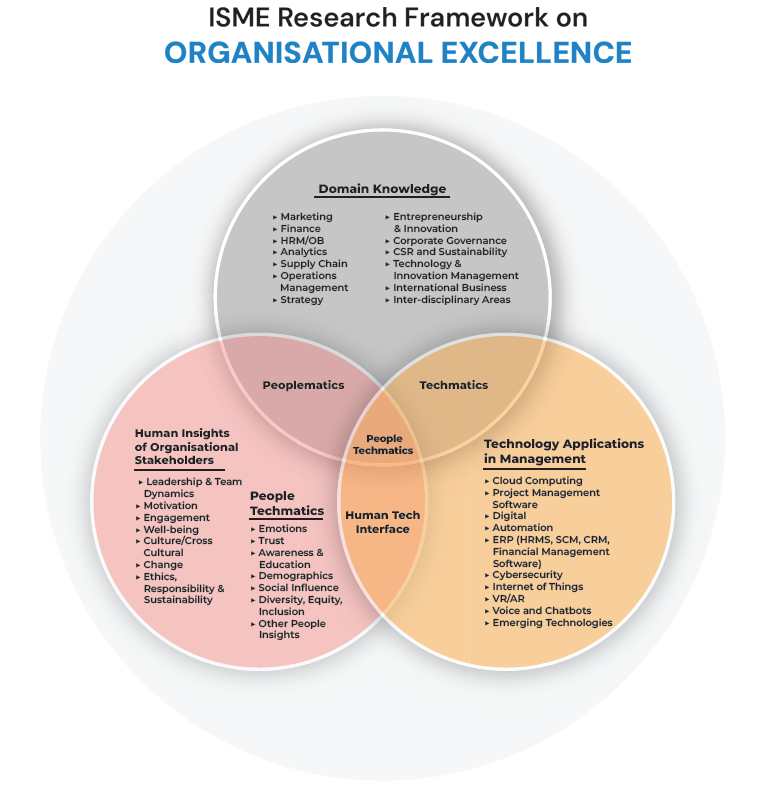
Research Scope: Conceptual Foundation: Organizational Excellence
Organizational Excellence is based on the organization’s capability to:
- Leverage deep expertise (domain knowledge)
- Understand and align stakeholder needs and behaviours (human insights)
- Integrate and apply technology effectively in management practices
Key constructs of the organizational excellence framework are as follows:
- Peoplematics:
Systematic study of people in management contexts and their impact on organizational excellence. - Techmatics:
Systematic study of technology in management contexts and its impact on organizational excellence. - Human–Tech Interface:
Analysis of interactions between humans and technology and their influence on organizational excellence. - People Techmatics:
Integrated study of people and technology in management contexts to achieve organizational excellence.
The principal investigator is requested to note that the dependent (outcome) variable should be organizational excellence, while the independent variables should be domain, people, and technology, as indicated in Figure 1. Details of domains of ISME’s Organizational Excellence and how it can be measured is provided in the annexure-01
Eligibility
An individual faculty member or a team of up to four investigators may undertake the proposed research project.
In the case of a team submission, one applicant must be designated as the Principal Investigator.
- Applicants must be faculty members affiliated with a recognized university or higher education institute.
- All applicants/investigators must be citizens of India.
- Applicants should have a consistently strong academic record.
- Applicants should demonstrate a clear interest in learning and contributing to the field of management.
The proposed research must be in the area of management or related disciplines and should be aligned with ISME’s Organizational Excellence research framework.
Complete research proposals must be submitted on or before the deadline specified in the official announcement.
Selection and Mode of Application
One proposal per Principal Investigator (PI) per call; only one active project per PI.
Two-phase evaluation:
Phase 1: Proposal report (Approximately 1000 words as per template) and CV review
Phase 2: Full proposal reviewed by domain experts; shortlisted candidates will be called for an online presentation of their research proposals (as per template) before an expert panel committee.
Rejected proposals cannot be resubmitted without substantial revision.
For further information, download the brochure.
All proposals for the NVT Research Grant should be submitted via the Microsoft CMT portal.
The Microsoft CMT service was used for managing the peer-reviewing process for this conference. This service was provided for free by Microsoft and they bore all expenses, including costs for Azure cloud services as well as for software development and support.
The online application portal for the Research Grant will be live shortly. Please stay tuned for updates and application details