






Medium Link: https://medium.com/@doctorprakash/shopping-by-asking-the-rise-of-prompt-commerce-e83a2965fbf9
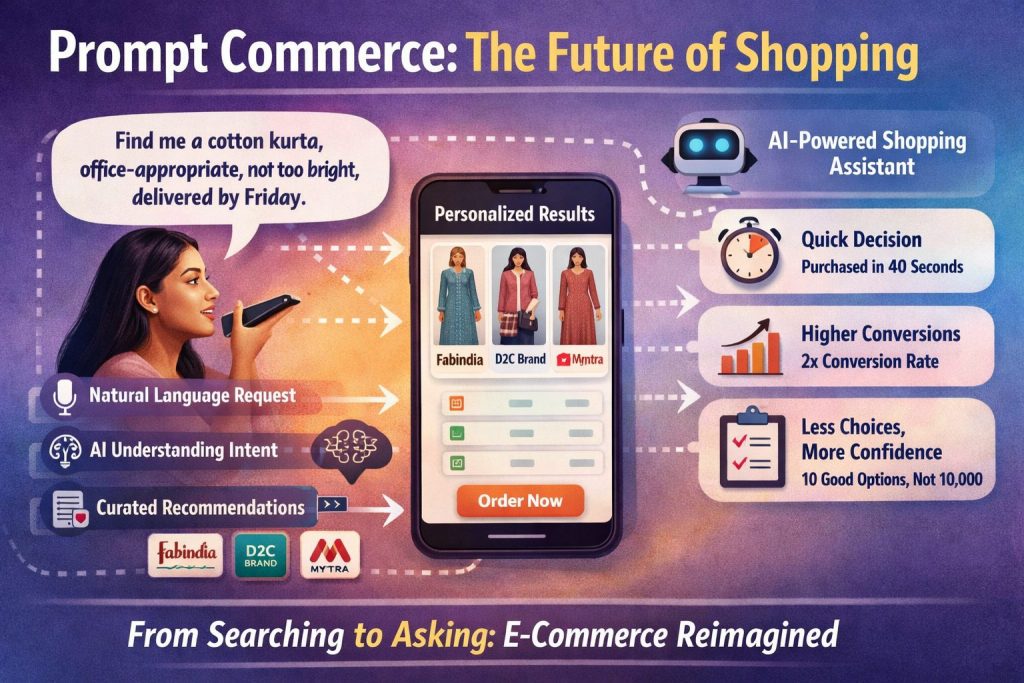
Image Courtesy: AI Generated Image
Course Relevance: Digital Marketing, Retail management & Commerce, Digital Marketing Analytics
Academic Concepts:
Platform Economics & Ecosystems:
AI platforms such as ChatGPT, Amazon Rufus, and Perplexity act as intermediaries
Consumer Behavior Transformation
Customers have reduced cognitive effort in decision-making.
There is a shift from marketplace to decision engine happening.
Digital Marketing Evolution:
There is a shift happening from SEO to AEO (Answer Engine Optimization)
Teaching Note:
Trigger Question- When was the last time you searched vs asked?
Case Discussion:
Discuss what is prompt commerce?
Ask them How is it different from e-commerce?
Concept Mapping:
Platform economics
Consumer behavior
Digital marketing shift
Debate:
Will AI replace the traditional e-Commerce platforms?
Wrap-Up
Introduce AEO plus Prompt Positioning to students.
Learning Objectives
After this case, students should understand:
✔ Shift from search → intent-based commerce
✔ Role of AI in decision-making
✔ Consumer psychology in digital buying
✔ Future of marketing
Key Concepts to Emphasize
1. Intent > Keywords
Earlier:
“Red shoes under ₹2000.”
Now:
“Something stylish for daily use but not expensive.”
2. Cognitive Load Reduction
Prompt commerce:
- Reduces thinking effort
- Increases buying speed
3. Trust Layer
AI becomes:
- Advisor
- Gatekeeper
4. Shift in Marketing Strategy
| Old | New |
| SEO | AEO |
| Page ranking | Answer ranking |
| Ads | Relevance |
Assignment: Practical Exercise
- Students create:
10 prompts for buying products and analyzing outputs
- How prompt commerce changes decision-making.
Discussion Questions:
- What is Prompt Commerce? How is it different from Search commerce, Voice commerce, and conversational commerce?
- Why does prompt commerce reduce decision fatigue?
- How did prompt-based discovery improve: Conversion rate (2x increase), Average order value (+12%)
- What is Answer Engine Optimization (AEO)?
- What are the risks of: AI bias, Wrong recommendations, Over-dependence on AI?
Ananya is standing in a crowded metro coach in Bengaluru. One hand is holding onto the overhead rail, and the other is holding her phone up to her chin. She doesn’t scroll. She talks.
“Find me a cotton kurta that I can breathe in, is appropriate for the office, isn’t too bright, and can be delivered by Friday.”
The assistant stops for less than a second. Then it gives you three choices. One from Fabindia. One from a D2C brand she hasn’t heard of before. One from Myntra, on sale.
She taps the second one.
“Will this get smaller after washing?”
“It’s cotton that has already shrunk. Based on 2,300 reviews, not much shrinkage.
She buys it. No tabs. No filters. No grid for comparisons.
The whole thing takes less than 40 seconds. I have done it myself. It’s quicker than unlocking your laptop.
And here’s the problem: she didn’t look for a product; she made a statement.
WHAT IS PROMPT COMMERCE?
Prompt commerce is when a customer uses natural language, either typed or spoken, to say what they need, and an AI system turns that into finding, evaluating, and buying a product. The prompt takes the place of the interface.
Not looking. Not looking around. Not even classic voice shopping.
Search wants you to turn your need into keywords. Voice commerce, like early Alexa shopping, still required strict commands like “Reorder toothpaste.” Conversational commerce added chat layers, but it often needed structured flows.
Prompt commerce is not the same. It starts off messy. People. Full of context.
“Something like Nike, but less expensive, for running in humid weather.”
That’s not a question. That’s something to think about.
Rufus from Amazon, which came out in 2024, does this. It lets people ask questions like “What would be a good gift for a 10-year-old who likes science?” and then gives them a list of products with explanations. Perplexity has started to test a “buy” button in answers. ChatGPT now combines shopping results with links to stores.
I tell my clients that traditional e-commerce is like a supermarket aisle. Prompt commerce is like a personal shopper who listens before doing anything.
I think this isn’t a niche feature. It’s a new door to the front.
THE CASE STUDY
Let us take a closer look at a real-life situation. India’s Tier 2. Commerce led by WhatsApp.
Say hello to Meesho.
By 2023, Meesho had more than 140 million users, and many of them lived outside of cities. But they had a problem. Friction in discovery.
People who were most likely to buy from them didn’t always search for clean keywords. Someone in Kanpur might think, “I need something nice to wear to my cousin’s wedding, but not too expensive.” It isn’t easy to turn that into filters like “ethnic wear > women > price < ₹2,000.”
There were a lot of drop-offs. According to internal estimates cited in industry reports, the conversion rate from session to purchase stayed around 2.5% in some categories.
Meesho tried different things.
They added a conversational layer to WhatsApp and later to their own app, which let users say what they wanted in simple Hindi, Hinglish, or regional languages. No buttons. Questions.
Someone could type, “Shaadi ke liye simple lehenga, heavy nahi, ₹2000 ke andar.”
The system would figure out what you wanted. Wedding. Simple is what I like. Budget: less than ₹2,000.
Then it would give you a list of products that had been chosen. Not a lot. Most of the time, less than 20.
But, and this is important, the magic wasn’t just in being able to understand language. It was about making choices easier.
They used data from similar users’ past purchases to train models. If 60% of people with similar prompts bought pastel colors, those colors were rated higher. They gave priority to sellers with lower return rates.
What happened?
In pilot areas, conversion rates are said to have gone up from about 2.5% to more than 5%. That’s a 2x rise. The average order value also went up by 12% because recommendations included items that went well together.
I’ve seen these kinds of patterns in other markets too. People spend more when you make it easier for them to think.
There’s something else going on here. Have faith.
Many people who are shopping online for the first time are afraid of having too many choices. Having too many options makes you feel like you’re taking a risk. It feels safer to get a guided recommendation.
In a panel discussion, one Meesho product manager said it plainly: “Our users don’t want 10,000 choices.” They want ten good ones.
That’s what people think. Not more options. Better understanding of intent.
And once users got that flow, they came back. The rates of repeat purchases in conversational cohorts were higher by double digits.
In my opinion, AI wasn’t the real breakthrough. It was about respecting how people really think.
THE MECHANICS
Let us make sense of what’s going on behind the scenes.
No technical terms. Just the flow.
A customer types, “Black sneakers for daily use that cost less than ₹3,000 and aren’t too big.”
Step one: processing the input.
The system takes the raw text and sends it to a language model. This could be a more precise version of GPT-like architectures or proprietary models that were trained on business data.
Step two: getting the intent.
The model points out important traits. Black is the color. Type: sneakers. The maximum price is ₹3,000. Use case: every day. Lightweight is the best choice.
Step three: translate the query.
The product database can understand these attributes as structured filters. You can think of it as turning a sentence into SQL queries.
Step four: getting back.
The system finds products that are similar. A lot of the time, hundreds.
Step five: putting in order.
This is where things get exciting. There are many factors that go into scoring products, such as how relevant they are to the prompt, their past conversion rates, the user’s history, the availability of inventory, the speed of delivery, and even the likelihood of a return.
Step six: the reasoning layer.
Some systems, such as Amazon Rufus, make explanations. “This shoe is light and has a 4.3-star rating from 12,000 people.”
Step seven: the interface.
A short list shows the results. Most of the time, there are 3 to 10 items. Not pages.
Step eight: the deal.
Payment flows are built in. One touch. Finished.
This all happens in less than two seconds.
There are a lot of things going on behind the scenes, like large language models, vector databases for semantic search, recommendation engines, and payment integrations.
But this is what matters. The system does more than just match words. It figures out what you want.
That’s the change.
IMPLICATIONS FOR BUSINESS
These are new rules. Quietly but deeply.
Let us begin with brands.
Your product page is less important if customers don’t look at pages anymore. Your information is more important. Structured attributes, reviews, and delivery promises are all things that AI uses to make decisions.
I call this “prompt positioning.”
It’s the skill of getting an AI to choose your product when someone says they need it. Not when they look for your brand name.
AEO is another term for Answer Engine Optimization.
SEO was about getting a high ranking on Google’s results page. AEO is about being the answer. If someone asks, “Best budget earbuds under ₹2,000,” and the AI suggests boAt 141, that’s the only shelf that matters.
I think we are going from page rank to answer rank.
Now, customers.
Prompt commerce makes things easier. That is clear. But it also makes exploration less likely. You don’t often look for a fourth option when an AI gives you three.
More convenience. Serendipity goes down.
I have seen this happen myself. I buy things faster when I use AI to shop, but I find less.
Finally, the ecosystem.
Marketplaces get stronger because they have control over data. Payment gateways work together more closely. Logistics gives you an edge over your competitors because delivery speed is now part of the recommendation algorithm.
What about smaller brands?
They have a chance. If their product fits a certain prompt well, they can show up without spending a lot on ads. That’s something new.
But this is important: it also means that we rely more on AI intermediaries.
Gatekeepers don’t go away. They change.
TENSIONS AND UNANSWERED QUESTIONS
There are cracks under the surface.
First, privacy.
Context is needed for quick commerce. Place, likes and dislikes, and past actions. The system works better the more it knows. But how much is too much? The Digital Personal Data Protection Act in India is still being tested in real life.
Second, seeing things that aren’t there.
AI can be wrong. People quickly lose trust in a system that confidently suggests a product that doesn’t meet their needs. People have already criticized Amazon for giving wrong summaries in early Rufus tests.
Third, being dependent.
Brands become dependent on algorithms they can’t control if 70% of discovery happens through AI layers. We’ve seen this movie with ads on Facebook.
And then there is exclusion.
Not everyone is comfortable asking questions in English or even typing out long ones. Voice helps, but systems still get confused by accents and dialects.
I think that adoption will be uneven. But it’s clear which way to go.
THE FINAL THOUGHT
It used to be that shopping was visual. After that, it could be searched.
It’s starting to sound like a conversation now.
But here’s what is really changing. We are hiring someone else to do articulation.
We don’t need to know what to click anymore. We only need to say what we want.
I’ve watched interfaces change over the years. The buttons got smaller. Menus got better. But this feels different.
Because the interface is going away.
And when that happens, the people who win won’t be the ones with the best websites.
They will be the ones who can best understand a sentence like, “I want something simple but special.”
And act like a person would.
References:
- Amazon. (2024). Introducing Rufus: Amazon’s AI-powered shopping assistant. Retrieved from https://www.aboutamazon.com/news/retail/amazon-rufus-ai-shopping-assistant
- Meesho. (2023). Annual report and user growth insights. Retrieved from https://www.meesho.io
- Economic Times. (2024). Indian startups shift focus from growth to profitability amid funding slowdown. Retrieved from https://economictimes.indiatimes.com
- Business Standard. (2024). Rise of performance marketing and CAC pressures in Indian startups. Retrieved from https://www.business-standard.com
- McKinsey & Company. (2023). The future of personalization and AI in retail. Retrieved from https://www.mckinsey.com
- Statista. (2024). E-commerce user behavior and conversion trends in India. Retrieved from https://www.statista.com