







Assistant Professor, International School of Management Excellence, Bengaluru.
Email: ratchana@isme.in
Assistant Professor, International School of Management Excellence, Bengaluru.
Email: sudindravr@isme.in
Abstract:
The Altman Z-Score Model has been employed to predict financial distress since its original conception in 1968. The model is perceived to be detailed in its methodology for assessing financial failure because it is predicated on values available in a company’s financial statements as well as principles established by influences extraneous to the firm’s operations.
This study investigates the internal dynamics of the Altman Z-Score model and examines its potential as a predictive factor of bankruptcy.
The research also evaluates the relationship between a firm’s Altman Z-Score and its mean share value in the Indian Manufacturing Sector using 20 randomly selected NSE-listed manufacturing companies for the period 2018–2022.
The study highlights a significant relationship between stock prices and Z-scores and suggests that investors can evaluate Zeta (ζ) index scores before making investment decisions in financially distressed companies.
Keywords: Altman Z-Score Model, Stock Prices, Financial Health, Indian Manufacturing Sector, Prediction Models, Bankruptcy
Introduction
India has transitioned from an agriculture-driven economy to a service-based economy over the past few decades.
The Indian government has recently focused on manufacturing and services sectors through initiatives such as “Make in India” and “Make AI Startup in India”.
Financial strength is essential for corporate survival, profitability, and shareholder wealth creation.
Investors and stakeholders evaluate a company’s financial health through accounting metrics such as balance sheets, income statements, cash flows, and profitability ratios.
Understanding a company’s financial health is critical before making investment decisions to avoid risks such as insolvency, scams, and financial crimes.
Business Failure
Business failure refers to a company’s inability to continue operations due to financial challenges.
Failure to repay debts can result in bankruptcy or divestiture.
Fitzpatrick (1932) identified five stages of insolvency:
- Incubation
- Fiscal Embarrassment
- Economic Insolvency
- Complete Insolvency
- Confirmed Insolvency
Altman Z Score Model
Edward I. Altman developed the Altman Z-Score framework in 1968 as a financial distress forecasting model.
The model evaluates a company’s financial condition using five financial ratios:
- X1: Working Capital / Total Assets (WC/TA)
- X2: Retained Earnings / Total Assets (RE/TA)
- X3: EBIT / Total Assets (EBIT/TA)
- X4: Market Value of Equity / Total Liabilities (MVE/TL)
- X5: Sales / Total Assets (S/TA)
Original Altman Formula:
Zeta (ζ) = 0.012X1 + 0.014X2 + 0.033X3 + 0.006X4 + 0.999X5
Revised Altman Formula:
Zeta (ζ) = 1.2X1 + 1.4X2 + 3.3X3 + 0.6X4 + 1.0X5
Classification based on Z-score:
- Z-score above 3 = Safe Zone
- Z-score between 1.8 and 3 = Grey Zone
- Z-score below 1.8 = Distress Zone
Literature Review
Previous studies applied the Altman Z-Score model to evaluate financial distress, bankruptcy prediction, corporate performance, and insolvency risk across different sectors and countries.
Researchers also examined the relationship between Z-scores and stock prices, profitability, and corporate sustainability.
The literature confirmed that the Altman Z-Score model is an effective tool for predicting financial distress in manufacturing firms.
Research Methodology
The study aimed to:
- Assess Altman Z-Scores for listed manufacturing firms in India.
- Evaluate the relationship between Altman Z-Scores and stock prices.
The study analysed audited financial statements of 20 randomly selected NSE-listed Indian manufacturing companies over the period 2018–2022.
Stock prices and Z-score data were verified using Top Stock Research (TSR) and NSE records.
Correlation analysis was conducted using Jamovi statistical software.
Analysis and Interpretation
The study analysed five years of financial data to calculate Altman Z-Scores and compare them with stock price movements.
Correlation tests were performed to determine whether stock prices and Z-scores were significantly related.
Table 1: Altman Z-Score Analysis
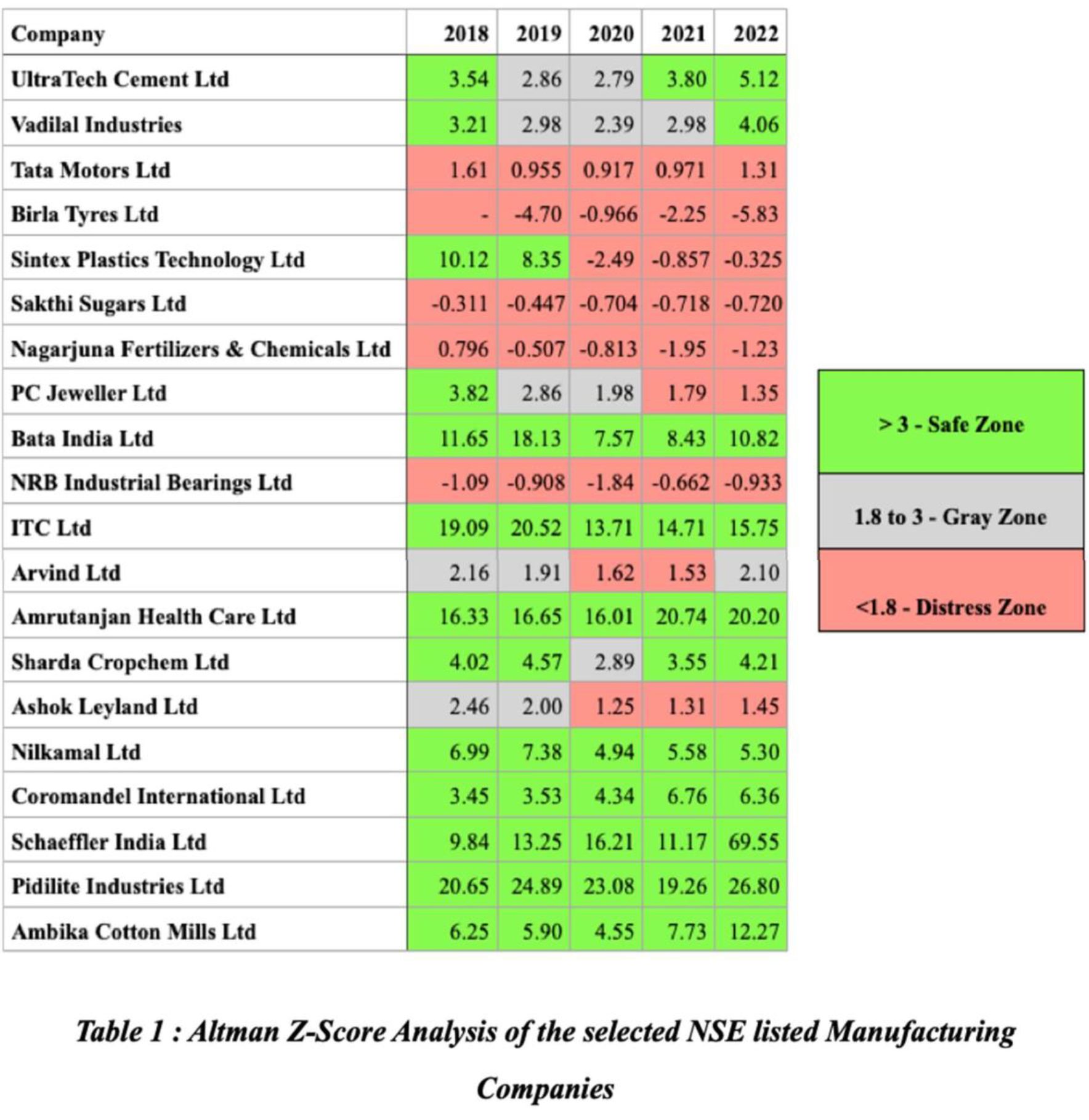
The table classifies companies into Safe Zone, Grey Zone, and Distress Zone based on their Z-scores.
Table 2: Share Prices of Selected NSE Listed Manufacturing Companies
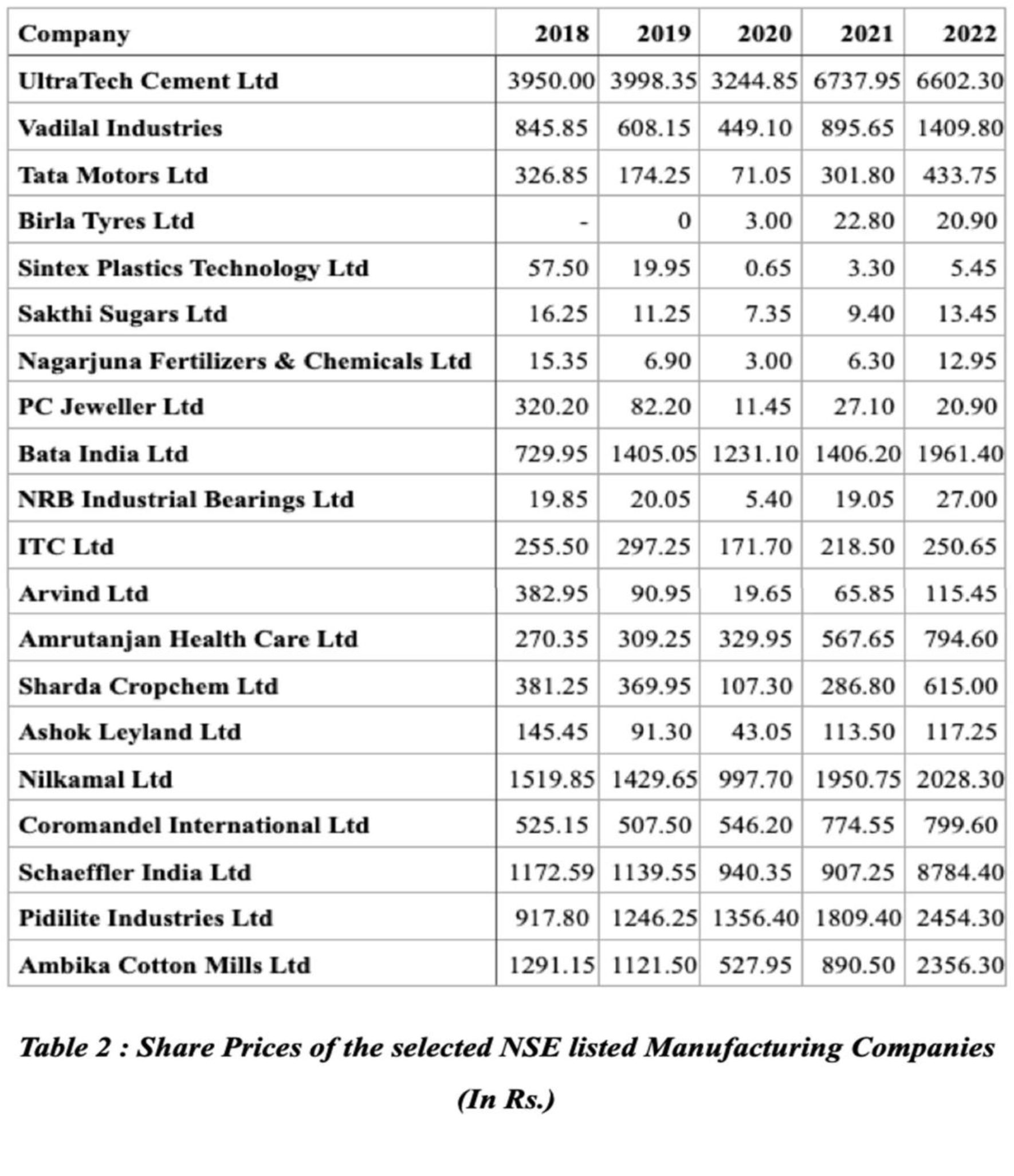
The table presents stock price trends of selected companies from 2018 to 2022.
Table 3: Correlation between Stock Prices and Altman Z-Scores
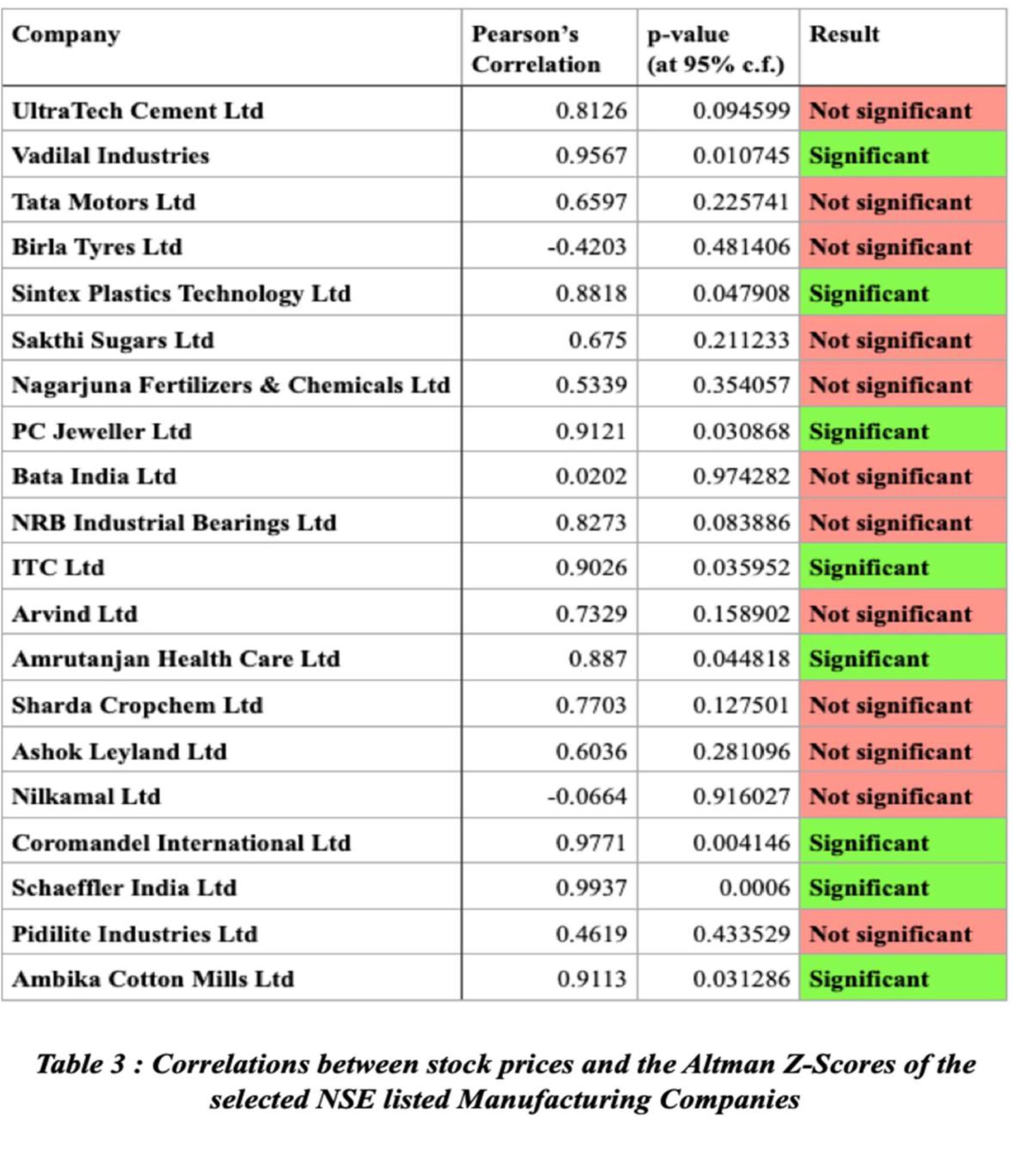
The results showed that some companies demonstrated significant relationships between stock prices and Altman Z-scores, while others did not.
Findings, Suggestions and Implications
The research indicated that the Altman Z-Score model is an effective predictor of financial distress in manufacturing companies.
Companies with negative or declining Z-scores often displayed signs of financial instability and insolvency risk.
The study highlighted Birla Tyres Ltd. as an example where declining Z-scores preceded insolvency proceedings.
Positive Z-scores corresponded with financially healthy and sustainable firms.
However, the model has limitations because it only considers five financial dimensions and ignores qualitative factors such as management quality, market conditions, and innovation.
Scope for Further Research and Limitations
The study was limited to 20 publicly listed manufacturing companies in India.
Future research can expand the sample size and include multiple industry sectors.
Further modifications to the Altman Z-score parameters may improve predictive accuracy.
The study also suggests integrating AI-powered tools and advanced predictive analytics for financial distress forecasting.
Conclusion
Financial health and economic distress are critical indicators of a company’s long-term sustainability and operational efficiency.
The Indian manufacturing sector has evolved significantly due to globalization, competition, and technological advancements.
The Altman Z-Score model provides valuable insights into corporate financial health and can support investors, lenders, and policymakers in making informed decisions.
The study contributes to understanding financial distress prediction and highlights the importance of sustainable financial management practices.
References
Agarwal, A., & Patni, I. (2019). Applicability of Altman Z-score in bankruptcy prediction of BSE PSUs.
Aharony, J., Jones, C. P., & Swary, I. (2004). Analysis of Risk and Return Characteristics of Corporate Bankruptcy.
Almamy, J., Aston, J., & Ngwa, L. N. (2016). Evaluation of Altman’s Z-score using cash flow ratio.
Altman, E. I. (1968). Financial ratios, Discriminant Analysis and Prediction of Corporate Bankruptcy.
Altman, E. I. (2013). Predicting financial distress of companies: Revisiting the Z-score models.
Batchelor, T. (2018). Corporate bankruptcy: Testing the efficacy of the Altman Z-score.
Dangayach, & Deshmukh. (2007). Manufacturing flexibility: A multi-sector study of Indian companies.
Foo, S. L., & Pathak, S. (2019). Examination of corporate performance and Altman Z-Scores.
Korath, M., & Nayak, S. (2022). Financial Distress Prediction using Accounting Variables.
Nandini, A. S., Zachariah, M., & Rao, S. (2018). Predicting Corporate Failure of ITI Ltd.