






Abstract: This study investigates how remote work strategies influence employee productivity and employees’ sustained intention to continue remote work arrangements. Drawing on theoretical foundations from Work Design Theory, the Resource-Based View, the Technology Acceptance Model, Social Exchange Theory, and the Theory of Planned Behavior, the research examines direct and mediated relationships among Remote Work Strategy, Information Systems (IS) Resources, Employee Productivity, and Continuous Intention to Remote Work. A descriptive research design was employed with a structured questionnaire administered to 223 respondents engaged in remote or hybrid work environments. Structural Equation Modelling (SEM) was used to analyze the data. Findings reveal that IS Resources significantly influence both employee productivity and the intention to continue remote work, while Remote Work Strategy exerts its effect primarily through the mediating role of productivity. The study addresses a notable research gap by demonstrating that strategic frameworks alone are insufficient without supporting technological infrastructure and managerial execution. These insights offer actionable guidance for HR professionals and organizational leaders striving to build sustainable remote work cultures in the post-pandemic era.
Key Words: Remote Work Strategy, Employee Productivity, IS Resources, Employee Support, Organizational Communication, Workforce Engagement, Continuous Intention to Remote Work.
1. Introduction:
The global transition to remote work, accelerated by the COVID-19 pandemic, has fundamentally transformed the organizational landscape. What initially began as an emergency response has evolved into a strategic model adopted by firms seeking to leverage flexibility, reduce operational costs, and attract global talent (Nowrouzi-Kia et al., 2023; Anakpo et al., 2023). However, the sustainability of remote work depends on more than mere adoption—it requires deliberate strategy, technological enablement, and the continuous commitment of employees to operate effectively in distributed environments.
Despite the growing body of research on remote work, significant gaps persist in understanding how organizational strategy and information systems infrastructure jointly shape employee productivity, and how productivity in turn mediates employees’ intention to persist in remote work arrangements. Prior studies have largely examined these variables in isolation, without exploring the integrative pathways through which strategic and technological factors translate into long-term remote work commitment (Nwankpa & Roumani, 2024; Hlapa & Majola, 2024).
This study addresses that gap by examining four interrelated constructs: Remote Work Strategy (RWS), IS Resources (ISR), Employee Productivity (EP), and Continuous Intention to Remote Work (CI). The research proposes that remote work strategy and IS resources drive productivity, and that productivity, in turn, fosters employees’ ongoing preference for remote work. Additionally, IS resources are expected to exert both direct and indirect influences on the intention to continue remote work. Understanding these mechanisms is particularly critical as organizations navigate the shift from pandemic-era mandates to voluntary hybrid arrangements, where employee buy-in and sustained performance are paramount.
This paper is organized as follows: Section 2 reviews the theoretical background and presents the conceptual framework. Section 3 states the research objectives. Section 4 outlines the methodology. Section 5 presents the data analysis and findings. Sections 6 and 7 offer discussion and conclusions, followed by managerial recommendations.
2. THEORETICAL BACKGROUND AND LITERATURE REVIEW
2.1 Research Gap
While numerous studies have explored individual antecedents of remote work productivity—such as work-life balance, self-efficacy, leadership behavior, and technology use—few have examined these within an integrated structural model that simultaneously accounts for the mediating role of employee productivity in linking organizational inputs to long-term remote work intention (Peters, 2025; Galchik, 2024). Furthermore, most extant research was conducted during or immediately following the peak of the pandemic, limiting generalizability to the stabilized post-pandemic context in which hybrid and remote arrangements are now strategic rather than reactive (Tsang et al., 2023; Hashmi et al., 2023). This study addresses these gaps by proposing and testing a theoretically grounded model that integrates remote work strategy, IS resources, employee productivity, and continuous intention within a single analytical framework.
2.2 Remote Work Strategy
Work Design Theory (Hackman & Oldham, 1976) posits that job characteristics—such as skill variety, task identity, task significance, autonomy, and feedback—are critical determinants of employee motivation and performance. In the remote work context, strategy plays a structuring role analogous to formal job design, providing employees with both operational clarity and behavioral flexibility. A well-articulated remote work strategy encompasses clear communication norms, accountability frameworks, structured check-ins, and digital collaboration protocols that preserve the motivational core of work design principles even outside conventional office environments.
Empirical evidence supports the view that strategically managed remote work positively influences performance outcomes. Campbell (2023) found that flexible work schedules aligned with organizational goals enhanced employee output and satisfaction. Similarly, Hashmi et al. (2023) demonstrated that structured flexible work arrangements improved perceived productivity and organizational commitment in a UAE-based study. Together, these findings suggest that strategy functions not merely as a policy document but as an enabler of effective remote performance when properly executed.
2.3 IS Resources
The Resource-Based View (Barney, 1991) conceptualizes IS resources as strategic assets that generate competitive advantage by augmenting employee capabilities beyond what competitors can easily replicate. In remote environments, where physical infrastructure is absent, information systems—including collaboration platforms, project management tools, cloud-based data systems, and secure communication networks—become the primary substrate of organizational functioning.
The Technology Acceptance Model (Davis, 1989) further elucidates the link between IS resources and employee outcomes by highlighting two key determinants: perceived usefulness and perceived ease of use. When employees find digital tools genuinely helpful and easy to navigate, their adoption and integration into daily work routines are higher, which in turn enhances both productivity and satisfaction. Nwankpa and Roumani (2024) found that digital business intensity moderated the relationship between remote work and innovation, underscoring the role of IS infrastructure in enabling performance beyond mere task completion. Semwal et al. (2024) similarly documented strong associations between technology access and remote worker productivity in the IT sector.
2.4 Employee Productivity
Social Exchange Theory (Blau, 1964) offers a powerful lens for understanding employee productivity in remote contexts. The theory posits that when organizations invest in employees—through strategic support, technological resources, and managerial attention—employees reciprocate through increased effort, commitment, and output. In remote settings, where direct supervision is diminished, productivity becomes a key behavioral expression of this exchange dynamic.
Ravhudzulo and Eresia-Eke (2024) found that employee engagement and telecommuting propensity significantly predicted performance in virtual workplaces. Anakpo et al. (2023) conducted a systematic review confirming that work-from-home arrangements positively affected employee performance when adequately supported. These findings reinforce the mediating potential of productivity between organizational inputs and employee behavioral intentions.
2.5 Continuous Intention to Remote Work
The Theory of Planned Behavior (Ajzen, 1991) provides the theoretical basis for understanding employees’ sustained commitment to remote work. According to this framework, behavioral intentions are shaped by attitudes toward the behavior, subjective norms, and perceived behavioral control. Employees who perceive themselves as productive, feel technologically empowered, and experience organizational support are likely to form positive attitudes toward continued remote work.
Galchik (2024) found that self-leadership and self-efficacy were significant predictors of engagement and remote work intention among municipal government employees. Peters (2025) demonstrated that leadership behaviors that foster trust and autonomy positively predicted remote employee engagement, which is closely tied to the intention to continue remote arrangements. These studies collectively suggest that both strategic and technological factors shape remote work intentions through their effects on productivity and psychological empowerment.
2.6 Hypotheses Development
Based on the theoretical framework and literature reviewed, the following hypotheses are proposed:
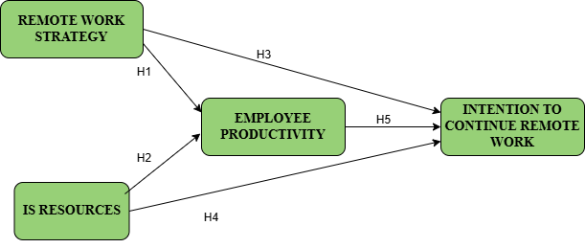
- H1: Remote Work Strategy has a positive and significant effect on Employee Productivity.
- H2: IS Resources have a positive and significant effect on Employee Productivity.
- H3: Remote Work Strategy has a positive and significant effect on Continuous Intention to Remote Work.
- H4: IS Resources have a positive and significant effect on Continuous Intention to Remote Work.
- H5: Employee Productivity has a positive and significant effect on Continuous Intention to Remote Work.
Figure 1: Conceptual Framework
3. OBJECTIVES OF THE STUDY
- To examine the effect of remote work strategies and IS resources on employee productivity.
- To analyze the influence of employee productivity on employees’ continuous intention to continue working remotely.
- To investigate the mediating effect of employee productivity between remote work strategy and employees’ continuous intention to remote work.
- To investigate the mediating effect of employee productivity between IS resources and employees’ continuous intention to remote work.
4. METHODOLOGY
This study adopts a descriptive research design, appropriate for systematically analyzing the current state of variables and their interrelationships without experimental manipulation. The design is well-suited for investigating constructs such as IS Resources, Remote Work Strategy, Employee Productivity, and Continuous Intention to Remote Work using quantitative data.
A purposive sampling technique was employed to recruit 223 participants actively engaged in remote or hybrid work environments. As a non-probability method, purposive sampling enabled selection of respondents with relevant experience, ensuring that responses reflect informed perspectives on remote work dynamics and thereby enhancing validity.
Primary data were collected via a structured questionnaire distributed digitally through Google Forms. The instrument incorporated Likert-scale items to measure perceptions related to all four constructs. Secondary data drawn from Google Scholar, ResearchGate, ScienceDirect, and ProQuest supplemented and contextualized the primary findings.
Data analysis involved descriptive statistics (mean, standard deviation, range), one-way ANOVA to test group differences, and Structural Equation Modelling (SEM) using SmartPLS to examine both direct and indirect relationships among the constructs. Model reliability and validity were assessed through Cronbach’s Alpha, Average Variance Extracted (AVE), and Composite Reliability (CR).
Limitations
This study acknowledges several limitations. First, purposive sampling introduces potential sample bias, as participants were selected based on their engagement in remote work and may not fully represent all remote worker profiles. Second, the reliance on self-reported measures may introduce common method variance. Third, the study was conducted during the post-pandemic transition period, which may influence respondents’ attitudes toward remote work in ways that do not generalize to more stable future contexts. Future research should employ probability sampling and longitudinal designs to strengthen causal inference.
5. DATA ANALYSIS
Table 1 presents a summary of the demographic and experiential characteristics of respondents.
| Variable | Category | No. of Respondents | Percentage (%) |
|---|---|---|---|
| Age | 20–29 | 140 | 62.8 |
| 30–39 | 68 | 30.5 | |
| 40–49 | 14 | 6.3 | |
| Above 50 | 1 | 0.4 | |
| Gender | Male | 124 | 55.6 |
| Female | 99 | 44.4 | |
| Experience | Less than 1 year | 97 | 43.5 |
| 1–4 years | 52 | 23.3 | |
| 5–10 years | 55 | 24.7 | |
| Above 10 years | 19 | 8.5 | |
| Educational Qualification | UG | 129 | 57.8 |
| PG | 94 | 42.2 | |
| Marital Status | Married | 84 | 37.7 |
| Unmarried | 139 | 62.3 | |
| Residential Location | With Parents | 86 | 38.6 |
| With Spouse | 37 | 16.6 | |
| With Spouse and In-laws | 26 | 11.7 | |
| Other | 74 | 33.2 |
5.1 One-Way ANOVA
Table 2 presents the ANOVA results examining differences across residential locations for the four study constructs.
| Variable | Source | Sum of Squares | df | Mean Square | F | Sig. |
|---|---|---|---|---|---|---|
| CI | Between Groups | 5.772 | 3 | 1.924 | 2.414 | .068 |
| Within Groups | 174.535 | 219 | .797 | – | – | |
| Total | 180.307 | 222 | – | – | – | |
| EP | Between Groups | 3.708 | 3 | 1.236 | 1.714 | .165 |
| Within Groups | 157.896 | 219 | .721 | – | – | |
| Total | 161.604 | 222 | – | – | – | |
| RWS | Between Groups | 8.667 | 3 | 2.889 | 5.254 | .002* |
| Within Groups | 120.437 | 219 | .550 | – | – | |
| Total | 129.104 | 222 | – | – | – | |
| ISR | Between Groups | 2.276 | 3 | .759 | 1.401 | .243 |
| Within Groups | 118.577 | 219 | .541 | – | – | |
| Total | 120.853 | 222 | – | – | – |
The ANOVA results indicate that Remote Work Strategy (RWS) shows statistically significant variation across residential locations (p = 0.002), suggesting that employees’ perceptions of remote work strategy are influenced by where they live. This likely reflects differences in digital infrastructure, workspace availability, and community norms between urban and rural settings. In contrast, Continuous Intention (CI), Employee Productivity (EP), and IS Resources (ISR) show no significant variation across locations (p > 0.05), implying that these constructs are perceived relatively uniformly—possibly due to standardized organizational policies and digital tool availability regardless of geography.
5.2 Model Validation
Figure 2: Model for Remote Work Strategy and IS Resources Influences Employee Productivity: Continuous Intention to Remote Work
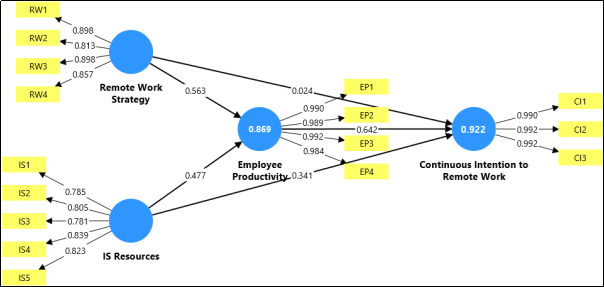
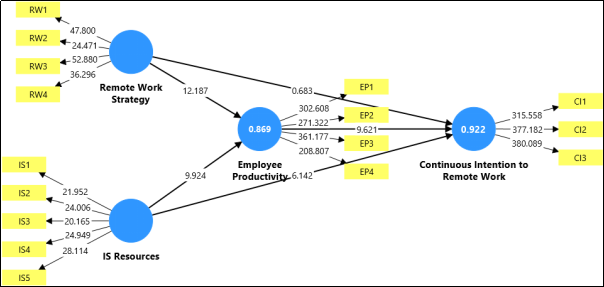
Figure 3: Bootstrapped Model Remote Work Strategy and IS Resources Influences Employee Productivity: Continuous Intention to Remote Work
5.3 Reliability and Validity
Table 3 presents the reliability and validity indicators for all constructs.
| Construct | Item | Loading | Indicator Loading² | Cronbach’s Alpha | CR (rho_a) | CR (rho_c) | AVE |
|---|---|---|---|---|---|---|---|
| CI | CI1 | 0.990 | 0.980 | 0.991 | 0.991 | 0.994 | 0.983 |
| CI2 | 0.992 | 0.984 | |||||
| CI3 | 0.992 | 0.984 | |||||
| EP | EP1 | 0.990 | 0.980 | 0.992 | 0.992 | 0.994 | 0.977 |
| EP2 | 0.989 | 0.978 | |||||
| EP3 | 0.992 | 0.984 | |||||
| EP4 | 0.984 | 0.968 | |||||
| IS | IS1 | 0.785 | 0.616 | 0.866 | 0.867 | 0.903 | 0.651 |
| IS2 | 0.805 | 0.648 | |||||
| IS3 | 0.781 | 0.610 | |||||
| IS4 | 0.839 | 0.704 | |||||
| IS5 | 0.823 | 0.677 | |||||
| RW | RW1 | 0.898 | 0.806 | 0.890 | 0.892 | 0.924 | 0.752 |
| RW2 | 0.813 | 0.661 | |||||
| RW3 | 0.898 | 0.806 | |||||
| RW4 | 0.857 | 0.734 |
All four constructs—CI, EP, IS, and RW—demonstrate strong psychometric properties. All indicator loadings exceed the recommended threshold of 0.70, with CI and EP items approaching 0.99, reflecting near-perfect reliability. IS and RW loadings range from 0.781 to 0.898, indicating robust measurement. Cronbach’s Alpha values are well above 0.70 for all constructs, confirming strong internal consistency. Composite reliability values (rho_c) further reinforce these conclusions: CI (0.994), EP (0.994), IS (0.903), and RW (0.924). AVE values exceed the 0.50 threshold across all constructs, supporting convergent validity. These results confirm that the measurement model is statistically sound and suitable for structural analysis.
Table 4 presents the discriminant validity analysis using AVE comparison with inter-construct correlations.
| Construct | CI | EP | IS | RW | AVE |
|---|---|---|---|---|---|
| Continuous Intention to Remote Work (CI) | 0.992 | 0.983 | |||
| Employee Productivity (EP) | 0.941 | 0.989 | 0.977 | ||
| IS Resources (IS) | 0.880 | 0.817 | 0.807 | 0.651 | |
| Remote Work Strategy (RW) | 0.776 | 0.851 | 0.604 | 0.867 | 0.752 |
Table 4: Discriminant Validity — AVE vs. Inter-Construct Correlations (diagonal = square root of AVE)
The discriminant validity analysis confirms that each construct’s AVE exceeds its squared correlations with other constructs, meeting the Fornell-Larcker criterion. CI achieves the highest AVE (0.983), followed by EP (0.977), RW (0.752), and IS (0.651). The diagonal elements (square roots of AVE) exceed all off-diagonal correlations in their respective rows and columns, affirming that each construct captures more variance from its indicators than from any other construct. Discriminant validity is thus established across the model.
5.4 Structural Model Assessment
Table 5: Structural Model — Hypothesis Testing Results
| Hypothesis (Null) | Path | β (Original Sample) | T-Value | Decision |
|---|---|---|---|---|
| No significant effect of EP on CI | EP → CI | 0.642 | 9.621 | Null Rejected (H5 Supported) |
| No significant effect of IS on CI | IS → CI | 0.341 | 6.142 | Null Rejected (H4 Supported) |
| No significant effect of IS on EP | IS → EP | 0.477 | 9.924 | Null Rejected (H2 Supported) |
| No significant effect of RW on CI | RW → CI | 0.024 | 0.683 | Null Accepted (H3 Not Supported) |
| No significant effect of RW on EP | RW → EP | 0.563 | 12.187 | Null Rejected (H1 Supported) |
The structural model results confirm four of the five hypotheses. Remote Work Strategy significantly predicts Employee Productivity (β = 0.563, T = 12.187), and IS Resources significantly predict both Employee Productivity (β = 0.477, T = 9.924) and Continuous Intention to Remote Work (β = 0.341, T = 6.142). Employee Productivity significantly predicts Continuous Intention (β = 0.642, T = 9.621). However, the direct path from Remote Work Strategy to Continuous Intention was not significant (β = 0.024, T = 0.683), indicating that strategy operates through productivity rather than independently influencing remote work intention.
5.5 Mediation Analysis
Figure 4: RW – EP – CI Bootstrapped model before and after the introduction of the mediator
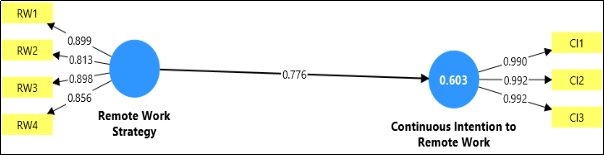
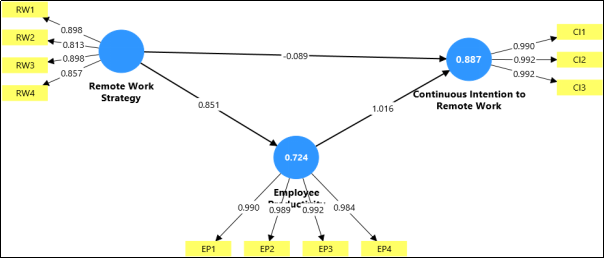
Mediation of Remote Work Strategy on Continuous Intention through Employee Productivity: Prior to the introduction of Employee Productivity as a mediator, Remote Work Strategy showed a strong direct path to Continuous Intention (β = 0.776). Once Employee Productivity was included, this direct effect dropped sharply to -0.089 (negligible and non-significant), while the indirect (mediated) effect registered at 0.362 with a T-value of 7.048, confirming statistical significance. This pattern is consistent with full mediation: Remote Work Strategy does not independently shape employees’ intention to continue remote work. Its influence is entirely channeled through its capacity to enhance productivity. This finding implies that well-designed strategies matter only insofar as they translate into tangible performance improvements.
Figure 5: ISR – EP – CI Bootstrapped model before and after the introduction of the mediator
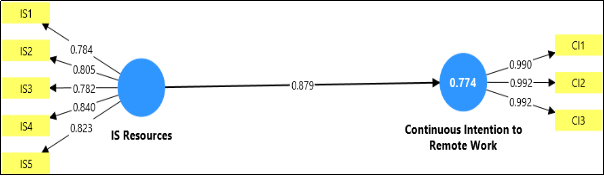
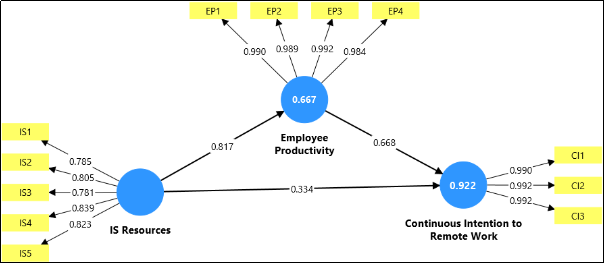
Mediation of IS Resources on Continuous Intention through Employee Productivity: Prior to mediation, IS Resources held a strong direct effect on Continuous Intention (β = 0.879). After introducing Employee Productivity, this direct effect declined to 0.334, but remained significant, while an indirect effect of 0.306 (T = 7.928) was also established. This result is consistent with partial mediation: IS Resources influence employees’ remote work intentions both directly and through their role in improving productivity. The dual pathway underscores the importance of IS infrastructure not just as a productivity enabler but as an independent signal of organizational investment in remote work sustainability.
| Hypothesis (Null) | Path | β | T-Value | Decision |
|---|---|---|---|---|
| EP does not mediate IS → CI | IS → EP → CI | 0.306 | 7.928 | Null Rejected (Partial Mediation) |
| EP does not mediate RW → CI | RW → EP → CI | 0.362 | 7.048 | Null Rejected (Full Mediation) |
6. FINDINGS
The following key findings emerge from the structural and mediation analyses:
- Remote Work Strategy exerts a strong and significant effect on Employee Productivity (H1 supported), but has no direct significant effect on Continuous Intention to Remote Work (H3 not supported). This suggests that strategic frameworks alone are insufficient to sustain remote work commitment; they must actively improve employee performance to have any lasting effect on remote work intentions.
- IS Resources significantly predict both Employee Productivity (H2 supported) and Continuous Intention to Remote Work (H4 supported), confirming the dual role of technological infrastructure as both a performance enabler and a direct driver of employee commitment to remote arrangements.
- Employee Productivity significantly predicts Continuous Intention to Remote Work (H5 supported), establishing productivity as a critical conduit through which organizational investments in strategy and technology translate into sustained behavioral intentions.
- Employee Productivity fully mediates the relationship between Remote Work Strategy and Continuous Intention (full mediation), and partially mediates the relationship between IS Resources and Continuous Intention (partial mediation). These findings advance understanding of how and why strategic and technological inputs convert to remote work persistence.
7. DISCUSSION
The findings of this study carry significant theoretical and practical implications. From a theoretical standpoint, they extend Social Exchange Theory by demonstrating that employee productivity serves as the behavioral currency through which organizational investments in strategy and technology are converted into long-term remote work commitment. Employees appear to experience a reciprocal obligation: when organizational strategy and IS resources make them more productive, they respond by endorsing the continuation of the remote work arrangement that enabled that productivity.
The finding that Remote Work Strategy has no direct effect on Continuous Intention—but operates fully through Employee Productivity—adds an important qualification to prior research that has treated strategic support as an independent predictor of remote work attitudes (Hashmi et al., 2023; Campbell, 2023). The current findings suggest that the mechanism matters as much as the construct: strategy must demonstrably improve performance to influence intention.
The partial mediation finding for IS Resources reflects a more nuanced mechanism. IS infrastructure directly signals organizational commitment to remote work, independent of its productivity-enhancing effects. This aligns with the Technology Acceptance Model (Davis, 1989), where perceived usefulness of technology shapes attitudes and behavioral intentions beyond its actual productivity impact.
The study also extends the Theory of Planned Behavior to the remote work domain by showing that perceived behavioral control—operationalized here as IS-enabled capability and productivity—is a stronger predictor of intention than organizational policy alone. Policymakers and HR managers should therefore focus not just on communicating strategy but on ensuring that the technological and managerial conditions exist for that strategy to translate into measurable employee performance.
Regarding the ANOVA findings, the significant variation in Remote Work Strategy perceptions across residential locations suggests that strategy design must be sensitive to contextual heterogeneity, particularly differences in home infrastructure, connectivity, and workspace quality across urban and peri-urban settings.
8. RECOMMENDATIONS
Based on the findings and discussion, the following recommendations are proposed for organizational leaders and HR professionals:
- Invest strategically in IS infrastructure: Organizations must prioritize dependable internet connectivity, cloud-based collaboration tools, secure data access, and real-time communication platforms. The study demonstrates that IS resources are the most direct organizational lever for enhancing both productivity and remote work intention.
- Design executable, not just declarative, remote work strategies: Strategy documents must be accompanied by operational mechanisms—structured check-ins, clear accountability frameworks, outcome-based performance metrics, and defined communication norms. A policy that does not translate into improved performance will not sustain remote work commitment.
- Address geographic disparities in remote work support: Given that perceptions of Remote Work Strategy vary significantly across residential locations, organizations should assess and mitigate infrastructure inequalities—for example, through stipends for home office equipment or subsidized broadband access for employees in underserved areas.
- Provide targeted capability-building programs: Employees should receive training in remote collaboration tools, time management, virtual teamwork, and digital communication skills. Empowering employees to use IS resources effectively amplifies the productivity benefits that ultimately drive sustained remote work engagement.
- Institutionalize feedback mechanisms: Regular structured check-ins and pulse surveys should be employed to monitor employee well-being, detect isolation, and identify strategic misalignments. Responsive management adjustments based on this feedback will sustain the cycle of productivity and remote work commitment.
9. CONCLUSION
This study examined the structural relationships among Remote Work Strategy, IS Resources, Employee Productivity, and Continuous Intention to Remote Work among 223 employees in hybrid and remote work settings. Using SEM via SmartPLS, the research demonstrated that while Remote Work Strategy significantly enhances employee productivity, its influence on remote work intention is entirely mediated by that productivity gain—a finding consistent with full mediation. IS Resources, meanwhile, independently influence both productivity and remote work intention, with partial mediation through productivity confirming a dual pathway.
These results highlight a fundamental insight: organizational strategy for remote work is a necessary but insufficient condition for sustaining employee commitment to remote arrangements. Its effectiveness is contingent on the quality of IS infrastructure and the degree to which strategic frameworks are operationalized into measurable improvements in employee performance. Organizations that align remote work policy with technological investment and managerial execution will be better positioned to cultivate a resilient, productive, and voluntarily committed remote workforce in the post-pandemic era.
Future research should explore longitudinal designs to track how remote work intentions evolve over time, and should incorporate organizational culture, leadership style, and team dynamics as additional moderating or mediating variables in this framework.
REFERENCES
Ajzen, I. (1991). The theory of planned behavior. Organizational Behavior and Human Decision Processes, 50(2), 179–211.
Anakpo, G., Nqwayibana, Z., & Mishi, S. (2023). The impact of work-from-home on employee performance and productivity: A systematic review. Sustainability, 15(5), 4529. https://doi.org/10.3390/su15054529
Barney, J. (1991). Firm resources and sustained competitive advantage. Journal of Management, 17(1), 99–120.
Blau, P. M. (1964). Exchange and power in social life. Wiley.
Campbell, K. M. (2023). Flexible work schedules, virtual work programs, and employee productivity [Doctoral dissertation, Walden University].
Davis, F. D. (1989). Perceived usefulness, perceived ease of use, and user acceptance of information technology. MIS Quarterly, 13(3), 319–340.
Galchik, J. G. (2024). Exploring the role of self-leadership in enhancing self-efficacy and engagement among remote municipal government employees (Publication No. 31768714) [Doctoral dissertation, Wayland Baptist University]. ProQuest.
Hackman, J. R., & Oldham, G. R. (1976). Motivation through the design of work: Test of a theory. Organizational Behavior and Human Performance, 16(2), 250–279.
Hashmi, M. A., Al Ghaithi, A., & Sartawi, K. (2023). Impact of flexible work arrangements on employees’ perceived productivity, organisational commitment and perceived work quality. Competitiveness Review, 33(2), 332–363. https://doi.org/10.1108/CR-10
Hlapa, M. W., & Majola, B. K. (2024). The relationship between remote work and employee productivity in the educational technology organisation in South Africa. International Journal of Applied Research in Business and Management, 5(2). https://doi.org/10.51137/ijarbm.2024.5.2.29
Nowrouzi-Kia, B., Haritos, A. M., Long, B.-Z. S., Atikian, C., Fiorini, L. A., & Gohar, B. (2023). Remote work transition amidst COVID-19: Impacts on presenteeism, absenteeism, and worker well-being. PLOS ONE, 18(7), e0307087. https://doi.org/10.1371/journal.pone.0307087
Nwankpa, J. K., & Roumani, Y. F. (2024). Remote work, employee productivity and innovation: The moderating roles of knowledge sharing and digital business intensity. Journal of Knowledge Management, 28(6), 1793–1818. https://doi.org/10.1108/JKM-12-2022-0967
Peters, B. (2025). Using leadership behaviors to predict employee engagement of remote employees (Publication No. 31840636) [Doctoral dissertation, Capella University]. ProQuest.
Ravhudzulo, H., & Eresia-Eke, C. (2024). Employee engagement, telecommuting propensity, and employee performance in the virtual workplace. Cogent Business & Management, 11(1), 2422559. https://doi.org/10.1080/23311975.2024.2422559
Semwal, M., Devi, J. V., Tummepalli, L. S., Tehazeeb, S., & Rithin, G. O. (2024). The impact of remote work on employee productivity in IT sector: An analysis of Andhra Pradesh region. International Journal of Advance Research and Innovation, 12(4), 50–54. https://doi.org/10.69996/ijari.2024023
Tsang, S.-S., Liu, Z.-L., & Nguyen, T. V. T. (2023). Family–work conflict and work-from-home productivity: Do work engagement and self-efficacy mediate? Humanities & Social Sciences Communications, 10(1), 419. https://doi.org/10.1057/s41599-023-01929-y