






Research Scholar, Department of Economics, Manipur University
Email: aguraj@manipuruniv.ac.in
Abstract:
Electricity is considered a significant source of economic growth and access to it helps in the production process and overall increases the standard of living.
This paper used real per capita Net State Domestic Product (NSDP) and per capita electricity consumption to empirically examine the electricity and economic growth nexus by adopting panel cointegration tests for the fiscal period from 2002-03 to 2021-22 in Northeastern states of India.
The findings revealed the existence of a long-run equilibrium relationship between electricity consumption and economic growth.
Keywords: Northeast India, Electricity consumption, Panel data, cointegration
1. Background
The Indian government recognized the significance of the electricity sector from the early phase of planning and gradually expanded it over time.
Installed electricity capacity increased from 1713 MW in 1950 to 370106 MW in 2020.
Policymakers introduced schemes such as Power for All, SAUBHAGYA – Pradhan Mantri Sahaj Bijli Har Ghar Yojana, and Rajiv Gandhi Grameen Vidyutikaran Yojana (RGGVY) to reduce regional disparities.
Providing electricity to Northeastern states remains challenging because of hilly terrain, sparse population, lack of infrastructure, and high forest coverage.
Mizoram has the highest forest coverage (84.53%), followed by Arunachal Pradesh, Meghalaya, Manipur, and Nagaland.
Figure 1
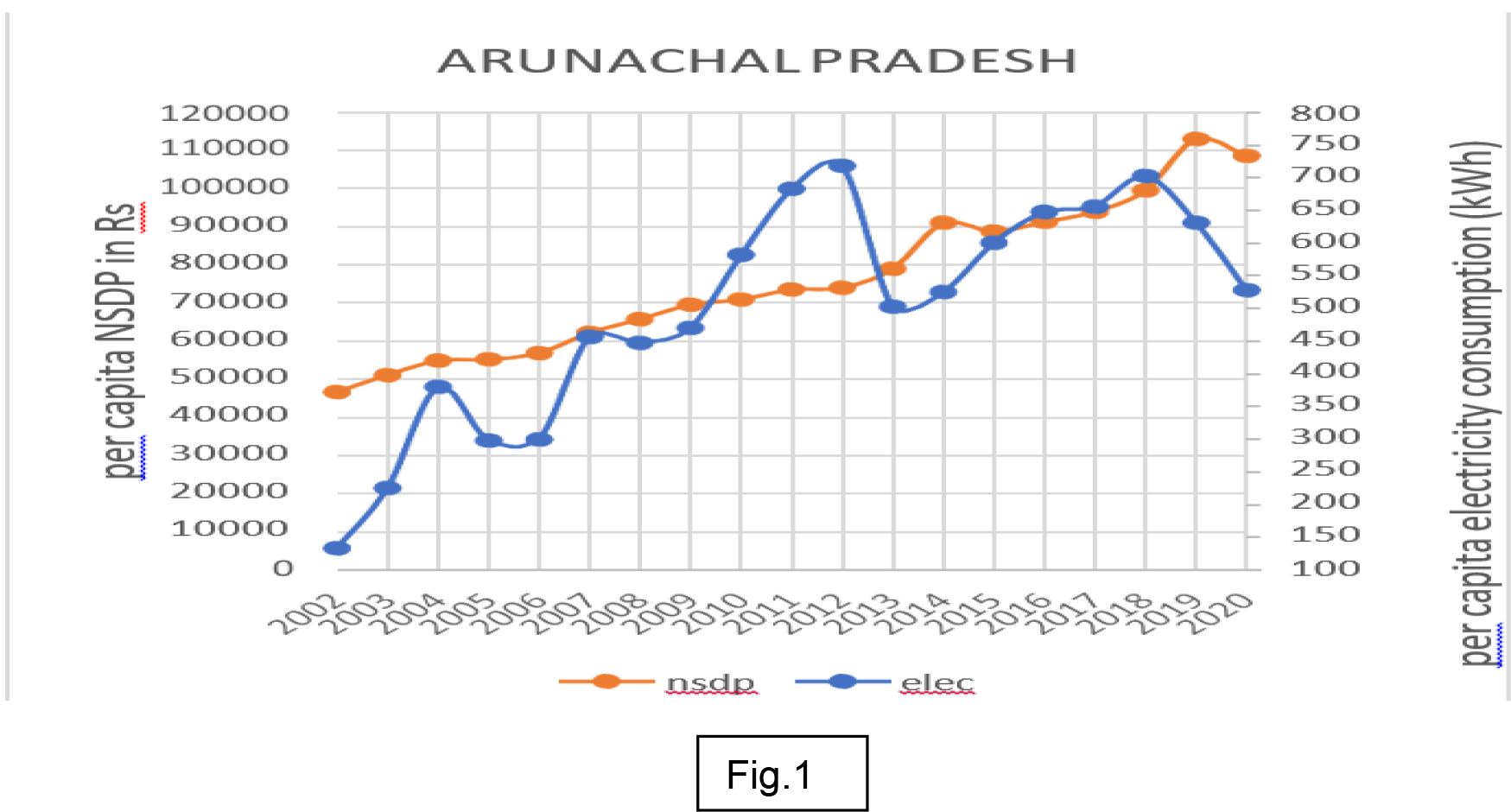
Figure 2
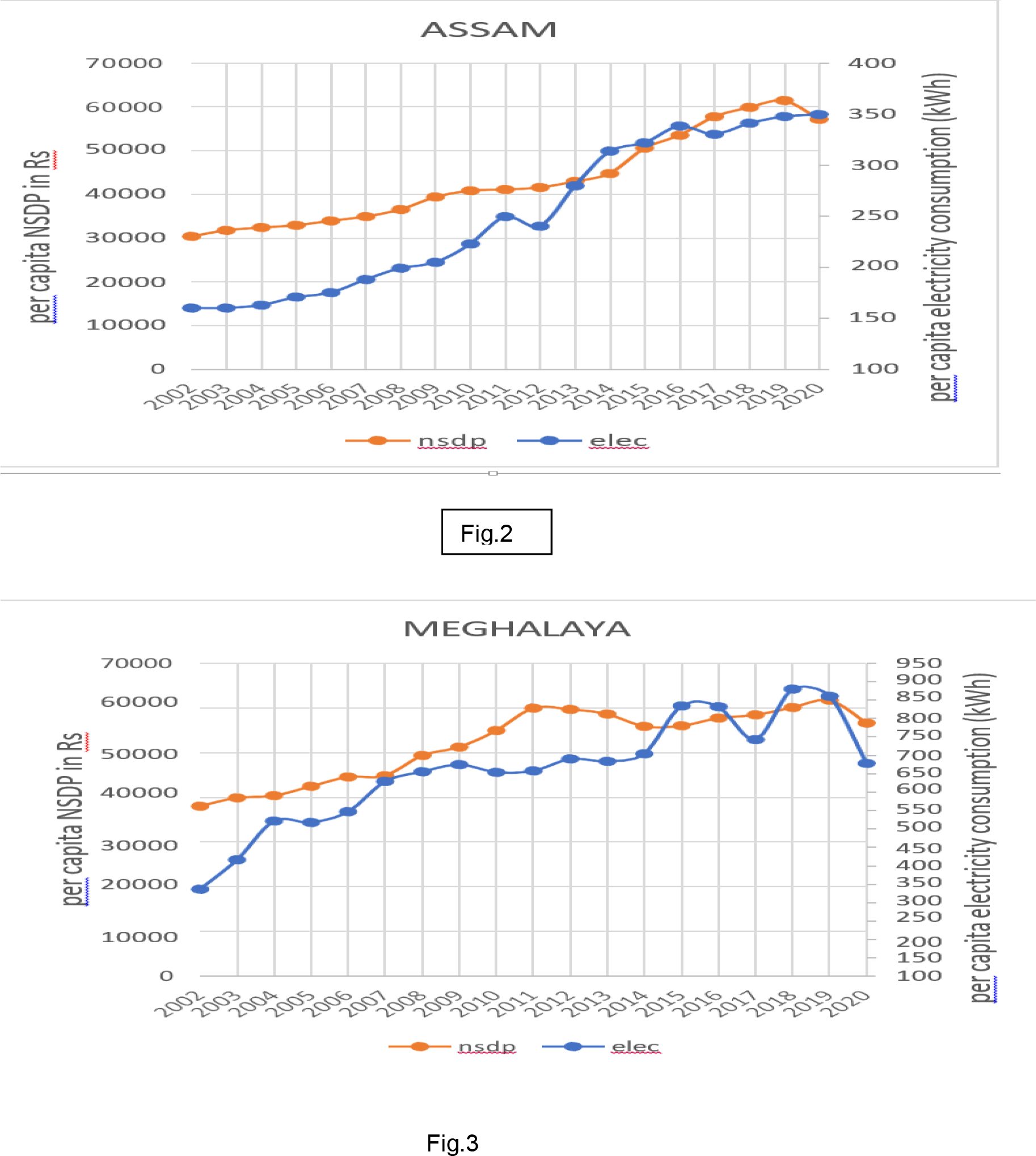
Figure 3
Figure 4
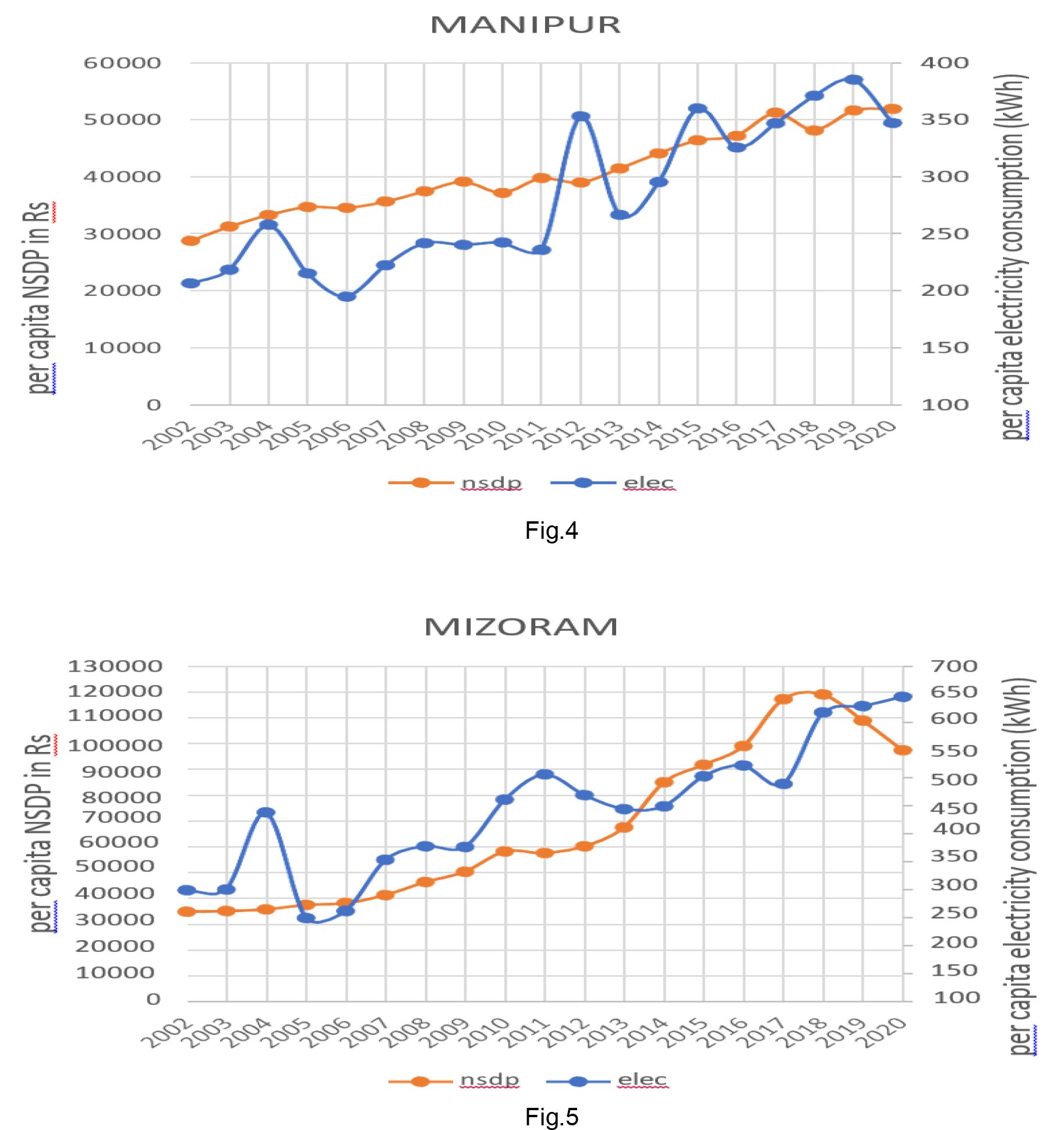
Figure 5
Figure 6
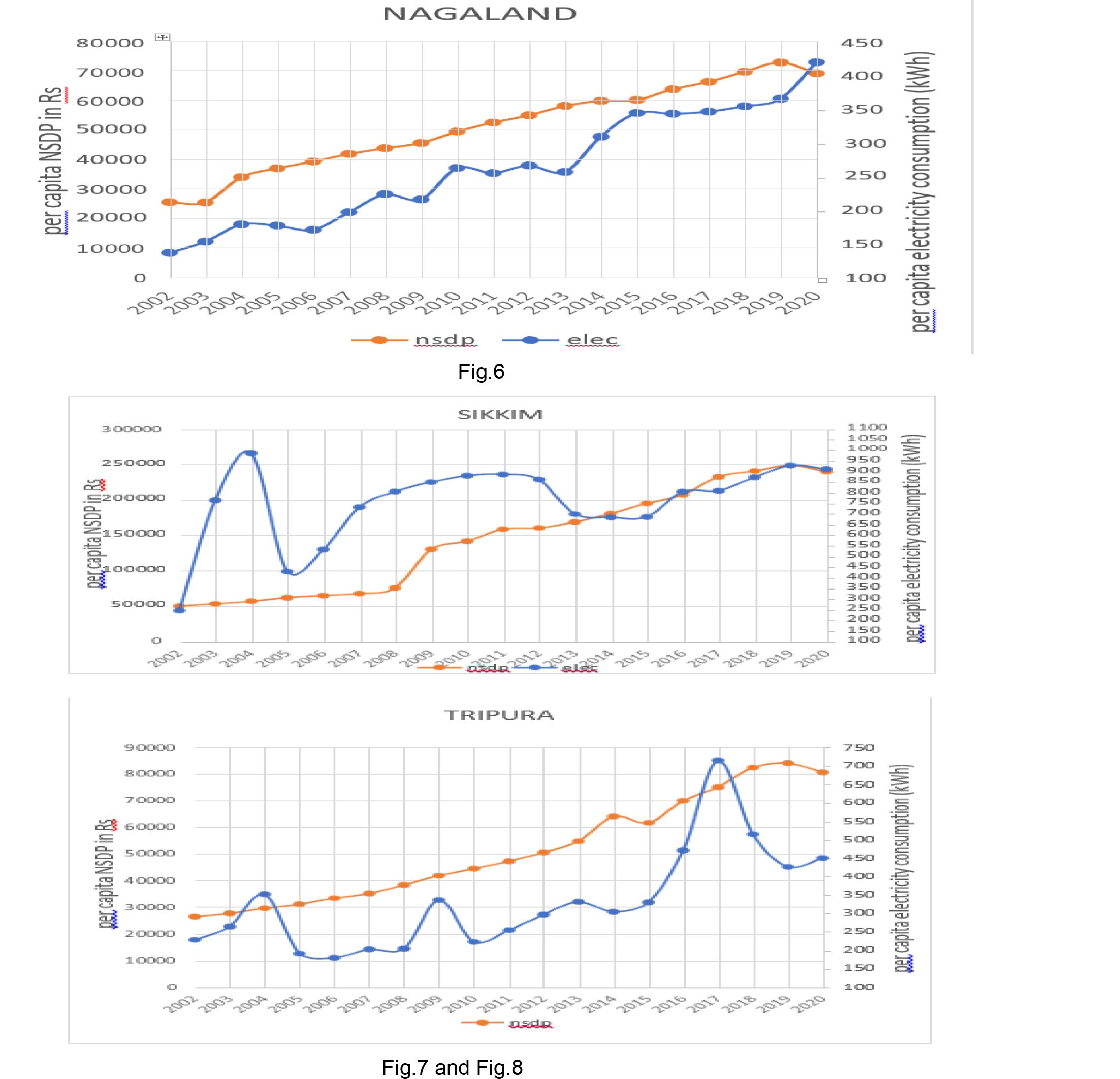
Figure 7
Figure 8
Figures 1 to 8 illustrate the trends of per capita NSDP and per capita electricity consumption across Northeastern states.
Sikkim experienced a sharp rise in electricity consumption in 2004 followed by a sudden decline in the next year and gradual growth afterward.
Similar patterns were observed for Arunachal Pradesh in 2012.
In states such as Assam, Meghalaya, Manipur, and Tripura, per capita NSDP remained higher than electricity consumption in most years.
Nagaland showed a different pattern where NSDP consistently remained higher than electricity consumption until 2020.
The paper examines the relationship between electricity consumption and economic growth for Arunachal Pradesh, Assam, Meghalaya, Mizoram, Nagaland, Sikkim, and Tripura using panel cointegration methods.
2. Literature Review
Several empirical studies examined the relationship between electricity consumption and economic growth across different countries and regions.
Rufael (2005) studied African countries and found evidence of causality between electricity consumption and GDP.
Al-Iriani (2006) examined Gulf Cooperation Council countries and observed unidirectional causality from GDP to energy consumption.
Chen et al. (2007) studied developing Asian countries and identified short-run and long-run causality relationships.
Numerous panel data studies revealed either unidirectional or bidirectional causality between electricity consumption and economic growth depending on the region and methodology used.
Previous Indian studies mainly focused on national-level analysis or larger states, while this study specifically focuses on Northeastern states of India.
3. Model and Sources of Data
3.1 Model to be Estimated
The relationship between economic growth and electricity consumption is represented as:
NSDP = f (Per Capita Electricity Consumption)
The econometric model used:
Yit = αi + βi PCEC it + εit
Where:
- Yit = Log of per capita real NSDP
- PCEC = Per capita electricity consumption
- t = Time period (2002-03 to 2021-22)
- εit = Error term
3.2 Sources of Data
The study used panel data from eight Northeastern states of India for the period 2002-03 to 2021-22.
Data on real per capita NSDP at 2011-12 prices were collected from EPW Time Series Data.
Electricity consumption data were collected from the Central Electricity Authority (CEA).
EViews 10 software was used for analysis and all variables were converted into natural logarithmic form.
4. Methods and Findings
4.1 Variables Descriptive Statistics
The mean electricity consumption for the Northeastern states was 5.94 with a maximum value of 6.89.
The average NSDP was 10.95 with a maximum value of 12.42.
Descriptive Statistics Table
| Variables | lnelec | lnnsdp |
|---|---|---|
| Mean | 5.94 | 10.95 |
| Min | 5.87 | 10.91 |
| Max | 6.89 | 12.42 |
| Std. Dev. | 4.88 | 10.16 |
| Observations | 152 | 152 |
4.2 Unit Root Test
Levin, Lin & Chu (LLC), IPS, ADF-Fisher Chi-square, and PP-Fisher Chi-square tests were used to test stationarity.
Some variables were non-stationary at level form but became stationary after first differencing.
Since all variables were integrated of the same order, cointegration analysis was conducted.
Panel Unit Root Test Table
4.3 Cointegration Test
Pedroni Panel Cointegration Test and Kao Residual Cointegration Test were applied to examine long-run relationships among the variables.
Pedroni test results showed six statistics significant at the 1% level, confirming cointegration.
Kao Residual Cointegration Test also confirmed a long-run equilibrium relationship.
Panel Cointegration Test Results
5. Conclusion
Northeastern states are relatively less developed due to geographical and political challenges.
The study found that electricity consumption and economic growth are cointegrated in the long run.
The findings emphasize the importance of the electricity sector in promoting economic transformation in Northeastern India.
However, economic development also depends on complementary factors such as education, healthcare, and infrastructure development.
References
Abbas, F., & Choudhury, N. (2013). Electricity consumption-economic growth nexus.
Akinlo, A. E. (2009). Electricity consumption and economic growth in Nigeria.
Al-Iriani, M. A. (2006). Energy-GDP relationship revisited.
Apergis, N., & Payne, J. E. (2009). Energy consumption and economic growth in Central America.
Chen et al. (2007). GDP and electricity relationship in developing Asian countries.
Chontanawat, J., Hunt, L. C., & Pierse, R. (2008). Energy consumption and economic growth study.
Girish, G. P. M., Singh, S., & Supra, B. (2022). Electricity consumption, economic growth and FDI in India.
Hasanov, F., Bulut, C., & Suleymanov, E. (2017). Energy-growth nexus for Eurasian oil exporting countries.
Karanfil, F., & Li, Y. (2015). Electricity consumption and economic growth panel study.
Majewski, S., Mentel, U., Salahodjaev, R., & Cierpiał-Wolan, M. (2022). Electricity consumption and economic growth in South Asia.