







S. Shyam Prasad PhD
Professor in Corporate Strategy and Marketing
International School of Management Excellence, Bengaluru
s_shyam_prasad@yahoo.com
Dr. Shampa Nandi
Professor in Marketing & Quantitative Techniques & Principal PGDM
International School of Management Excellence, Bangalore
shampanandi12345@gmail.com
Amrutha Krishna, Pranathi A N, Shatakshi Vats
PGDM Students
International School of Management Excellence, Bangalore
amruthak.isme2224@gmail.com
pranathian.isme2224@gmail.com
shatakshi.isme2224@gmail.com
Abstract:
This study aimed to discover what interactive activities of emerging brands build brand recognition.
The study used secondary data related to different interactive marketing strategies adopted by three leading emerging brands: Nykaa, MamaEarth, and Sugar Cosmetics.
Primary data collected from 695 respondents was used to investigate patterns in interactive activities.
SEM was used to analyse empirical data and examine the conceptual model.
The study examined online reputation, brand familiarity, and visual influence on brand recognition and brand image.
The paper provides crucial findings regarding interactive online activities and contributes new insights for practicing managers.
Keywords: Interactive Activities, Emerging Brands, Brand Recognition, Visual Influence, Schema Theory, Online Reputation
1. Introduction
The Indian market is flooded with emerging brands that have entered the market within the last 10 to 12 years.
Building powerful brands requires high levels of brand awareness, recall, and recognition.
Brand Recognition (BR) refers to consumers’ familiarity with a brand and their ability to identify it through visual or auditory cues.
Strong brand recognition increases consumer trust, market share, and sales.
With the rapid growth of Web3 and Online Social Networks (OSN), online interactions have become a powerful tool for brand building.
Social networking platforms provide firms opportunities to engage consumers and create strong brand recognition.
The study focuses on three popular emerging brands:
- Nykaa
- Mamaearth
- Sugar Cosmetics
These brands were selected because they follow similar business models and target similar audiences in the beauty and personal care industry.
2. Literature Review
2.1 Brand Recognition
“The first lesson of branding: memorability. It’s very difficult buying something you can’t remember.” – John Hegarty
The primary goal of brand management is to make consumers recognize the brand.
Brand Recognition is a critical element of brand awareness and influences consumer purchase decisions.
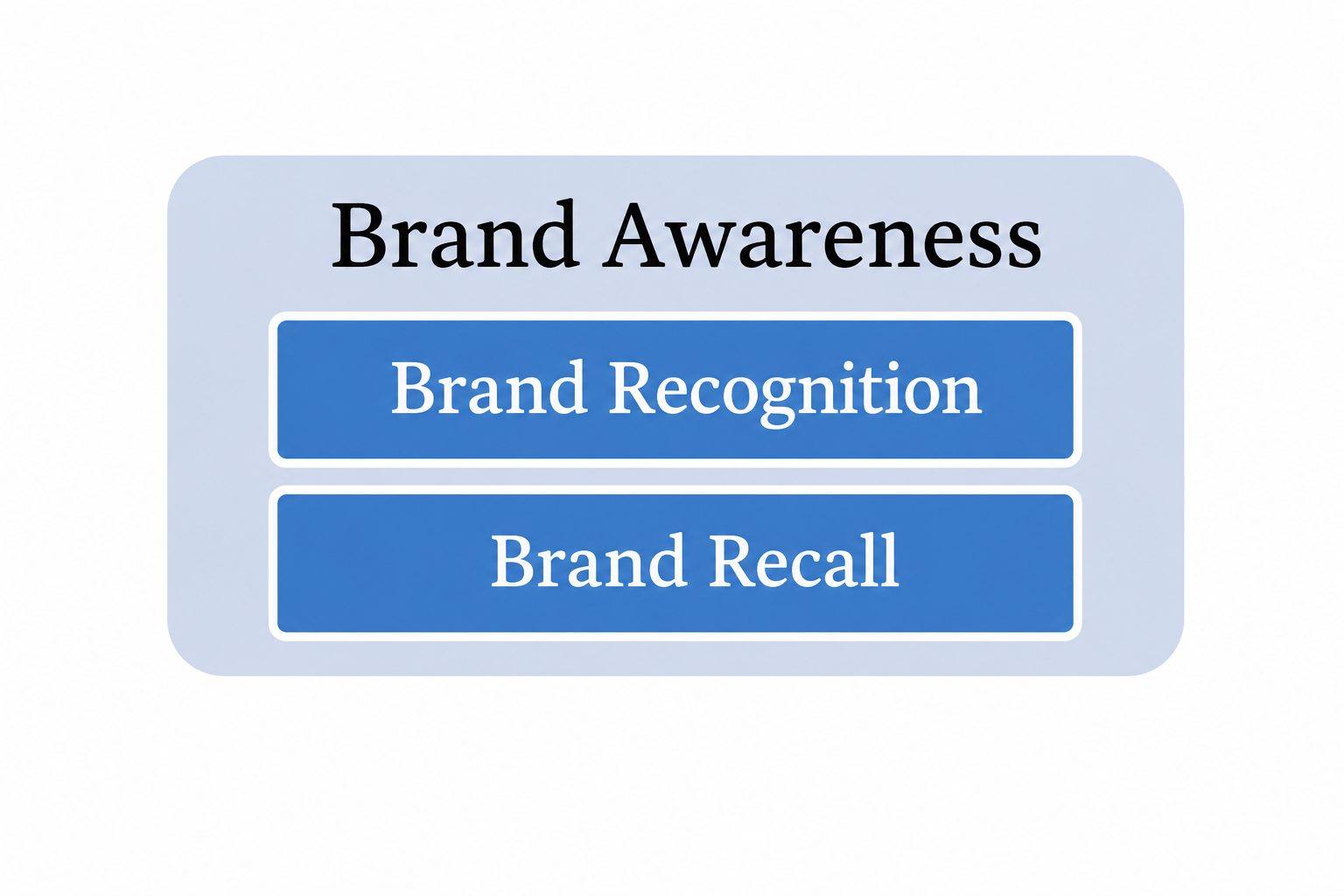
According to Keller (1993), Brand Recognition and Brand Recall are two major dimensions of Brand Awareness.
Figure I: Relation between Brand Awareness, Brand Recognition and Brand Recall
2.2 Online Reputation
Online reputation is essential for gaining consumer trust on digital platforms.
Online brand reputation includes:
- Organic search visibility
- Social media communication
- Digital marketing activities
Social media communication integrated with other channels improves brand loyalty and brand reputation.
Hypothesis H1
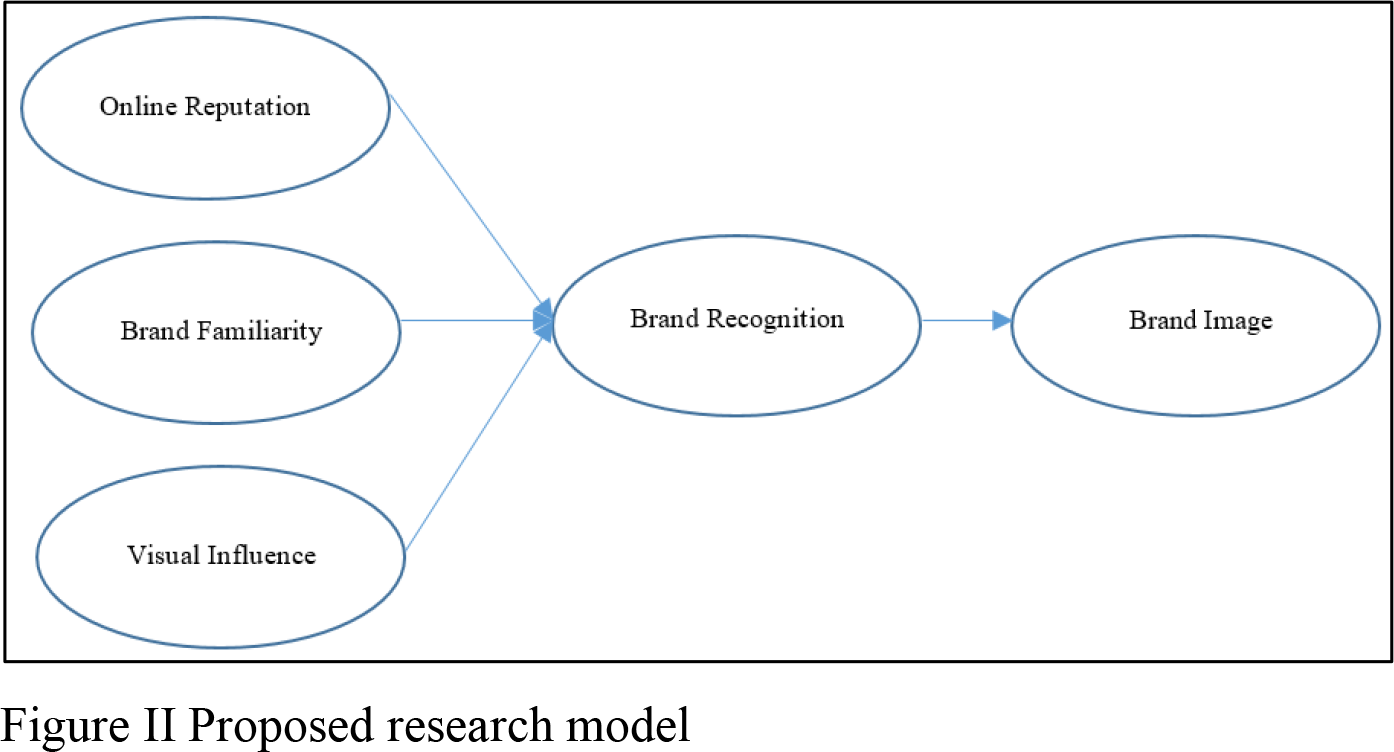
Interactive Marketing’s Online Reputation component will positively affect Brand Recognition.
2.3 Brand Familiarity
Brand familiarity depends on consumers’ memory and knowledge regarding a brand.
Familiarity can arise through:
- Usage experience
- Advertisements
- Word-of-mouth communication
- Media exposure
Hypothesis H2
Interactive Marketing’s Brand Familiarity component will positively affect Brand Recognition.
2.4 Visual Influence
“People simply choose with their eyes.”
Visual content plays a major role in capturing customer attention and influencing buying behavior.
Social media visual storytelling has become an effective branding strategy.
Hypothesis H3
Interactive Marketing’s Visual Influence component will positively affect Brand Recognition.
2.5 Interactive Marketing and OSN
Interactive marketing evolved through Web 2.0 technologies and online social networking platforms.
Platforms such as Facebook, Instagram, LinkedIn, YouTube, blogs, podcasts, and wikis provide firms opportunities to build strong brands.
Firms must consistently maintain brand presence through visual and verbal strategies to remain in customers’ minds.
Hypothesis H4
Brand Recognition positively affects Brand Image.
2.6 Schema Theory and Brand Recognition
Schema theory explains how consumers organize and interpret information using cognitive frameworks.
Consumers process online brand activities and associate them with prior knowledge and existing brand schemata.
These schemata influence brand recognition and eventually shape brand image.
Figure II: Proposed Research Model
3. Research Method
3.1 Research Type
The study collected both primary and secondary data for each brand separately.
3.2 Generating Scale Items
The study adapted measurement scales related to Brand Recognition from previous literature.
Three dimensions were analyzed:
- Brand Familiarity (BF)
- Visual Influence (VI)
- Online Reputation (OR)
3.3 Data Collection
Data was collected mainly from female respondents between April 5, 2023 and April 16, 2023.
A total of 695 women participated in the survey:
- 253 – Sugar Cosmetics
- 216 – Nykaa
- 226 – Mamaearth
3.4 Data Analysis Tools and Techniques
The study adopted a mixed-method approach using both quantitative and qualitative techniques.
4. Results
4.1 Qualitative Analysis
Interactive marketing strategies of the three brands were grouped into:
- Online Reputation (OR)
- Brand Familiarity (BF)
- Visual Influence (VI)
Table 1: Content Analysis of Interactive Marketing Strategies
| Name of Category | Name of Activity | Description |
|---|---|---|
| OR (Mamaearth) | Influencer Marketing | Targeted millennials and witnessed 400% growth during COVID-19. |
| OR (Nykaa) | Brand Endorsement | Katrina Kaif endorsed Nykaa and promoted the brand. |
| OR (Sugar Cosmetics) | Customer Influencers | Turned customers into influencers and leveraged user-generated content. |
| BF (Mamaearth) | YouTube Marketing | Promoted products through YouTube campaigns and digital marketing. |
| BF (Nykaa) | Pink Friday Sale | Created shopping engagement through exclusive sale campaigns. |
| BF (Sugar Cosmetics) | Virtual Try-On | Allowed customers to experiment with makeup virtually. |
| VI (Mamaearth) | TV Commercials | Focused on visually driven advertisements and storytelling. |
| VI (Sugar Cosmetics) | Packaging and App | Used eye-catching packaging and visual identity in digital media. |
| VI (Nykaa) | Nykaa TV | Created makeup tutorials and visual content using AR technologies. |
4.2 Quantitative Analysis
Quantitative analysis assessed relationships between interactive marketing dimensions and Brand Recognition.
4.2.1 Demographic Data Analysis
Table 2: Demographic Profile of Respondents
| Characteristics | Number of Respondents |
|---|---|
| Below 18 | 22 (3.2%) |
| 18 to less than 22 | 146 (21%) |
| 22 to less than 30 | 300 (43.2%) |
| 30 to less than 40 | 117 (16.8%) |
| More than 40 | 110 (15.8%) |
4.2.2 Measurement Model
Confirmatory Factor Analysis (CFA) was conducted to evaluate Online Reputation, Brand Familiarity, and Visual Influence constructs.
Table 3: Measurement Model
| Constructs | Item | Mean | SD | SL | SMC | CA (Cronbach’s Alpha) | CR (Composite Reliability) | AVE (Av. Variance explained) |
|---|---|---|---|---|---|---|---|---|
| SR17 | 3.73 | 0.892 | 0.801*** | 0.641 | ||||
| SR18 | 3.69 | 0.920 | 0.806*** | 0.649 | ||||
| SR19 | 3.61 | 0.898 | 0.749*** | 0.561 | ||||
| SR20 | 3.52 | 0.868 | 0.701*** | 0.491 | ||||
| SR25 | 3.67 | 0.936 | 0.722*** | 0.521 | ||||
| SR26 | 3.56 | 0.976 | 0.678*** | 0.459 | ||||
| OR (Interactive Marketing_Online Reputation) | 3.63 | 0.915 | 0.880 | 0.881 | 0.554 | |||
| BF1 | 3.87 | 1.083 | 0.758*** | 0.571 | ||||
| BF3 | 3.64 | 1.106 | 0.786*** | 0.638 | ||||
| BF5 | 3.72 | 1.054 | 0.799*** | 0.617 | ||||
| BF6 | 3.48 | 1.101 | 0.756*** | 0.574 | ||||
| BF (Interactive Marketing_Brand Familiarity) | 3.67 | 1.086 | 0.856 | 0.857 | 0.601 | |||
| VS8 | 3.26 | 1.185 | 0.777*** | 0.603 | ||||
| VS9 | 3.45 | 1.125 | 0.805*** | 0.648 | ||||
| VS10 | 3.55 | 0.965 | 0.787*** | 0.619 | ||||
| VS11 | 3.37 | 0.991 | 0.731*** | 0.534 | ||||
| VI (Interactive Marketing_Visual Influence) | 3.41 | 1.066 | 0.856 | 0.857 | 0.601 |
4.2.3 Reliability
Reliability and validity of scales were confirmed through CFA analysis.
All factor loadings were statistically significant and Average Variance Extracted (AVE) values exceeded 0.50.
4.2.4 Structural Equation Model (SEM)
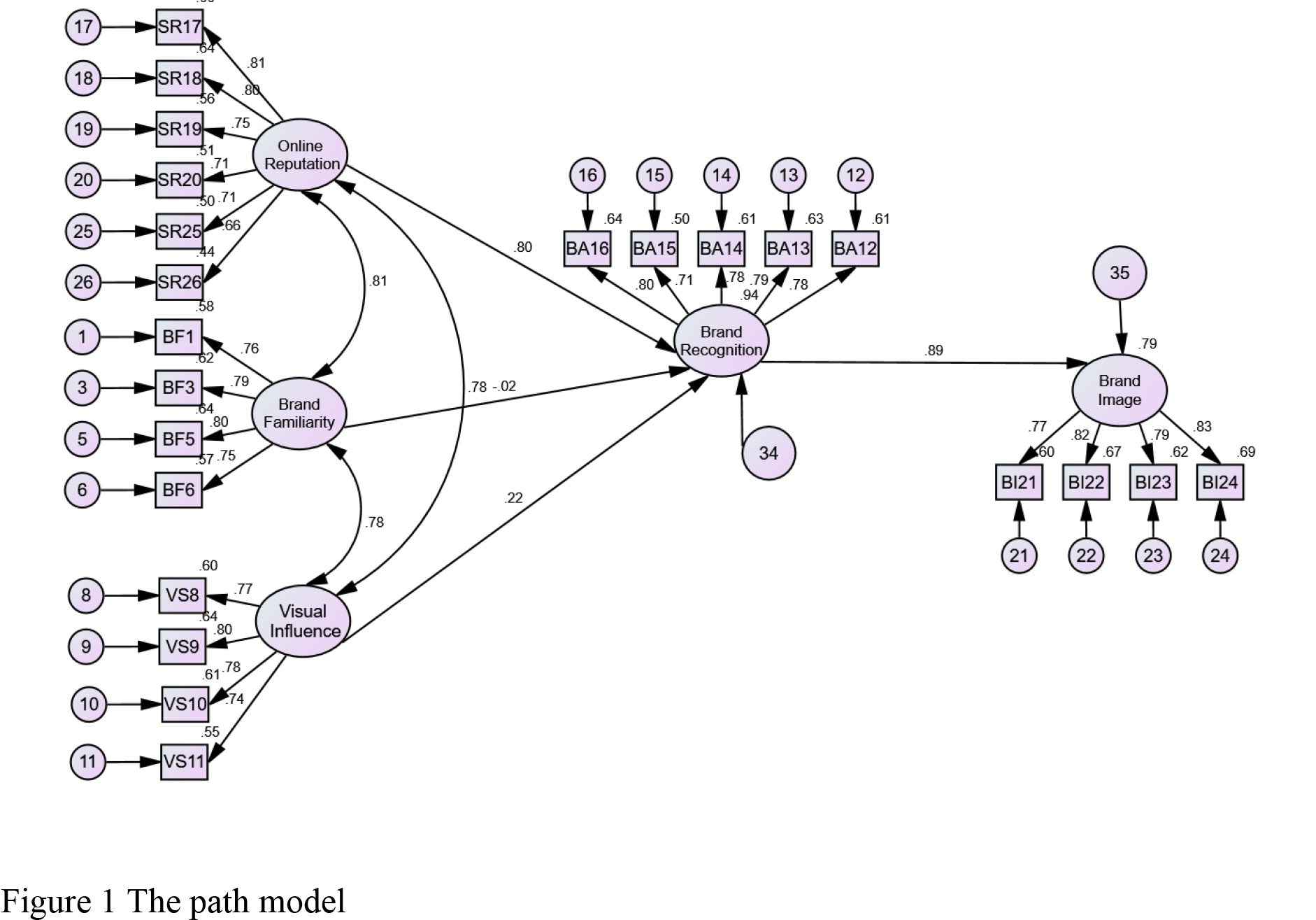
Structural Equation Modeling was used to evaluate relationships among online activities and brand recognition.
Figure III: Path Model
4.2.5 Test of Hypotheses
Table 4: Hypotheses Results
| Hypothesis | Relationship | β | Result |
|---|---|---|---|
| H1 | Online Reputation → Brand Recognition | 0.80 | Supported |
| H2 | Brand Familiarity → Brand Recognition | -0.02 | Not Supported |
| H3 | Visual Influence → Brand Recognition | 0.23 | Supported |
| H4 | Brand Recognition → Brand Image | 0.88 | Supported |
5. Discussion
The internet has evolved into a powerful source of communication and entertainment.
COVID-19 accelerated the use of digital channels for brand building and online engagement.
The study showed that Online Reputation and Visual Influence significantly affect Brand Recognition.
Social media advertising, influencer marketing, content marketing, tutorials, videos, and CSR campaigns helped the selected brands strengthen recognition.
Surprisingly, Brand Familiarity did not significantly affect Brand Recognition.
Emerging brands successfully gained popularity despite being relatively unfamiliar to consumers.
6. Theoretical Implications
The study used Schema Theory to explain the impact of online social networking activities on brand recognition.
It contributes new theoretical insights into online brand promotion and social media marketing.
7. Managerial Implications
Mamaearth, Nykaa, and Sugar Cosmetics established strong online presence through digital promotions, influencer marketing, content creation, and AR/VR technologies.
The major finding of the study is that Brand Recognition can precede Brand Familiarity for emerging brands.
This insight helps firms sharpen their marketing focus and prioritize recognition-building activities.
8. Limitations
The study considered only three brands, which limits generalization of findings.
Only online interactive activities were analyzed, leaving scope for future research on offline marketing strategies.
Future studies may include brands from industries beyond beauty and personal care.
References
Aaker, D. (1996). Measuring brand equity across products and markets.
Barwise, P., & Meehan, S. (2010). Building a brand.
Bilgihan, A. (2016). Gen Y customer loyalty in online shopping.
Bruhn, M., Schoenmueller, V., & Schäfer, D. (2012). Social media and brand equity creation.
Campbell, M. C., & Keller, K. L. (2003). Brand familiarity research.
Chen, M.H., Chang, Y.Y., & Lo, Y.H. (2015). Creativity and brand research.
Clement, J. (2007). Visual influence on in-store buying decisions.
Fornell, C., & Larcker, D. F. (1981). Structural equation models.
Halkias, G. (2015). Mental representation of brands.
Keller, K. (1993). Customer-based brand equity.
Lim, H., & Childs, M. (2020). Visual storytelling on Instagram.
Schivinski, B., & Dabrowski, D. (2016). Social media communication and consumer perceptions.