




Adjunct Faculty, Ramaiah Institute of Management, Bangalore
preejasreedhar@msrim.org
preejasreedhar@gmail.com
Abstract:
Purpose: The paper explores the most pertinent employment issues present in academia in the current era and how to bridge the gap of those glaring issues through competence-based approach learning.
This paper examines and reviews the available literature on the current status of employability skills and job-ready individuals from 2012 to 2021.
Design/Methodology/Approach: This paper is based on a systematic review approach structure and examines the most relevant literature from online databases using keyword search methods.
Results/Findings: The systematic literature review identified a strong relationship between employability skills and job readiness factors.
Research Limitations/Implications: This review highlights the importance of a competence-based approach in creating job-ready professionals and identifies research gaps for future studies.
Originality Value: There are limited studies on competence-based approaches for building employability skills among youth in the post-pandemic job market.
Type of Paper: Systematic Literature Review
Keywords: Employability issues, Training, Interventions, Academia Industry Interface, Industry Preparedness Program, Post-Pandemic Job Market, Skill Sets.
Introduction
The word employability is no longer just a buzzword in the contemporary era. The business world faces retrenchment, layoffs, downsizing, and rightsizing.
The need for producing job-ready individuals is one of the most pertinent challenges in today’s education system.
In a fast-evolving world where knowledge is the key driver, employability has become extremely critical.
The changing perspectives of the job market require the young workforce to become competent enough to sustain in the long run.
Research Questions
- What problems are faced by the industry in terms of employability in the new norm?
- How do we mitigate the gap between academia and industry?
- Why is a competence-based approach needed in today’s educational arena?
The Purpose / Aim
- To evaluate the impact of employability skills in the job market.
- To assess business competencies needed to sustain in the VUCA world.
- To analyse competence-based approaches in academia to build job-ready individuals.
Material and Method
A systematic literature review was conducted using keywords such as “Employability skills,” “Competence-based approach,” “Job preparedness,” and “Post-pandemic job market.”
Electronic databases such as ResearchGate, Scopus, and Web of Science were used for analysis.
About 10 papers from 2012 onwards were reviewed to understand the existing skill gap.
The study identified a strong association between employability skills and unemployment.
The research highlighted five core habits required for the 21st-century workplace:
- Thinking
- Solving
- Communicating
- Collaborating
- Leading
These habits are considered essential for GIG workers in the VUCA world.
The study recommends that educational institutions update curriculum and instructional design aligned with Industrial Revolution 4.0 requirements.
Related Work-Based Analysis
Employability has become a significant factor for stakeholders because industries seek individuals who can adapt to jobs that may not yet exist.
The educational system needs to revamp its training methodologies to create job-fit manpower.
The two major aspects of employability are:
- Competence-based approach
- Skill-building methodologies
Research studies by Hillage and Pollard (1998), Harvey (2001), Yorke (2006), and others emphasize that employability is strongly related to attitude, behavior, communication, and personality characteristics.
The competence-based approach focuses on workplace performance and building professional capabilities.
Employability competencies help professionals sustain and succeed in the workplace.
Know-Why, Know-How and Know-Whom Framework
DeFilippo and Arthur (1994) introduced three major characteristics:
- Know-Why: Professional objectives and alignment with organizational values.
- Know-How: Attitude, skills, knowledge, and professional capabilities.
- Know-Whom: Social skills, networking, and interpersonal relationships.
These characteristics contribute to career mobility and professional sustainability.
Employers increasingly value soft skills over technical skills while recruiting graduates.
Simulation-based learning, experiential learning, internships, and placement training are considered important strategies for employability enhancement.
Research Objectives
- To review literature on employability issues and understand the gap between current and ideal job preparedness.
- To identify research gaps and recommend skill development initiatives.
- To evaluate the underlying constructs of employability issues.
- To analyse the developed model using the SWOC framework.
- To suggest strategies for building employability skills through a competence-based approach.
Methodology
This paper develops a theoretical concept using a systematic literature review method and analyses the framework using the SWOC model.
Discussion
The review identifies the importance of employability and soft skills for sustaining in a competitive and turbulent world.
Educational institutions should integrate industry preparedness and application-based learning into their teaching methods.
Remote learners should develop cognitive skills such as:
- Critical Thinking
- Logical Thinking
- Communication
- Collaboration
- Leadership
Figure 1: BANI World Framework
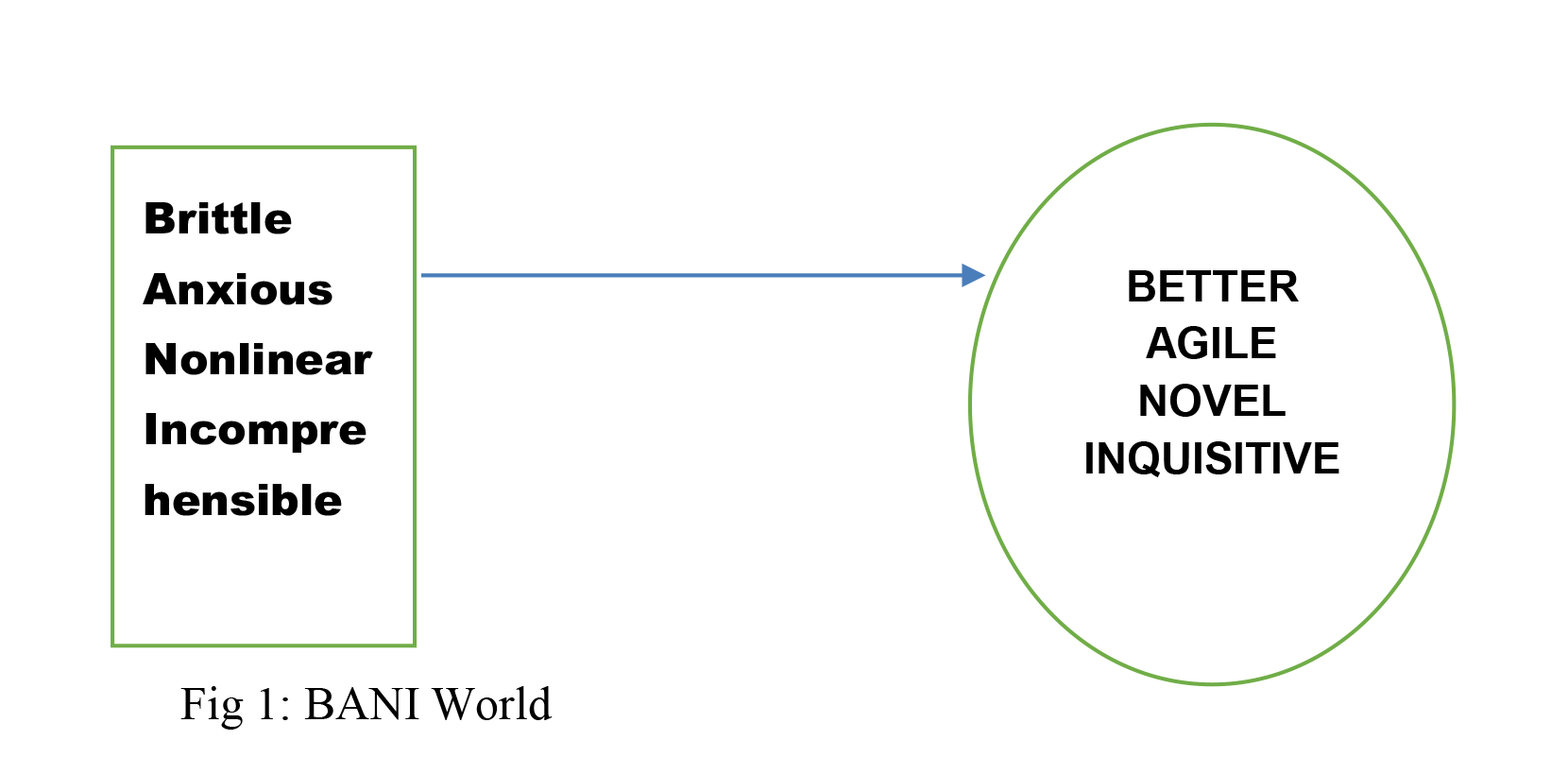
The BANI framework introduced by Jamais Cascio replaces the VUCA model.
BANI stands for:
- Brittle
- Anxious
- Non-linear
- Incomprehensible
The paper proposes a positive upward spiral framework:
- Brittle → Better
- Anxious → Agile
- Non-linear → Novel
- Incomprehensible → Inquisitive
Competence-based learning can help create job-ready individuals capable of thriving in uncertain environments.
Qualitative Analysis of BANI using SWOC Framework
Strength
The framework supports positive transformation and skill-building capabilities among Gen Z professionals.
Weakness
Fast-paced technological changes may create stress, anxiety, and psychological imbalance among professionals.
Opportunities
New technologies and automation create opportunities for new roles, tasks, and competencies.
Challenges
Resistance to change and inability to adapt to new workplace environments may create difficulties for professionals.
Limitations
The study is based on a systematic literature review and therefore provides scope for future empirical research.
There is a paradigm shift toward blended learning and future pedagogical innovations.
The NEP 2020 framework also opens avenues for further research in skill-building and competency development.
Research Gaps
Most studies were generic and did not focus on specific populations such as B-school students or postgraduates.
There is a need for more detailed methodologies such as PRISMA or meta-analysis.
Studies focusing on specific organizations or universities are limited.
Research related to hybrid learning, post-COVID learning environments, and employability gaps remains insufficient.
Current State and Desired State: Concept Mapping
The current state of employability and job fitment factors was analysed through a systematic literature review.
The desired state is to achieve placement preparedness through competence-based approaches in educational institutions.
Effective partnerships between academia and industry are required to bridge the employability gap.
Conclusion
The study reviewed literature related to employability skills and job preparedness among youth.
Creating employable youth remains a major challenge in the contemporary job market.
The 21st century requires repositories of skill sets for sustainability and career success.
Competency-based pedagogy can become a strong strategy for improving employability in the country.
References
Zaharim, A., Yusoff, Y., Omar, M. Z., Mohamed, A., & Muhamad, N. (2009). Engineering employability skills required by employers in Asia.
Tan, C. Y., Abdullah, A. G. K., & Ali, A. J. (2021). Soft Skill Integration for Inspiring Critical Employability Skills.
Farouq, A., & Adilovic, S. (2014). Understanding Graduate Employability.
Buheji, M., & Buheji, A. (2020). Planning competency in the new normal.
Aloysius, O. I., Ismail, I. A., Suandi, T., & Arshad, M. M. (2018). Enhancing employability collaboration.
Kaushal, U. (2011). Empowering engineering students through employability skills.
Husam, H. A., & Abraham, P. (2019). Employability skills development through assessment.
Fahimirad, M., Nair, P. K., Kotamjani, S. S., Mahdinezhad, M., & Feng, J. B. (2019). Integration and development of employability skills.
Finch, D. J., Hamilton, L. K., Baldwin, R., & Zehner, M. (2013). Factors affecting undergraduate employability.
Archer, W., & Davison, J. (2008). Graduate employability.