






(With Special Reference to Top Consumer Food Companies in Viewof Section 135 of Companies Act 2013)
Abstract:
Companies Act 2013 mandated an expenditure of 2% of average net profit to CSR in order to hold companies accountable and responsible to their stakeholders. Corporate social responsibility is the duty of a corporate entity to satisfy the needs of all of its stakeholders through legally required activities and programmes. The current study looked at the linkage between expenditure on CSR and share prices for the NSE listed consumer food companies. The study can tell us whether the government’s mandatory move is a significant on businesses or not. Prices of the shares were chosen because they reflect the wealth of shareholders as well as an impression of investor confidence. Karl Pearson’s coefficient of correlation and Linear Regression has been employed to find out the degree and effect of relationship between expenditure on CSR and Share Prices of Consumer Food companies. The findings show that as far as all the firms are concerned, it has been found that there is a very high correlation of 0.966833, that is 96.6% between share prices and CSR spending. The effect of CSR spending can only be seen if the correlation exists. As per the it has been found out that the regression is significant, and hence CSR spending does affect share prices but only by 0.0000276 times the change in CSR expenditure.
Keywords: CSR, Share Prices, Consumer Food companies, Companies Act 2013
Introduction
Corporate social responsibility is the duty of a corporate entity to satisfy the needs of all of its stakeholders through legally required activities and programmes. It can also be described as upholding mutually beneficial relationships with its stakeholders while being socially responsible. Corporate social responsibility used to be seen as a charitable endeavor that Businesses engaged in on a voluntary basis. The need to monitor the resources used by businesses and how they use their social initiatives to meet the needs of this resourceful society has arisen with the globalization of commerce, particularly in India. In order to fulfil their Social responsibility, businesses must take care of and support all facets of society as a whole, including the government, the general public, the environment, and the nation. Except for a few companies, corporate social responsibility has become a requirement for most businesses. Due to the expanding significance of the role that corporations play in various facets of society, these corporations are now seen as institutions that contribute to social advancement in addition to making a profit.
Perspective of Corporate Social Responsibility:
Corporate social responsibility can be studied from the three perspectives as follows:
- Conventional corporate philanthropy, which includes charitable giving for social, Cultural, and religious causes
- The importance of stakeholders’ interests in corporate social responsibility
- Business ethics based on long-term interests of stakeholders
Traditional and Modern Views of Corporate Social Responsibility
Traditional View
The traditional perspective holds that businesses must produce goods and services effectively in order to meet society’s basic needs. About the only social responsibility that the company was expected to fulfil was that. Therefore, a company was deemed to be operating in a socially responsible manner if it was able to use the wealth-producing resources at its disposal efficiently and provide the consumer with goods and services of the proper quality at fair prices.
Modern View
Beyond producing and marketing goods and services fora profit, modern corporations have many duties to society. Aside from the shareholders, a company’s stakeholders also include the community, the government, its employees, and its suppliers. Corporate social responsibility, when viewed in the context of this fact, implies that businesses are more than justeconomic institutions and that they have a duty to assist society in resolving some of its Most pressing social issues by dedicating even a small portion of their resources.
Carroll’s models for CSR components, including:
- Ethical economic responsibilities
- Legal responsibilities
- Ethical responsibilities
- Discretionary responsibilities
Although these elements don’t actually interact with one another, they are not mutually exclusive. The management of any Organization, though, can use this model as a guide when fulfilling their social obligations. Corporate social responsibility is the duty of a corporate entity to meet the needs of all of its stakeholders through legally required activities and programmes. It can also be described as upholdingsocially conscious relationships with its stakeholders by promoting their welfare. Previously, corporate social responsibility was thought of as a charitable endeavor that businesses engaged in on a voluntary basis.
The Companies Act 2013
According to the Companies Act of 2013, every company that has a net worth of at least Rs. 500 crores,annual revenue of at least Rs. 1000 crore, or net profit of at least Rs. 5 crores are required to give away at least 2% of their average net profits to CSR. The average net profits will be calculated as the average of the three prior fiscal years’ profits.
The section 135 of Companies Act of 2013 specifies the prerequisites and the process by which a company may fulfil its corporate social responsibility. This was done to make corporations legally responsible. This section applies to all companies that:
A Board consisting of CSR committee must have three or more directors, one of whom must be an independent director, and must have a net worth of Rs 500 crore or more, a turnover of Rs 1000 crore or more, or a net profit of Rs 5 crore or more during any financial year.
The CSR committee’s membership must be disclosed.
“The CSR committee is responsible for a) formulating and recommending to the Board a CSR policy that specifies the activities the company will carry out in accordance with Schedule VII; b) recommending the amount of money to be spent on those activities; and c) periodically Reviewing the company’s corporate social responsibility policy.”
Each company listed in subsection (1) shall have a board of directors that shall: a) After considering the recommendations made by the CSR committee, approve the company’s CSR policy; b) Ensure that the activities listed in the policy are carried out by the company; and c) Disclose the contents of the policy in its report andpost it on the company’s website, if one exists.
Corporate Social Responsibility Policy:
As long as the company spends the money designated for CSR activities with preference in the local and surrounding areas where it operates.Furthermore, if the company doesn’t use the money, the Board must explain why in its report submitted inaccordance with section 134.
Review of Literature
According to Fiori et al., (2007), in their study on CSR and Firms performance of Italian listed Companies, it was concluded that there is no relationship between CSR and stock prices, may be due a small sample size of 25 companies and some hindrances in the availability of data on CSR spending by firms in Italy. Donato & Izzo, (2012) in their study on CSR and stock prices: An analysis of Italian listed companies also shows negative results. Aggarwal, ( 2013) carried out an empirical analysis of impact of sustainability performance of 20companies listed on NIFTY on the financial performance of the firms, by taking accounting variables such as ROA, ROE, PBT and also studied the impact of each dimension of sustainability such as community, environment, employee and government on the performance of the companies. It was concluded that sustainability performance as a whole has no significant effect on the financial performance of the companies, however separate dimensions have varying impact of the performanceon financial basis and the firms should use them to enhance their financial performance.
Makori & Jagonga, (2013) in his study on environmental accounting and profitability found that environmental accounting had a positive linkage with net profit margin and dividend per share and negative linkage between return on capital employed and earning per share, where environmental accounting is represented by environmental cost incurred by the companies. Mehta & Deodhar, (2014) have used event study methodology to find out effect of announcement of compulsory CSR spending on various firms in food industry and have made a comparison of stock prices before and after such policy changes. However, the null hypothesis formed that mandatory CSR affects the stock prices of food firms negatively was rejected.
Nag & Bhattacharya, (2015), in their study presented in a Conference held by Asia-Pacific EconomicAssociation, in Taiwan, in July 2015 on the topic CSRin India, by taking ROA and PE ratio as a measures of financial performance concluded that there was a positive correlation between financial performance and firms CSR, but insignificant, however environmental reporting has negative correlation with financial performance. Mehta & Chandani, (2015) analysed the correlation of CSR and Financial performance of top fivepharmaceutical companies on the basis of Market capitalization in which the null hypothesis assuming no relationship between CSR and financial performance was rejected and concluded a positive and strong correlation between the two variables. Manchiraj & Rajgopal, (2015) in their study” Does CSR create shareholder value? Exogeous stock based evidence from the Indian Companies Act 2013” have concluded that the share values are affected negatively of the firms which are forced to spend the amount as per the act.
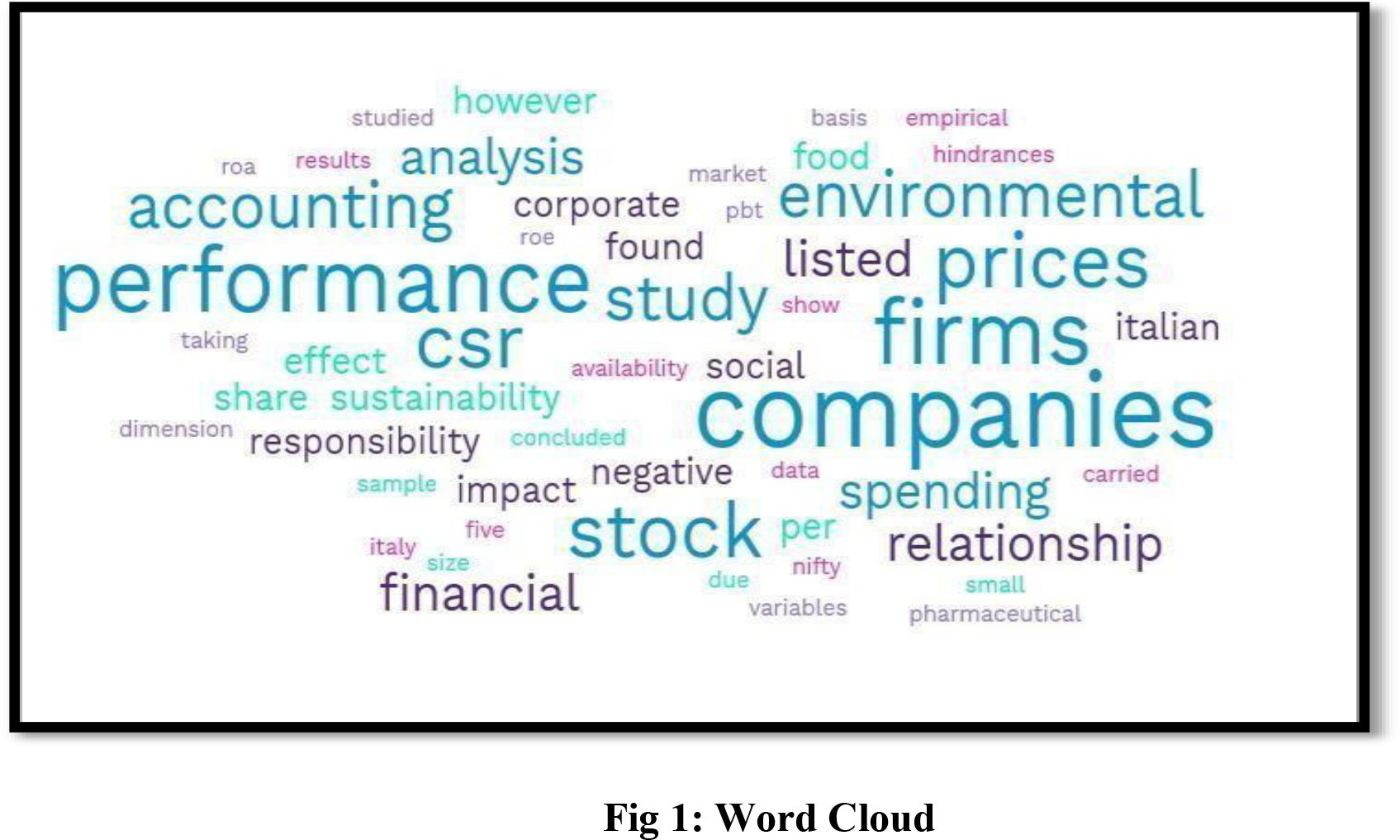
A Word cloud in “R” was created during the literaturereview and used as a first step in the analysis process to confirm earlier results. In which 35 words from the 30 highly indexed journal articles were represented.
Objectives of the study:
- To identify the relationship between Compulsory CSR Spending and Share Prices of the Consumer Food companies.
- To analyze the effect of Compulsory CSR Spending on Share Prices of the Consumer Food companies.
Theory and Hypothesis
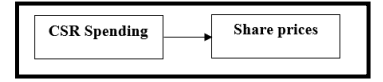
The researcher has taken the two variables. CSR Spending is taken as independent variable whereasShare Prices is taken as dependent variable. The figure shows the model which depicts both the variables.
HI: There is no relationship between CSR Spending and Share price of the companies
H2: There is no significant effect of CSR on share prices of Consumer Food companies
Research Methodology
Sample Selection:
A sample of top Consumer Food companies have been taken. The companies having companies having Net Profit have been rejected. As per the data available on moneycontrol.com, there are 9 top Consumer Food companies. For the purpose of this study, companies earning losses have been rejected; there are few companies of which the historical price data is not available and some are those companies which are not eligible for compulsory CSR spending.
Therefore, all these companies have also been excluded the sample. Out of the total top consumer food companies, 9 have been studied in the manner discussed.
Variables and Methodology of Analysis:
For the analysis part, first of all month end closing prices have been taken for each company for the year 2014-2015. Averages of closing prices have been calculated to find out the representative price for each company selected. Data related to CSR Spending has been taken from the Annexure to the Director’s report of each company. Hence, we collected the data forming two variables; one the average share prices and second, the CSR spending. Karl Pearson’s coefficient of correlation has been utilized to identify the degree of linkage between The two variables. Linear Regression has also been used to find out the effect of compulsory CSR on Share Prices of Consumer Food companies. The study has been carried out only for the period of 2014-15, in which Companies Act, 2013 became applicable.
Table 1: Names of the companies with their Average monthly Closing prices and CSR spending
| Name of the company | Mean monthly closing prices (2014-2015) (in Rupees) | CSR spending(in Rupees) |
|---|---|---|
| Nestle | 5976.292 | 2061,00,000 |
| Britannia | 737.4517 | 735,00,000 |
| Jubilant Food | 131.5092 | 207,87,000 |
| Zydus Wellness | 694.5875 | 179,00,000 |
| LT Foods | 11.2825 | 69,00,000 |
| DFM Foods | 61.45 | 24,03,000 |
| Heritage Foods | 166.7917 | 69,63,000 |
| IFB Agro | 275.1292 | 4,69,000 |
| Anik Industries | 28.74583 | 7,51,000 |
Source: Author’s Compilation
After finding the necessary statistics, they were tested using t test for small samples for each company. Test for tests were used at 5 percent significance level.Significance of Correlation was also used using R table, R square has also been calculated to know the level of determination of share prices by CSRspending. The tests were used at 5 percent significance level.
Findings of the Study
As far as the tests of significance of correlation are concerned, t test values are computed as per Table 2 and compared with table values of t test table at given of degrees of freedom as T test is a small sample test. The computed T Test value (p-value) i.e., 0.134745 which is less than the table value at 5% significance. level i.e., 2.447 which leads to the significant correlation.
Table 2: T test to test the significance of correlation calculated between CSR Spending and share prices
| Correlation | T Test Value (p-value) | Table Value at 5% Significance. Level | Result, If T Test Value (p- value) < Table Value then Significant else Not Significant |
|---|---|---|---|
| 0.966833 | 0.134745 | 2.447 | Significant |
Source: Author’s Compilation
Next, we used R table, (Table 3) for testing the significance of correlation, in which correlation for entire set of companies were also tested, the result was significant correlation for all companies.
Table 3: Correlation and R Test
| Correlation value | Table value as per Pearson’s correlation table | Result: If correlation value > table value at 5% significance level, then significant, otherwise not significant. |
|---|---|---|
| 0.966833 | 0.707 | Significant |
Source: Author’s Compilation.
R square values have also been computed in Table 4. To know the level of determination of share prices by CSR spending, hence it can be seen that the share prices are very strongly determined by the CSR spending, only except companies with net profits up to 30 crores.
Table 4: R square values (Coefficient of Determination)
| All companies | 0.9347 |
|---|
Source: Author’s Compilation.
Regression coefficient can only be found out if the correlation is significant, the effect of CSR spending on share prices can be seen in case of those 9 companies. For the computation of Regression coefficient, we used data analysis package of Microsoft excel. The following results have been derived (Table 5).
Table 5: Regression table for companies having significant correlation
| Multiple R | 0.966833 |
|---|---|
| R Square | 0.934766 |
| Adjusted R Square | 0.925447 |
| Standard Error | 525.2811 |
| Observations | 9 |
| df | SS | MS | F | Significance F | |
|---|---|---|---|---|---|
| Regression | 1 | 27676586 | 27676586 | 100.3065 | 0.0000212 |
| Residual | 7 | 1931441 | 275920.2 | ||
| Total | 8 | 29608027 |
| Coefficients | Standard Error | t Stat | P-value | Lower 95% | Upper 95% | Lower 95.0% | Upper 95.0% | |
|---|---|---|---|---|---|---|---|---|
| Intercept | -133.34 | 203.1373 | -0.6564 | 0.532541 | -613.683 | 347.0033 | -613.683 | 347.0033 |
| CSR Spending | 0.0000276 | 0.00002117 |
Source: Author’s Compilation
The regression equation can be interpreted as y= a + bx
Where y is the dependent variable, in this case, the share prices, as is the intercept, which is the value of y or share prices. when x i.e. CSR spending is 0. Here for the 9 companies with significant correlation, the regression equation can be as follows:
y= -133.34 + 0.0000276x
This means, one Rupee increase in CSR spending increases the share prices by 0.0000276 Rupees.
For significance testing, p value also has been calculated as 0.00002117 and the significance level is 0.05, since p value is less than significance level, the test for regression is significant.
Conclusion:
The main purpose of the research was to identify the relationship of compulsory CSR Spending by consumer food firms with their Share Prices. As far as all the firms are concerned, it has been found that there is a very high correlation of 0.966833, that is 96.6% between share prices and CSR spending and further the relationship is also significant, resulting in rejection of null hypothesis of no relationship between the two variables.
As far as our second objective is concerned, the effect of CSR spending can only be seen if the correlation exists. As per the it has been found out that the regression is significant, and hence CSR spending does affect share prices but only by 0.0000276 times the change in CSR Spending. Even though the share prices are slightly affected but they are significantly affected by CSR spending for the companies. This leads to the non-acceptance of the null hypothesis of no significant effect of CSR on share prices of Consumer Food companies.
Limitations of the Study
The study is only restricted to consumer food companies. The data was limited with respect to share prices. The concept of Compulsory CSR is new, hardly one year has passed, hence time period of the study is oneyear, and so long term effects cannot be concerned. CSR is just one of many factors that affect share prices, including dividend decisions, earnings, and other factors.
References
Aggarwal, P. (2013). Impact of Sustainability Performance of Company on its Financial Performance: A study of Listed Indian Companies. Global Journal of Management and Business Research Finance, 13(11), 61-70.
Fiori, G., Di Donato, F., & Izzo, M. F. (2007). The Relation between Corporate Social Responsibility andFirm’s Performance -An Analysis of Italian ListedCompanies. http://ssrn.com/abstract=1032851.
Izzo, M. F., & Di Donato, F. (2012). Corporate Social Responsibility and Stock Prices: An Analysis of Italian Listed Companies. http://ssrn.com/abstract =1986324.
Makori, D. M., & Jagongo, A. (2013). Environmental Accounting and Firm Profitability: An Empirical Analysis of Selected Firms Listed on Bombay Stock Exchange, India. International Journal of Humanities and Social Science, 3(18), 249- 256.
Manchiraju, H., & Rajgopal, S. (2015). Does corporate social responsibility create shareholder value? Exogenous shock- based evidence from Indian Companies Act 2013. http://ssrn.com/abstract= 2602960.
Mehta, M., & Chandani, A. (2015). Where Indian Pharma Corporates Stand Study With Reference To Corporate Governance Practices and CSR, Indian. Journal of Science and Technology, 8(S4),76-82.
Mehta F., & Deodhar, S. (2014). Assessing Impact of Mandatory CSR on Food Industry, http://EconPapers.repec.org/ RePEc:iim:iimawp:13304.
Tirthankar, N., & Bhattacharya. A.K., (2012). Corporate Social Responsibility Reporting in India: Exploring Linkages with Firm Performance and Development, www.apeaweb.org/confer/ tw15/papers/Nag_T.pdf.
Porter M.E. & Van Der Linde, C. (1995), “Green and Competitive. Ending the Stalemate”, Harvard Business Review, 73 (5)
Preston, L.E. & O’Bannon, D. (1997), “The corporate social-financial performance relationship”,Business and Society 36 (1): 5-31
Roberts, P. & Dowling, G. (2002), “Corporate Reputation and Sustained Superior Financial Performance,” Strategic ManagementJournal, 23/12
Roberts, R. W. (1992), “Determinants of Corporate Social Responsibility Disclosure. An application of Stakeholder Theory”, AccountingOrganizations and Society, 17 (6)
Ruf, B. M., Muralidhar K., Brown R. M., Janney J.J. &Paul K. (2001), “An Empirical Investigation of the Relationship Between Change in Corporate Social Performance and Financial Performance: A Stakeholder Theory Perspective”, Journal of Business Ethics 32, 143–156.
Soloman, R. & Hansen K. (1985), “It’s Good Business”, Atheneum, New York SPICER, B.H. (1978), “Investors, Corporate Social performance and Information Disclosure: An empirical study”. The Accounting Review, 53 (4)
Stanwick, P.A. & Stanwick, S.d. (1998), “The Relationship Between Corporate Social Performance, and Organizational Size, Financial Performance, and Environmental Performance: An Empirical Examination”, Journal of Business Ethics,17, 195-204.
Tirole, J. (2001), “Corporate governance”, Econometrica, 69(1), 1-35.
Acknowledgements
Saniya Marwah gratefully acknowledges support and encouragement from the “Rukmini Devi Institute of Advanced Studies, affiliated with Guru Gobind Singh Indraprastha University. Finally, I am very thankful for providing the opportunity as this article was presented at 11th International Conference on Contemporary Issues in Management organized by International School of Management Excellence, Bangalore held on 24th and 25th February 2023”.