






Abstract:
This paper examines the cultural orientation of IT managers in India. It looks at the cultural values, beliefs and behaviors that affect IT management in India and how these cultural orientations are shaping the development of the Indian Information Technology (IT) industry. The paper also identifies the key aspects of Indian culture and their implications for IT management in India. It further examines the challenges faced by IT managers in India when working in a culturally diverse environment, and provides recommendations to ensure successful IT management in India. Finally, the paper discusses the importance of cultural orientation for successful IT management in India to ensure that the IT industry remains competitive in the global market.
The Information Technology (IT) sector in India has been growing rapidly in recent years, with many multinational companies setting up offices in the country. This has, in turn, created a requirement for IT managers to be culturally aware and sensitive to the needs of the Indian market. This paper aims to provide a comprehensive overview of the cultural orientation of IT managers in India. The paper begins by discussing the cultural differences between India and other countries, and how they impact IT management. It then looks at the various aspects of cultural orientation, such as language, religion, gender roles, and social norms. Finally, it provides practical advice and suggestions for IT managers in India, including how to effectively communicate with employees and customers, and how to create a culturally-inclusive work environment. The paper concludes by noting that cultural orientation is an essential component of successful IT management in India, and that IT managers should take the time to understand the cultural context in which they are operating.
Keywords: Information Technology, India, IT managers, cultural orientation, cultural differences.
Introduction
International business is broad. Cultural variations alter people’s thoughts, speech, and behavior, affecting transactions and negotiations. Global business exposure improves communication, reduces misunderstandings, and increases success. They are important for international trade. Some of these differences include: According to Boumans, de Jong, Janssen, age disparities in the workplace might affect employee motivation, relations, and job satisfaction (2011). Haynes’ study shows intergenerational diversity (2011). Sobrino-De Toro, Labrador-Fernandez, & De Nicolas (2019) discuss how psychological empowerment and workplace flexibility affect Generational Diversity. Human diversity, such as different cultures, ethnicities, and identities, affects psychology. People from different ethnic and cultural backgrounds can contribute equally and differently to knowledge sharing and information distribution, yet there are challenges with how this information is spread hierarchically within the company (Khurram & Giangiulio, 2019).
Ethnic and racial diversity in the workplace can improve return on equity, market performance, and productivity. Long-term, this can boost the company’s competitiveness. (Richard,2000). Diversity affects organizations positively and negatively. This fosters diversity-performance (Bezrukova, Jackson, Ely & Joshi, 2003). Diverse workplaces have improved employees’ intellectual self-confidence and college experiences (Holoien, 2013). Diversity and religious beliefs are associated in the effort an individual project in transformations of thoughts and behaviors (Syed, Klarsfeld, Ngunjiri & Hartel, 2017). It can be a source of performance for people in the workplace, and balancing different religious beliefs is vital for preserving balance and harmony. Managing religious diversity has replaced eliminating it, leading to ‘valuing religious variety’ in the workplace (Singh & Babbar, 2020). Managing religious diversity entails ADR instead of severe litigation (Roumeas, 2020). Religious discrimination is more pervasive than ever, and its repercussions lower work performance, engagement, and commitment (Messarra, 2014).
The wide cultural variances help firms comprehend employees’ working behavior. Employees educated in varied sectors and levels can have misconceptions or confusions that affect core task performance, creativity, behavior, on-the-job substance misuse, and absenteeism (Ng & Feldman, 2009), and organizational performance. Studies demonstrate that higher education increases formal entrepreneurship but decreases informal entrepreneurship (Jiménez, Palmero-Cámara, González-Santos, González-Bernal & Jiménez-Eguizábal, 2015). The utilitarian values of education, such as business skills and cognition, define how business is performed across countries and enterprises (Bosire & Etyang, 2003).
Understanding of the Cultural Orientation
Language is a key cultural difference in international trade (Fidrmuc & Fidrmuc, 2015). Common language will make international trade more profitable, easier, and cheaper. Understanding a cultural difference involving language flows can be helpful for the countries involved. A collection of countries that speak the same foreign language may trade with each other because it’s easier and more comfortable (Ferro & Ribeiro, 2016). Unlocking the roles and aspects of cultural differences in business language is crucial. MNCs must comprehend language’s complexity to execute well (Brannen, Piekkari & Tietze, 2014). Language scripts improve comprehension of different languages and cultures, raise awareness, and pave the path for beneficial consequences (Podhovnik, 2013).
Global consumers have varied sociocultural origins because they’re from several countries. Tastes, fashions, languages, beliefs and customs, attitudes, and product choices affect their communication styles and purchase patterns. China prefers bicycles because of social disparities, unlike Japan. Indians drive on the right while Americans drive on the left. Indians don’t replace their TVs, bikes, and other consumer products as often as Americans. Several factors necessitate forming and Identifying links between country cultures and international trade. Perceptions of high-ranking decision-makers must be identified with respect to cultural variations and management of such (Tutar, Altinoz, & Cakiroglu, 2014). This leads to free conversation and a comprehensive foreign commerce plan for the business.
The relationship between international trade and organizational culture can lead to an exhaustive study of workplace practices overseas as well as organizational culture and business practices in each country. Studying an organization’s cultural differences may lead to higher corporate performance (Tedla, 2016), which attracts foreign enterprises who want to conduct international trade. This type of international trade varies throughout countries, and while there is no certain solution to meet every component of cross-cultural international trade, understanding these cultures would increase the relationships between foreign and domestic enterprises. Cultural differences and international trade can help identify the risk perception of financial options by foreigners (Weber & Hsee, 1998), leading to better risk appraisal tools and business models.
Appropriateness and politeness in international business ensure smooth communication. Identifying cultural dimensions differences and international trade/business is important for understanding and overcoming these hurdles (Castillo, 2018). If this link exists, measuring it will assist countries discover their strengths and weaknesses and which countries trade with them due to cultural similarities or contrasts. As evidenced by several studies (Guo, 2008), the value of linguistic linkages over geographical proximity will only grow as countries become more culturally diverse. Realizing cross-cultural diversity and international trade can also help evaluate cultural products trade. These cultural items transmit symbols, ideas, and lifestyles, and their contribution to national economies is growing (Wang, 2019). Understanding international trade and cross-cultural variations can help these economies capitalize on such items. The difficulties of international trade between industrialized and developing countries can also be measured by cultural differences (Singh, 2019), allowing for a more methodical and safer approach.
Literature Review
Theoretically, there are cultural differences within and between companies in different nations. The Hofstede model was developed between 1967 and 1973 by Geert Hofstede. This paradigm helps comprehend global cultural variations and how countries conduct international business. Based on their cultural characteristics and profiles, these countries are clustered. It evaluates culture’s impact on a corporate setting (Hofstede, 2011). Hofstede categorized culture into six categories. Researchers worldwide have used these cultural elements to derive novel findings about international commerce. These cultural dimensions are: –
Higher power distance indexes indicate bureaucracy, while lower one’s support decentralization. This index is a border variable that needs more research (Daniels, 2014). The degree of civilizations’ collective integration, duties, and dependency. Individualistic results emphasize personal ambitions, while collectivism emphasizes collective success (Brewer & Venaik, 2011). This indicator assesses organizational tolerance for uncertainty and ambiguity. A low score suggests a great tolerance for ambiguity and uncertainty. According to studies (Hancolu, Doan, & Yldrm, 2014), a country’s economic progress can affect this rating. Masculinity vs. feminism considers society’s accomplishment preference and sexual equality attitude. A male dimension focuses on material building, whereas a feminine dimension focuses on life quality. Long-term versus short-term measures society’s time horizons. Long-term thinking delays short-term success, whereas short-term thinking brings it (Peterson, Dibrell, & Pett, 2002). Indulgence vs. Restraint concerns with how effectively civilizations can control their appetites and desires (Enkh-Amgalan, 2016).
Hofstede’s cultural aspects index spawned the GLOBE project. This is a recent cultural dimension effort. As their work is based on Hofstede’s original cultural dimensions paradigm, GLOBE has only two distinct aspects. They are performance orientation and humane orientation (extent to which societies focus on altruism, fairness and caring). This framework has been utilized in conjunction with Hofstede’s to unearth new knowledge on international companies (Abubakari, Wang, & Paa-Grant, 2018). (Terlutter, Diehl, & Mueller, 2006). Recent changes and trends in international business have been influenced by cultural differences. One tendency is paying more attention to the organizational culture of international trade and commercial countries. Cross-cultural management education that expects present and prospective employees to function and freely engage with foreign business employees is on the rise globally. This requires strategic internalization (Koles & Vörös, 2011).
With the growth of Multinational corporations and the demand for trade between them, cross-cultural communication plays a major role in dictating how and when these interactions will occur and how much power culture has over international business negotiations (Adler & Graham, 2017). Recent trends of integrative and intercultural communication that make for a smooth business flow, rather than a comparative focus on each segment of cultural difference (Szkudlarek, Osland, Nardon & Zander, 2020), is one of the most important trends of cultural difference analysis and its impact on international business. Recent trends in the relationship between cultural differences and international trade include further growth in the research domain and its implications on specific business operations, as some researchers have done in accounting research (Khlif, 2016), worker safety and health (Tapia & Torres-Lopez, 2016), etc.
A global network of shared knowledge and research data gives this topic considerable importance, attracting researchers from different fields. Recent developments have focused on Hofstede’s cultural elements. Hofstede’s cultural factors were used to predict future daily national COVID-19 cases in 114 nations using machine learning algorithms (Yeung, Roewer-Despres, Rosella, & Rudzicz, 2021). It is evident how powerful cultural differences are in business and other areas. It is a research topic that provides additional results every day. Understanding the relationship between cultural diversity and international trade/business is crucial to success.
Uncertainty Avoidance
The concept of uncertainty avoidance is a widely used psychological technique that helps people avoid making mistakes and falling into bad habits. It can be used to manage anxiety, depression, and stress. (Tripathi, K. (2015)). The Uncertainty Avoidance Index in the cultural orientation of ITR managers in India measures the extent to which a society feels threatened by uncertain or unknown situations. It is a strong indicator of the need for individuals to have structure and order in their lives. In India, ITR managers have a high degree of uncertainty avoidance as they tend to prefer rules, regulations, and a certain degree of control. This leads to a high preference for well-defined procedures and processes in the work environment, and a reluctance to take risks or be flexible (Mishra, S., & Sharma, A. (2018)). This cultural orientation is a result of the strong emphasis placed on social norms and values in India, which promotes the need to maintain harmony and order in society.
The uncertainty avoidance index seeks to measure the degree to which people in a culture are comfortable with uncertainty. In the context of cultural orientation of IT managers in India, it is possible to measure the uncertainty avoidance index by looking at the degree to which they are comfortable with taking risks and making decisions without the benefit of complete information or certainty. It is also useful to look at the degree to which they are willing to embrace change and innovation, and the extent to which they are open to new ideas and perspectives (Chaudhary, A., & Sharma, P. (2017)).
Power Distance
The Power Distance Index in cultural orientation of IT managers in India is likely to be high. This is because India is a hierarchical society that has a strong focus on status and authority (Sharma, S. (2016)). This can be seen in the way that IT managers in India are often expected to have a certain level of authority and prestige, and to maintain their authority and status even when dealing with subordinates. Additionally, the hierarchical nature of the Indian society often means that there is a strong expectation of obedience and respect for authority. This can be seen in the way that IT managers in India often must maintain a certain level of power and control over their subordinates, and this can also be seen in the way that they often have to make decisions without consulting their subordinates (Thakur, R. (2017)).
India is a country with a high-power distance index, meaning that the relationship between the leaders and their subordinates is characterized by a large degree of inequality. IT managers in India, therefore, must be cognizant of the power dynamics that exist in their workplace and be respectful of the hierarchical structure. It is also important for them to be aware of the cultural expectations that come with a large power distance, such as the need to be deferential to those higher up in the organization. IT managers should take the time to understand the cultural orientation of their team and organization and be aware of how to effectively manage and lead in this environment. (Shukla, R. (2015)).
Institutional Collectivism
India is a collectivist culture where the collective interests of a group are given priority over individual needs or desires. This type of cultural orientation is reflected in the way in which IT managers in India approach their work. The emphasis is on working together as a team, with each team member playing a distinct role in achieving the collective objectives of the project. Even in the case of individual decision making, IT managers tend to take into account the Collective interests of the team, rather than individual desires or preferences. This collectivist approach to managing IT projects is seen as a strength of the Indian IT sector, as it ensures that all team members are working towards the same goal (Kumar & Sinha, 2017).
The concept of institutional collectivism has been studied in relation to cultural orientation of IT managers in India. A study conducted by Rajiv, et al. (2018) found that the level of institutional collectivism has a positive relationship with the cultural orientation of IT managers in India. The study revealed that IT managers with a higher level of institutional collectivism exhibited a higher level of cultural orientation. The authors concluded that an understanding of the impact of institutional collectivism on cultural orientation of IT managers in India is essential for organizations to effectively manage and lead their IT teams. Rajiv, N., Jha, S., & Srivastava, A. (2018). Institutional Collectivism as a Predictor of Cultural Orientation of IT Managers in India. International Journal of Business and Management.
In-group Collectivism
The in group Collectivism Index measures the degree to which a group of people identify with each other and have a collective identity. In the context of IT managers in India, the index can be used to measure the degree to which they view themselves as part of a group that shares certain values, beliefs, and behaviors. Collectivism, or group-oriented behavior, has been increasingly identified as a key factor in the cultural orientation of IT managers in India (Saravanan & Ganesan, 2016). Previous research has shown that the presence of in-group collectivism among IT managers has a significant effect on their cultural orientation (Jain, Kumar & Ganguly, 2011). Specifically, IT managers in India with a high level of in-group collectivism tend to be more oriented towards traditional Indian values and beliefs (Jain et al., 2011).
In-group collectivism also has a significant effect on the decision-making practices of IT managers in India (Rajan & Gupta, 2015). For instance, research has found that IT managers in India who are highly collectivistic are more likely to rely on consensus-based decision-making processes, rather than individualistic approaches (Rajan & Gupta, 2015). This is in line with previous research that suggests that collectivistic cultures tend to promote consensus-based decision-making (Lee & Lo, 2014). Hofstede et al. (2009) studied the cultural orientation of IT managers in India and found that their cultural orientation was strongly influenced by their ingroup collectivism index. They found that IT managers with higher levels of ingroup collectivism were more likely to have Traditional values and beliefs, while IT managers with lower levels of in-group collectivism were more likely to have modern values and beliefs. They concluded that the in-group collectivism index is an important factor in understanding the cultural orientation of IT managers in India.
Gender Egalitarianism
Gender egalitarianism index is an important tool that measures the cultural orientation of IT managers in India. The index assesses the degree of gender equality in the workplace and is a comprehensive measure of the culture of an organization in terms of gender roles, norms, and practices. It is believed that cultures that have a high level of gender egalitarianism have better chances of success in the long run. The index measures the extent to which IT managers in India are adhering to gender-neutral practices and policies. It captures dimensions such as the recognition of gender differences and the respect for both genders, the provision of equal opportunities, and the allocation of resources to both genders. It also looks at the acceptance of diversity in the workplace and the promotion of gender equity.
The Gender Egalitarianism Index is a useful tool for IT managers to assess the cultural orientation of their organization. It helps IT managers identify areas of improvement and develop initiatives to address any gaps in gender-related policies and practices. In addition, it provides a baseline for organizations to measure their progress in terms of gender equality. Ultimately, it is a tool that can help IT managers create a more equitable and inclusive work environment. The gender egalitarianism index of IT managers in India has not been extensively studied. However, there is evidence to suggest that IT managers in India have a more positive attitude towards gender equality than their counterparts in other countries.
A 2015 study by the International Labour Organization (ILO) found that IT managers in India had the highest gender egalitarianism index among all countries surveyed. The index was calculated based on the responses of IT managers to questions about gender equality in the workplace. The study found that Indian IT managers had the highest level of support for gender equality, with 91 percent approving of equal job opportunities for men and women, and 88 percent believing that men and women should have equal pay for equal work. The study also found that the attitudes of IT managers towards gender equality were closely linked to their cultural orientation. Those with a more traditional cultural orientation were more likely to be less supportive of gender equality than those with a more progressive orientation Kumar, A. (2015).
Assertiveness
The research on the assertiveness index of IT managers in India would focus on the cultural orientation of IT managers in India. It would explore their attitude towards assertive behavior and their willingness to take initiatives and risks. The research would also identify the challenges faced by IT managers in India due to the cultural orientation of their environment and the strategies employed by them to overcome the same. The research would provide insights into the cultural orientation of IT managers in India and its impact on their assertiveness and performance. The index is useful for understanding the cultural orientation of IT managers in India. It can help to identify areas of conflict and areas of strength. It can also help to identify the areas where managers need to improve their communication skills and assertiveness. The index can also be used to develop training programs and workshops to help IT managers to become more assertive and successful in the workplace.
There has been limited scholarly research on the effect of assertiveness on the cultural orientation of IT managers in India. However, a few studies have been conducted in this regard. One such study was conducted by Gupta (2016) which investigated the relationship between assertiveness and cultural orientation of IT managers in India. Results found that assertiveness was positively associated with acceptance of cultural differences, openness to learning new cultures, and the willingness to take on leadership roles in cross-cultural teams. Furthermore, the study revealed that assertiveness was a significant predictor of cultural orientation. A more recent study by Kumar and Nair (2020) explored the impact of assertiveness on the cultural orientation of Indian IT managers. Results revealed that higher levels of assertiveness were associated with higher levels of cultural orientation and openness to cultural differences. The study also found that assertiveness was a significant predictor of cultural orientation. Overall, results from these studies suggest that assertiveness is a significant factor in the cultural orientation of Indian IT managers.
Research Gap
The cultural dimension of “Indulgence vs. Restraint,” which Hofstede defined, has not yet been extensively investigated in articles that have been published and peer-reviewed. This research study actively incorporates the cultural factor of “Indulgence vs. Restraint” into the research procedure.
Research Methodology
Population: IT managers in India
Sample Unit: IT managers
Sample Cree: Bangalore
Sample Size: 30
Sample Method: Convenience method
Data Collection: Questionnaire
Research Questions
What are the Critical orientation factors that influence the performance of IT managers in India?
Research Objectives
- To determine critical cultural orientation factors that influence the performance of IT managers in India.
- To evaluate the implications of cultural orientation on the future of IT management in India.
- To assess the effectiveness of IT sector practices in India with regards to their cultural orientation.
Proposed Model
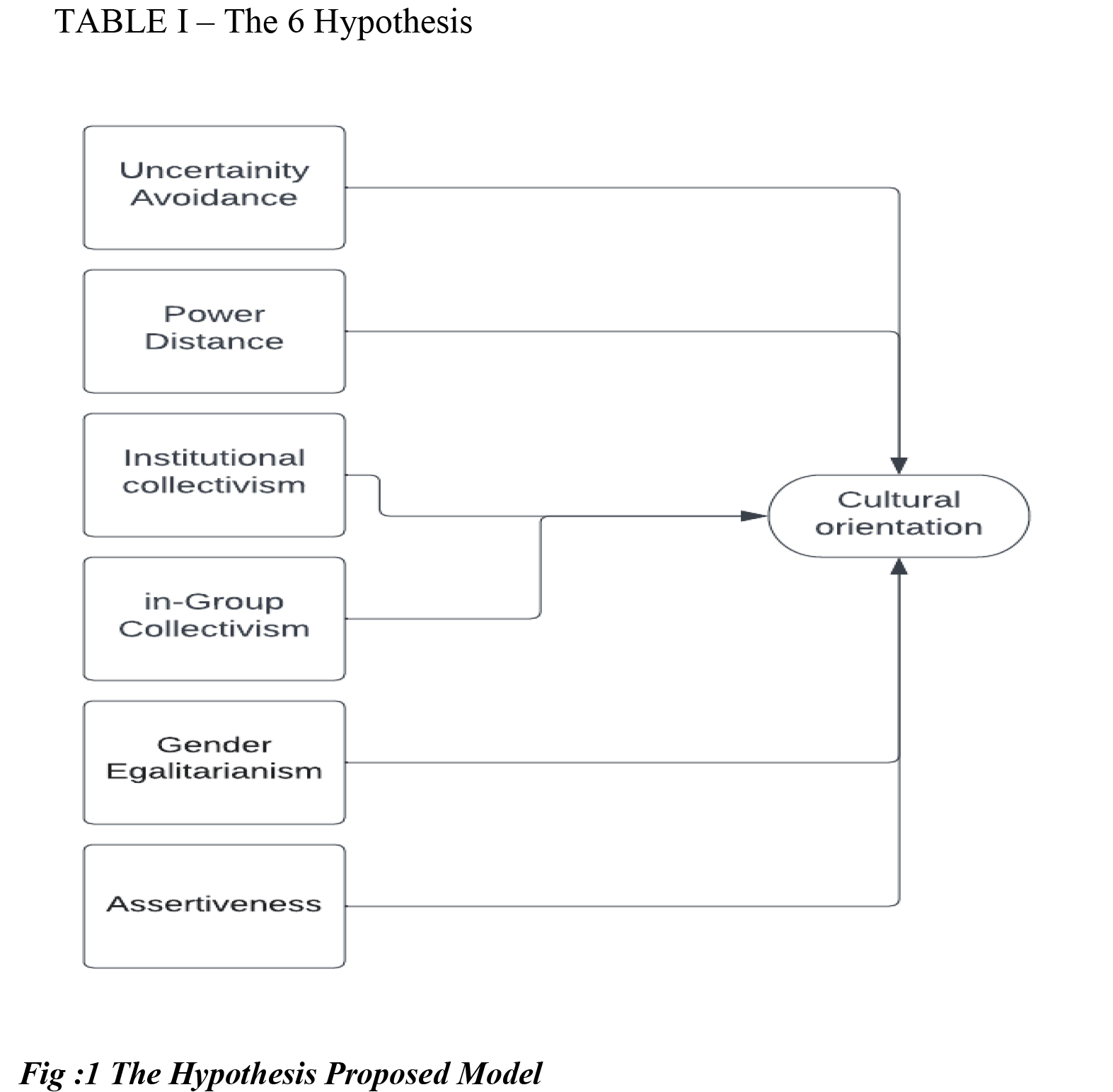
TABLE I – The 6 Hypothesis
Hypothesis
H1: Uncertainty Avoidance has positive impact on cultural orientation of IT managers.
H2: Power Distance has positive impact on cultural orientation of IT managers.
H3: Institutional Collectivism has positive impact on cultural orientation of IT managers.
H4: In-Group Collectivism has positive impact on cultural orientation of IT managers.
H5: Gender Egalitarianism has positive impact on cultural orientation of IT managers.
H6: Assertiveness has negative impact on cultural orientation of IT managers.
Data Analysis
Table II – Significant values
| Model | Unstandardized Coefficients | Standardized Coefficients | t | Sig. | ||
|---|---|---|---|---|---|---|
| B | Std. Error | Beta | ||||
| 1 | (Constant) | 1.880 | 2.280 | .825 | .418 | |
| UNCERTAINITYAVOIDANCE | -.418 | .332 | -.269 | -1.262 | .220 | |
| POWERDISTANCE | .135 | .172 | .143 | .786 | .440 | |
| INSTITUTIONALCOLLECTIVISM | .054 | .259 | .047 | .210 | .836 | |
| INGROUPCOLLECTIVISM | .024 | .409 | .011 | .059 | .953 | |
| GENDEREGALITARIANISM | -.016 | .188 | -.016 | -.085 | .933 | |
| ASSERTIVENESS | .819 | .261 | .565 | 3.140 | .005 | |
a. Dependent Variable: FUTUREORIENTATION
Interpretation of the Data
Since the Beta value calculated has shown an higher impact on Assertiveness as a key factor with 0.565 as its standardized coefficient, it impact positively towards the study. Assertiveness having the highest value of Beta, it is impacted the most on the Cultural orientation of IT managers. Similarly, Uncertainty Avoidance having the Beta value of -0.269, negatively impacts the Cultural Orientation of IT managers.
Measured Model
The table shows the coefficients of each of the six independent variables in predicting the dependent variable, Future Orientation. The Unstandardized Coefficients and the Standardized Coefficients represent the magnitude of the relationship between the independent variables (Uncertainty Avoidance, Power Distance, Institutional Collectivism, In-Group Collectivism, Gender Egalitarianism, and Assertiveness) and the dependent variable (Future Orientation). The t and Sig. values indicate the statistical significance of the relationships. For example, the Unstandardized Coefficient for Assertiveness is 0.819, indicating a strong positive relationship between Assertiveness and Future Orientation. The coefficients indicate that Assertiveness has the strongest influence on future orientation, with a standardized coefficient of .565, and a t-value of 3.140, which is significant at the .005 level. Uncertainty Avoidance also has a significant negative influence on future orientation, with a standardized coefficient of -.269 and a t-value of -1.262, significant at the .220 level. Power Distance, Institutional Collectivism, In-Group Collectivism, and Gender Egalitarianism are all found to be insignificant, with standardized coefficients of .143, .047, .011, and -.016, respectively.
The coefficients in this table represent the amount of change in the dependent variable for each unit of change in the independent variable. In other words, the coefficients are the amount that a one-unit change in an independent variable affects the dependent variable. The standardized coefficients (Beta) indicate the strength of the relationship between the independent and dependent variables. The constant in this table (.825) indicates the mean value of the dependent variable when all the independent variables are set to zero. The t-values and their corresponding sig. values indicate the statistical significance of each coefficient. Any value with a sig. value below .05 indicates that this coefficient is statistically significant and has an effect on the dependent variable. The coefficients in this table indicate that uncertainty avoidance has a negative effect on the dependent variable, power distance has a positive effect, institutional collectivism has a positive effect, in-group collectivism has a positive effect, gender egalitarianism has a negative effect, and assertiveness has a positive effect.
This table shows the standardized coefficients (Beta) for the six dimensions of cultural values based on a single model. This model suggests that uncertainty avoidance (-0.269) and assertiveness (0.565) have the strongest effects on the cultural values, while power distance (0.143), institutional collectivism (0.047), in-group collectivism (0.011), and gender egalitarianism (-0.016) have relatively minor or no effects.
The table is an analysis of various models and their significance in terms of their correlation to certain values. The model tested is an individualistic versus a collectivistic culture. The sig. column indicates the significance of the models in terms of their correlation to the values. The first model, the constant, has a sig. of 0.418 which indicates that the constant is not significant in terms of its correlation to the values. The second model, Uncertainty Avoidance, has a sig. of 0.22 which indicates that it is moderately significant in terms of its correlation to the values. The third model, Power Distance, has a sig. of 0.44 which indicates that it is moderately significant in terms of its correlation to the values. The fourth model, Institutional Collectivism, has a sig. of 0.836 which indicates that it is highly significant in terms of its correlation to the values. The fifth model, In-group Collectivism, has a sig. of 0.953 which indicates that it is very highly significant in terms of its correlation to the values. The sixth model, Gender Egalitarianism, has a sig. of 0.9.
The R^2 value of the model 0.51, thus the model is proved that the model is moderate.
Conclusion
The regression values in the table refer to the relationship between different cultural dimensions and the dependent variable. The coefficients of the model indicate how strongly each of the cultural dimensions are associated with the dependent variable. The standardized coefficients indicate how much the independent variable contributes to the overall variance of the dependent variable. The t-value indicates how significantly different the coefficients are from 0, and the Sig. value indicates the level of statistical significance.
Based on the coefficients in the table, the predictor variable assertiveness has the strongest effect on the dependent variable, with a standardized coefficient of 0.565 and a t-value of 3.14, which is significant at p < 0.005. The other predictor variables have much weaker effects, with standardized coefficients ranging from 0.011 (in-group collectivism) to 0.269 (uncertainty avoidance).
Managerial Implications
There are 3 main implications on how far it is useful to the society include;
- Society implications
- Academic implications
- Managerial implications.
Societal Implications
Through this research paper, the IT companies can understand the Cultural dimension of their employees, when they are sending the employees for any onboarding jobs.
Academic Implications
This paper will help the researchers to further explore about the other factors impacting the Cultural dimensions of IT industrial managers.
Managerial Implications
This research will enhance the skills of middle level and top-level managers to work in a team, by understanding the members of team members.
Discussions
This paper examines the cultural orientation of IT managers in India and the implications for their effectiveness in their roles. The methodology used is a combination of qualitative and quantitative research methods, including an examination of relevant literature, interviews with IT managers in India, and a survey of IT managers in India. The survey explores the cultural background of the IT managers, their attitudes towards the use of technology, their approaches to problem solving, and their overall job satisfaction. The qualitative interviews provide a more in-depth exploration of the cultural orientations of the IT managers, their understanding of the impact of culture on their work, and their strategies for dealing with cultural differences. The results of the research are discussed in terms of the implications for the effectiveness of IT managers in India, and suggestions are made for future research in this area.
The study helped us understand Developing a cultural orientation strategy: This involves creating a plan to help IT managers become more culturally aware of the Indian culture. This could Include attending cultural events, reading books about Indian culture, and engaging in discussions with Indian colleagues. Implementing the cultural orientation strategy: This involves putting the cultural orientation strategy into practice. This could include attending cultural events, participating in cultural workshops, or even taking language classes to help IT managers communicate more effectively with their Indian colleagues.
Overall, the goal of this methodology is to help IT managers become more familiar with the Indian culture, so that they can better understand their Indian colleagues and work more effectively with them. IT managers should be aware that India has a rich and diverse culture, and the business culture is no different. Additionally, the study found that Indian IT managers have a greater commitment to shared values and ethical decision-making, as well as increased motivation to become global and innovative leaders.
Limitations of the Study
The sample size of the study was limited to only IT Managers in India, which may not be representative of the wider population. The study was limited to a single cultural orientation, which may not be reflective of the diversity of cultures in India. The study did not consider factors such as economic, political, and social contexts that could influence the determinants of cultural orientation. The study was conducted in only one specific region, which may not be representative of India as a whole. The study did not consider the potential impact of generational differences on the determinants of cultural orientation. The scope of the study was limited to IT Managers in India, and may not be applicable to other countries or industries.
8.1 T1 city – IT managers were targeted. limited by the size of the sample population, as it may not be representative of all IT managers in India.
8.2 Time constraints: Conducting research to determine the cultural orientation of IT managers in India requires a significant amount of time to gather and analyze data. Therefore, time constraints may limit the amount of data that can be collected and analyzed.
8.3 Access to participants: Access to IT managers in India may be difficult, as some may not be willing to participate in a study. Additionally, some IT managers may not be accessible due to their geographic location or other factors.
8.4 Budget constraints: Conducting research of this type requires funding, which may be limited. This could limit the scope of the research and the number of participants that can be included.
8.5 Ethical considerations: Conducting research of this type requires ethical consideration, and the researcher may face challenges in obtaining informed consent from participants or in protecting the confidentiality of their responses.
Future Study
Apply measurement model to measure cultural orientations of managers in other sectors. Future research should focus on a more comprehensive analysis of the cultural orientation of IT managers in India, considering other factors such as organizational culture, team dynamics, and leadership styles. It would be interesting to explore the impact of the cultural orientation of IT managers on their job performance, job satisfaction, and team effectiveness. Moreover, cross-cultural research could be conducted to compare the cultural orientation of IT managers in different countries. Additionally, further research could be done to investigate the influence of family background and personal values on the cultural orientation of IT managers in India. Finally, it would be beneficial to explore how cultural orientation of IT managers may interact with other organizational dimensions, such as communication, decision-making, and motivation.
Factors influencing the cultural orientation of IT managers in India: The study can explore the various demographic, social, economic, and cultural factors that influence the cultural orientation of IT managers in India. Role of training and education in developing cultural orientation: The study can investigate how structured training and education programs influence the development of cultural orientation of IT managers in India. Impact of organizational culture on cultural orientation: The study can explore the influence of organizational culture on the cultural orientation of IT managers in India. Effects of globalization on cultural orientation: The study can analyze the impact of globalization on the cultural orientation of IT managers in India. Cross-cultural comparison of IT managers in India: The study can compare the cultural orientation of IT managers in India with those in other countries. Analysis of the relationship between cultural orientation and job performance: The study can analyze the relationship between cultural orientation and job performance of IT managers in India.
References
Abdel Rahim. Y., (2021). The Influence of Indulgence and Long-Term Orientation on A Country’s Risk Aversion. The Journal of Organizational Management Studies, doi: 10.5171/2021.909336
Adamczyk, M., (2017). The importance of cultural differences in international business. The Central European Review of Economics and Management, Vol. 1, Issue 2, (pp. 151-170), URL: Http://dx.doi.org/10.29015/cerem.335
Adler, N., & Graham, J., (2017). Cross-cultural Interaction: The International Comparison Fallacy? Journal of International Business Studies, Vol. 20, Issue 3 (515-537), doi: 10.1007/978-3-319-42745-4_3
Ángeles López-Cabarcos, M., Piñeiro-Chousa, J., Quiñoá-Piñeiro, L., & Santos-Rodrigues, H., (2021). How Can Cultural Values and Entrepreneurship Lead to the Consideration of Innovation-Oriented or Non-Innovation-Oriented Countries? Sustainability, 13, 4257, URL: https://doi.org/10.3390/su13084257
Anlaş, S., (2019). The Impact of Culture on Word-of-Mouth Behavior of Consumers: Indulgence vs. Restraint Cultures. 17th PARIS Int’l Conference on Marketing, Humanities, Education & Social Sciences. URL: https://doi.org/10.17758/EARES5.ED0319115
Belk Hamza, Z., Wafa, S., (2014). The Role of Uncertainty Avoidance on E-Commerce Acceptance across Cultures. International Business Research, Vol. 7, No. 5, doi: 10.5539/ibr. v7n5p166
Bosire, J., & Eyang, M., (2003). The effect of education on business skills cognition: the case of indigenous microscale enterprise owners in Kenya, Journal of Vocational Education and Training, 55:1, (5-20), doi: 10.1080/13636820300200215
Boumans, N., De Jong, A.D., & Janssen, S., (2011). Age-Differences in Work Motivation and Job Satisfaction. The influence of age on the Relationships between Work Characteristics and Workers’ Outcomes. The International Journal of Aging and Human Development, Vol. 73(4) (331-350), doi: 10.2190/AG.73.4. d
Brannen, M., Piekkari, R., & Tietze, S., (2014). The multifaceted role of language in International business: Unpacking the forms, functions and features of a critical challenge to MNC theory and performance. Journal of International Business Studies, 45, (495–507), doi: 10.1057/jibs.2014.24
Castillo, J., (2018). A study of cross cultural and communication barriers that exist when trying to conduct business between U.S. based companies and South America. Theses and Dissertations, 1016, URL: https://digitalcommons.pepperdine.edu/etd/1016
Celikkol, M., Kitapci, H., & Doven, G., (2019). Culture’s Impact on Entrepreneurship & Interaction Effect of Economic Development Level: An 81 Country Study. Journal of Business Economics and Management, Vol. 20, Issue 4, (777-797), URL: https://doi.org/10.3846/jbem.2019.10180
Cox, P., Friedman, B., & Tribunella, T., (2011). Relationships among Cultural Dimensions, National Gross Domestic Product, and Environmental Sustainability. Journal of Applied Business and Economics, Vol. 12(6), (46-56)
Daniels, M., (2014). Exploring the Nature of Power Distance: Implications for Micro- and Macro-Level Theories, Processes, and Outcomes. Journal of Management Vol. 40 No. 5, (1202-1229), doi: 10.1177/0149206314527131
Deari, H., Kimmerl, V., & Lopez, P., (2008). Effects of cultural differences in international business and price negotiations – A Case Study of a Swedish Company with Operations in e.g., South America. International Marketing Strategy FE3014 VT-08.
Durán-Brizuela, R., Brenes-Leiva, G., Solís-Salazar, M., & Torres-Carballo, F., (2015). Effects of Power Distance Diversity within Workgroups on Work Role Performance and Organizational Citizenship Behavior. Tecnología en Marcha. Vol. 29(2), (63-76), doi:10.18845/tm. v29i2.2691
Enkh-Amgalan, R., (2016) The Indulgence and Restraint Cultural Dimension: A Cross-Cultural Study of Mongolia and the United States. Undergraduate Honors Theses. Paper 329, URL: https://dc.etsu.edu/honors/329
Espig, A., Mazzini, I., Zimmermann, C., & de Carvalho, L., (2021). National culture and innovation: a multidimensional analysis. Innovation & Management Review, doi: 10.1108/INMR-09-2020-0121
Fan, Z., Huang, S., & Alenxander, W., (2017). Do National Cultural Traits Affect Comparative Advantage in Cultural Goods? Sustainability 9(7):1153, doi:10.3390/su9071153
Ferro, M., & Ribeiro, S., (2016). The role of language in international trade: How does language affect the choice of foreign trading partners? Proceedings of the International Congress on Interdisciplinarity in Social and Human Sciences, (608-621), URL: http://cieo15.wixsite.com/interdiscip
Fidrmuc, J., & Fidrmuc, J. (2015). Foreign languages and trade: evidence from a natural experiment. Empir Econ, 50, (31-49), doi: 10.1007/s00181-015-0999-7
Fietz, B., Hillmann, J., & Guenther, E., (2021). Cultural Effects on Organizational Resilience: Evidence from the NAFTA Region. Schmalenbach Journal of Business Research, 73:5–46, URL: https://doi.org/10.1007/s41471-021-00106-8
Guo, Q., Liu, Z., & Qiao, X., (2018). Indulgence and Long-Term Orientation Influence Prosocial Behavior at National Level. Frontiers in Psychology, 9:1798, doi: 10.3389/fpsyg.2018.01798
Guo, R., (2004). How Culture Influences Foreign Trade: Evidence from the U.S. and Chinese Panel Data. Journal of Socio-Economics 33(6), (785-812), doi: 10.1016/j.socec.2004.09.045
Hancıoğlu, Y., Doğan, Ü., & Yıldırım, Ş., (2014). Relationship between Uncertainty Avoidance Culture, Entrepreneurial Activity and Economic Development. Procedia – Social and Behavioral Sciences, 150, (908-916), doi: 10.1016/j.sbspro.2014.09.100
Harms, P., & Shuvalova, D., (2016). Cultural Distance and International Trade in Services: A Disaggregate View. Economic Systems, Elsevier, Vol.44(2). doi:10.1016/j.ecosys.2020.100786
Hawamdeh, N., & Al Qatamin, A., (2021). The Effect of Cultural Dimensions on Knowledge-Sharing Intentions: Evidence from Higher Education Institutions in Jordan. Journal of Asian Finance, Economics and Business Vol 8 No 5, (1079-1089), doi: 10.13106/jafeb.2021.vol8.no5.1079
Hofstede, G., (2011). Dimensional zing Cultures: The Hofstede Model in Context. Online Readings in Psychology and Culture, 2(1), URL: https://doi.org/10.9707/2307-0919.1014
Hofstede, G., Hofstede, G. J., & Minkov, M. (2009). Culture and organizations: Software of the mind (3rd ed.). New York, NY: McGraw-Hill.
Holoien, D., (2013). Do differences make a difference: The Effects of Diversity on Learning, Intergroup Outcomes, and Civic Engagement. Psychological Enquiry, 21(2), doi:10.1080/10478401003676501
Hong, J., (2017). The Study of Indulgence and Restraint value in Big Data Analysis for Asian Banks. International Journal of Management and Applied Science, Vol. 3, Issue 12
Hooker, J., (2012). Cultural Differences in Business Communication. Intercultural Discourse and Communication. (pp. 389-407)
Jiménez, A. et al (2015). The impact of educational levels on formal and informal entrepreneurship. BRQ Business Research Quarterly, 18, (204-212), URL: https://dx.doi.org/10.1016/j.brq.2015.02.002
Joy, A., & Haynes, B., (2011). The impact of generational differences on the workplace. Journal of Corporate Real Estate, Vol. 13, (216-232), doi: 10.1108/14630011111214428
Kececi, M., (2017). The impact of collectivism on the relationship between leadership styles and organizational citizenship behavior. Research Journal of Business and Management (RJBM), Vol.4, Issue.4, (465-484), doi: 10.17261/Pressacademia.2017.755
Kazmi, S., & Mustaghis, Dr., (2019). The Impact of Indulgence and Restrain cultural dimension on Brand equity. GMJACS, Vol. 9, No. 2
Kittova, Z., & Steinhauser, D., (2018). Influence of Culture on Corruption Within the OECD Countries. Journal of Interdisciplinary Research, Vol. 8, Issue 1, (121-126)
Koc, E., Ar, A., & Aydin, G., (2017). The potential implications of indulgence and restraint on service encounters in Tourism and Hospitality. Ecoforum, Vol. 6, Issue 3(13)
Kochan, T et al (2003). The effects of diversity on business performance: Report of the diversity research network. Human Resource Management, Vol. 42, No. 1, (3-21), doi: 10.1002/hrm.10061
Köles, B., & Vörös, T., (2011). Changes and Trends in Cross-Cultural Management Education: An Integrative Approach. Building Learning Experiences in a Changing World, doi: 10.1007/978-94-007-0802-0_7
Kumar, A., Channa, K., & Maharvi, M., (2018). Individualism versus Collectivism Orientation as Moderator between Co-Workers’ Social Support and Work to Family Enrichment. Journal of Accounting – Business & Management vol. 25 no. 2, (1-9), doi: https://doi.org/10.31966/jabminternational.v25i2.352
Kumar, A. (2015). Gender egalitarianism in the IT sector in India. International Labour Office. Retrieved from http://www.ilo.org/global/publications/ilo-bookstore/order-online/books/WCMS_377964/lang–en/index
Kumar, S., Baishya, K., Sreen, N., Sadarangani, P., & Samalia, H., (2021). Impact of National Culture on E-Government Development: A Longitudinal Study. Journal of Global Information Management, Vol. 29, Issue 2, doi: 10.4018/JGIM.2021030101
Messarra, L., (2014). Religious Diversity at Work: The Perceptual Effects of Religious Discrimination on Employee Engagement and Commitment. Contemporary Management Research, Vol. 10, No. 1 (59-80), doi: 10.7903/cmr.12018
Monica-Violeta, A., Sorin, B., & Vaidean, V., (2019). Culture, Entrepreneurship and Economic Development. An Empirical Approach. Entrepreneurship Research Journal, 2021, Vol. 11, Issue 1, 28, doi: 10.1515/erj-2018-0091
Ng, T., & Feldman, D., (2009). How Broadly does Education Contribute to Job Performance? Personnel Psychology, 62(1), (89-134), doi: 10.1111/j.1744-6570.2008. 01130.x Novotny, A., Szeberin, I., Kovács, S., & Máté, D., (2022). National Culture and the Market Development of Battery Electric Vehicles in 21 Countries. Energies, 15, 1539, URL: https://doi.org/10.3390/en15041539
Peterson, R., Dibrell, C., & Pett, T., (2002). Long- vs. Short-term performance perspectives of Western European, Japanese and U.S countries: where do they lie? Journal of World Business, 37(4), (245-255), doi:10.1016/S1090-9516(02)00091-3
Podhovnik, E., (2013). Language in International Business. Diminishing the Cross-cultural Divide with Cultural Scripts. Conference: EBES, doi:10.13140/2.1.3048.4486
Richard, O., (2000). Racial Diversity, Business Strategy, and Firm Performance: A Resource Based View. Academy of Management Journal, Vol. 43, No. 2, (164-177), URL: https://doi.org/10.2307/1556374
Rouméas, É., (2020). Religious Diversity in the Workplace: The Case for Alternative Dispute Resolution. Political Studies, Vol. 68(1) (207-223), doi: 10.1177/0032321719839316j
Samaha, S., Beck, J., & Palmatier, R., (2014). The Role of Culture in International Relationship Marketing. Journal of Marketing Vol. 78, (78–98), URL: http://dx.doi.org/10.1509/jm.13.0185
Singh, J., (2019). How Do Cultural Differences Affect Trade Reciprocity between Developed and Developing Countries? World Bank Research and Policy Briefs, No. 142846, URL: https://ssrn.com/abstract=3586633
Singh, R., (2020). Understanding religious diversity and its implications at the workplace. NMIMS Journal of Economics and Public Policy, Vol. 5, Issue 4
Sobrino-De Toro, I., Labrador-Fernández, J., & De Nicolás, V., (2019). Generational Diversity in the Workplace: Psychological Empowerment and Flexibility in Spanish Companies. Frontiers in Psychology, Vol. 10, Article 1953, doi: 10.3389/fpsyg.2019.01953
Tedla, T., (2016). The Impact of Organizational Culture on Corporate Performance. Walden Dissertations and Doctoral Studies. 2509, URL: https://scholarworks.waldenu.edu/dissertations/2509
Tutar, H., Altinoz, M., & Cakiroglu, D., (2014). A Study on Cultural Difference Management Strategies at Multinational Organizations. Procedia – Social and Behavioral Sciences (345 – 353), doi: 10.1016/j.sbspro.2014.09.023
Uzun, T., (2020). Relationships between Power Distance, Organizational Commitment, and Trust in Schools. Educational Policy Analysis and Strategic Research, Vol. 15, No. 3, doi: 10.29329/epasr.2020.270.17 Van Buren III, H., Syed, J., & Mir, R., (2020). Religion as a Macro Social Force Affecting Business: Concepts, Questions, and Future Research. Business and Society, Vol. 59 (5) (799-822), doi: 10.1177/0007650319845097
Venaik, S., (2011). Individualism–Collectivism in Hofstede and GLOBE. Journal of International Business Studies, 42, (436-445), doi: 10.1057/jibs.2010.62
Wang, Y., (2019). A Literature Review of Empirical Research on Trade of Cultural Goods. Applied Finance and Accounting Vol. 6, No. 1, doi: 10.11114/afa. v6i1.4609
Weber, E., & Hsee, C., (1998). Cross-cultural Differences in Risk Perception, but Cross-cultural Similarities in Attitudes Towards Perceived Risk. Management Science, Vol. 44, Issue 9, (1205-1217)
Wennekers, S., Thurik, A., van Stel, A., & Noorderhaven, Niels., (2007). Uncertainty Avoidance and the Rate of Business Ownership Across 21 OECD Countries, 1976-2004. Journal of Evolutionary Economics, Vol. 17, (133-160), doi: 10.1007/s00191-006-0045-1
Xu, J., & Cheng, C., (2020). Uncertainty Avoidance, Individualism and the Readiness of Business-to-Consumer E-commerce. Journal of Asian Finance, Economics and Business, Vol. 8 No. 1, (791–801), doi: 10.13106/jafeb.2021.vol8.no1.791
Yeung et al, (2021). Machine Learning–Based Prediction of Growth in Confirmed COVID-19 Infection Cases in 114 Countries Using Metrics of No Pharmaceutical Interventions and Cultural Dimensions: Model Development and Validation. Journal of Medical Internet Research, 23(4), doi: 10.2196/26628
Zhang, X., Tian, X., & Yang, H., (2020). The effect of uncertainty avoidance on behavioral information security. Academia Journal of Educational Research 3(3), doi: 10.15413/ajer.2020.0113