







In a conservative country like India where cultural norms restrict open conservations about intimate wear or innerwear, Jockey has emerged as one of the most aspirational innerwear brands. It’s difficult to be differentiated in very commoditized categories. Innerwear is a low involvement category and seldom commands strong brand loyalty or premium pricing. Jockey, however, has repeatedly contested this assumption. The story of Jockey is a treasure trove of learning about brand building, consumer behavior and strategic pivots, from pioneering product innovations to reinventing retail visibility and digital transformation. Jockey is not just an inspirational brand but one of those few brands that brought in sea change through its advertising campaigns.
Historical Foundations and Early Innovation (1876–1934)
Jockey was founded in 1876 by Samuel Thrall Cooper in a town called St. Josephs, in Michigan. The company initially was called as “Black Cat,” and it focused on manufacturing durable socks for loggers/lumberjacks. The early success of the company stemmed from its ability to identify unmet consumer needs—primarily durability and comfort.
The first major breakthrough for Jockey came with the introduction of the “Singleton,” a departure from the traditional union suit. By redesigning a cumbersome one-piece garment into a more comfortable two-piece format, Jockey demonstrated an early commitment to user-centric innovation.
In the history of Jockey, the year 1934 can bookmarked as the most significant year, with the invention of the men’s brief. Inspired by a postcard, Arthur Kniebler created an outfit that provided security without using any extra fabric material. The arrival of the Y-Front Brief marked the beginning of the whole range of products and raised expectations for the brand, positioning it as the market leader in its industry. In the 1930s when it was not considered appropriate to use advertisements for undergarments, jockey came up with an outrageous way of promoting its products by organizing a themed show named the ‘cellophane wedding’, which was the first-ever underwear fashion show with models wearing cellophane wedding outfits.
Normalizing Innerwear and Building Brand Identity (1940s–1980s)
Jockey was successful in creating functional differentiation; however, the next challenge was cultural acceptance. In the 1940s, innerwear hadn’t been talked about or displayed openly. Jockey violated this rule by developing cellophane packaging that made retail display of products easier.
The brand reinforced its identity by stitching its name on waistbands, turning innerwear into a visible brand statement. This act turned a private product into a symbol of identity and status. Jockey also leveraged institutional associations to enhance credibility. It supplied garments for the British Olympic team and contributed to specialized innerwear for NASA missions. It created the first one of its kind underwear for the NASA’s space mission in 1962. These associations positioned the brand as performance-oriented and technologically advanced. NASA used the technology of PCM (Phase Change Materials), at very high temperatures PCMs absorb and hold heat to generate a cooling effect, at low temperatures PCMs released the stored heat to produce a cooling effect. PCMs also addressed as thermocules were used by Jockey to release a full line of staycool undergarments. In 1982, Jockey expanded into women’s innerwear with “Jockey for Her,” recognizing the growing importance of female consumers and diversifying its portfolio.
Expansion into India and Market Leadership (1995–2015)
Jockey entered the Indian market in 1995 through a licensing agreement with Page Industries the exclusive licensee of Jockey International Inc in India, Sri Lanka, Bangladesh, Nepal, the U.A.E., Oman and Qatar. The company is also a licensee for the U.K. swimwear brand Speedo International in India and Sri Lanka. The market at that time was fragmented & dominated by unorganized players. Jockey identified an opening for a branded, premium innerwear experience. Jockey’s sales trajectory speaks volumes about its disciplined market building.
1995: Entry into India with limited distribution
2000: ₹21 crore in revenue
2022: Over ₹3,725 crore in revenue—double the size of Rupa and Lux combined
2024: Over 50% share in India’s premium innerwear market
This exponential growth was achieved without diversifying into unrelated categories—a rarity in India’s consumer goods sector. Jockey, under Page Industries, focused solely on two global brands: Jockey and Speedo (swimwear). Nearly 98% of Page’s revenue still comes from Jockey
Jockey entered India by positioning itself as an category upgrader.
The brand’s strategy focused on:
– Consistent product quality
– Strong distribution networks
– Aspirational advertising emphasizing comfort and lifestyle
Over time, Jockey became synonymous with premium innerwear in India. Its ability to balance affordability with perceived luxury allowed it to capture a wide consumer base.
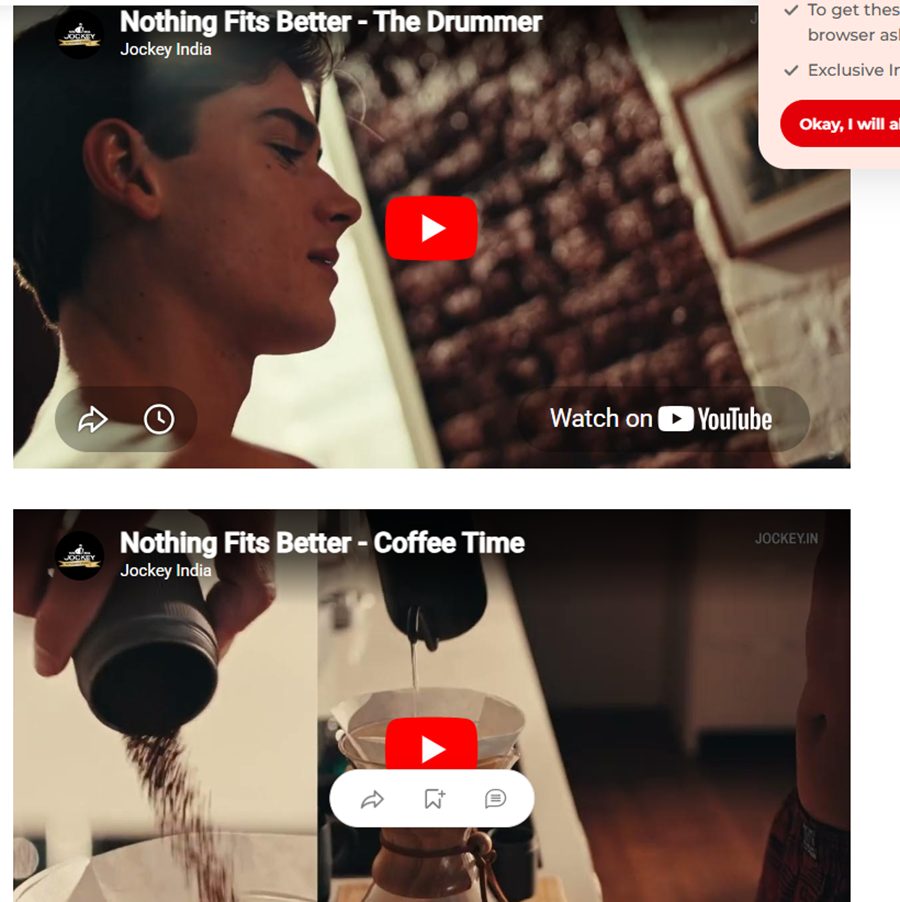
Jockey consistently created category salience and positioned itself very strongly by focusing on comfort, confidence, premium quality. Its campaign “Jockey or Nothing” was one of its strongest campaigns, the slogan implied multiple things, like comfort, superior quality and nothing fits better.
Jockey consistently created category salience and positioned itself very strongly by focusing on comfort, confidence, premium quality. Its campaign “Jockey or Nothing” was one of its strongest campaigns, the slogan implied multiple things, like comfort, superior quality and nothing fits better.
Digital Transformation and Consumer Experience (2022–Present)
Despite its strong offline presence, Jockey faced challenges in the digital space. Its legacy website suffered from high bounce rates and low engagement.
Recognizing the importance of digital touchpoints, Jockey India undertook a comprehensive transformation:
1. UI/UX Redesign: Simplified navigation and mobile-first design improved usability.
2. Localization: Inclusion of Indian models and culturally relevant imagery enhanced relatability.
3. Dynamic Content: Frequent updates aligned with trends kept the platform engaging.
Results of Transformation:
– 78% increase in views per session
– 21% increase in session duration
– 22% reduction in bounce rate
– 5% increase in conversions
These results demonstrate the direct relationship between user experience design and business performance.
Jockey’s journey can be analyzed through the perspective of :
Jockey’s success story can be interpreted using the lens of:
1. Continuous Innovation: Innovation has always been an ongoing process, from product development to digital experience.
2. Category Reconfiguration: Jockey redefined the category of innerwear from being a necessity to a lifestyle accessory.
3. Market Adaptability: Jockey managed to implement its international marketing strategy in the Indian market context.
Jockey International didn’t try to win the market by talking only about fabric, durability, or price—the usual functional cues in innerwear. Instead, it did something more subtle but powerful: it connected what people wear inside with how they feel outside.
At the most basic level, Jockey established trust by nailing the product – comfortable fits, consistent quality and innovations like the Y-Front brief. That gave consumers a compelling functional reason to pick the brand. Yet Jockey didn’t stop there.
Over time, it shifted the conversation from just “comfort” to “comfort that makes you feel confident.” The idea is simple but effective—when you’re comfortable underneath, you carry yourself better. This emotional layer helped Jockey stand out in a category where most brands still speak only about utility.
It also made innerwear a little less “invisible.” By putting its logo on waistbands and normalizing innerwear as something you can talk about (and even show, subtly), Jockey turned a private product into a small expression of personal style and identity.
In markets like India, this became even more important. Jockey positioned itself as a modern, premium, and aspirational brand, not just a necessity. Buying Jockey wasn’t just about innerwear—it was about upgrading your lifestyle in a small but meaningful way.
More recently, even its digital experience reflects this thinking. A smoother, more intuitive website isn’t just about convenience—it reinforces the brand’s image as contemporary and consumer-focused.
In short, Jockey shifted its focus from selling what the product does to how the product makes you feel. That transition — from function to emotion, from function to identity — is what made it special in an otherwise pedestrian category.
The development of Jockey demonstrates how, even in highly commoditized industries, success can be realized by innovation, brand positioning, and adaptation. The ability to adapt during different eras, whether product innovation or digital innovation, makes the brand an ideal subject of analysis..
Course Relevance
The case is relevant to the courses of Marketing and Selling, Marketing Communication and Brand Management
Teaching Notes
Learning Objectives:
– Understand innovation in low-involvement product categories
– Analyze brand positioning and category creation
– Evaluate digital transformation strategies
Teaching Plan:
– Introduction (10 min): Discuss commoditized markets
– Case Analysis (30 min): Break into groups for phase-wise analysis
– Discussion (20 min): Evaluate strategies
– Conclusion (10 min): Link to modern branding challenges
Questions:
1. How has Jockey International positioned itself in a category traditionally driven by functionality rather than emotion?
2. In a commoditized category, what specific levers has Jockey used to create differentiation? Are these sustainable?
3. What role did digital transformation play in recent growth?
4. With the rise of D2C brands and influencer-led innerwear labels, how should Jockey defend its brand leadership?
5. If you were the brand manager of Jockey India, what would be your next branding strategy to engage Gen Z consumers?
References
https://www.fortuneindia.com/enterprise/jockey-what-lies-beneath/104994
https://spinoff.nasa.gov/Spinoff2012/cg_3.html
https://www.afaqs.com/company-briefs/colors-tamil-celebrates-yoga-from-home